India New Zealand Defense Dialogue and Indo Pacific Security
Source:PIB ↗
Why It Matters
Understanding India's defence dialogues with nations like New Zealand is essential for GS Paper 2 (International Relations). It illustrates India's strategy of building multi-aligned partnerships to ensure a rules-based order in the Indo-Pacific and enhances answers regarding India's evolving maritime security frameworks and regional diplomacy.
Summary
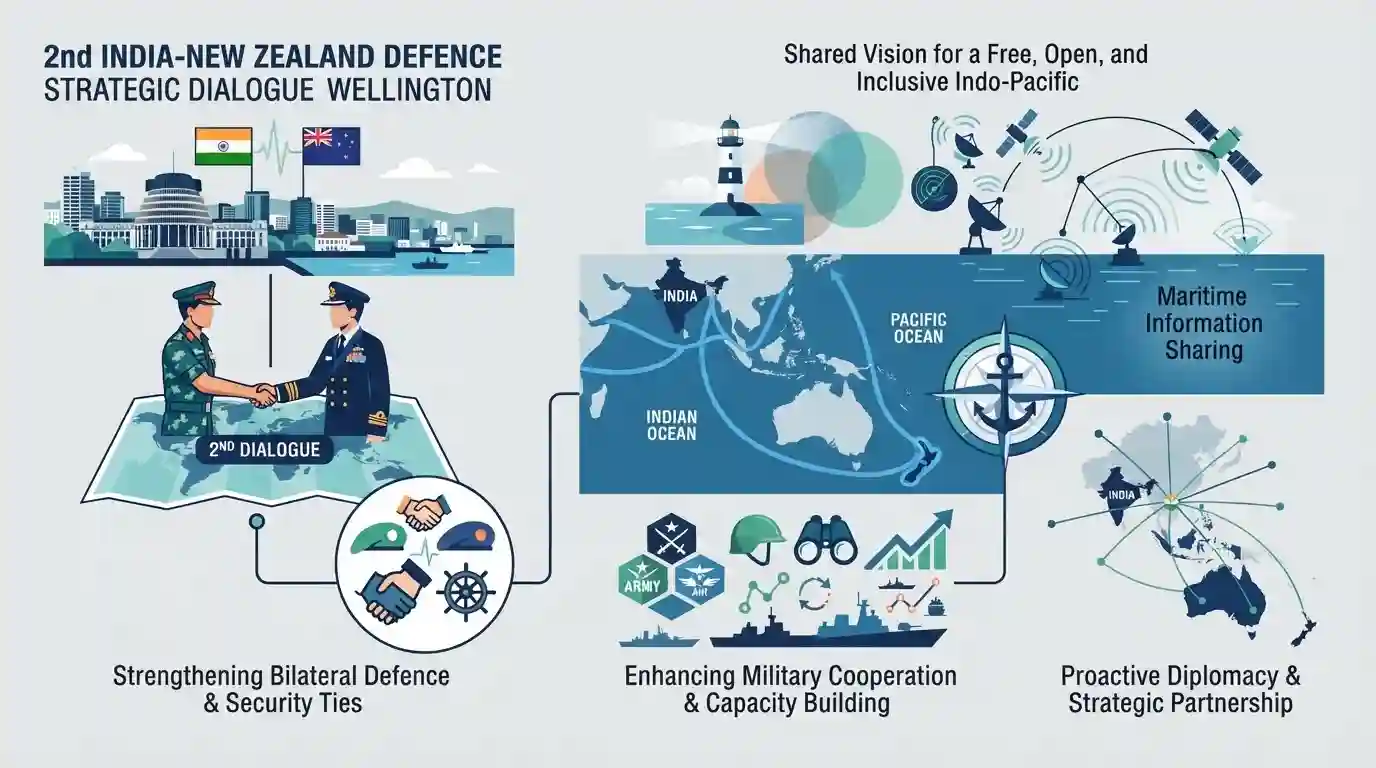
The 2nd India-New Zealand Defence Strategic Dialogue took place in Wellington, aimed at strengthening bilateral defence and security ties. The discussions centered on enhancing military-to-military cooperation, capacity building, and maritime information sharing. A key focus of the dialogue was the shared vision of both countries for a free, open, and inclusive Indo-Pacific region, underscoring their mutual interest in regional stability and maritime security. This engagement reflects India's proactive diplomacy to forge stronger strategic partnerships with key Indo-Pacific nations, thereby expanding its strategic and maritime footprint.
Key Points
- The 2nd India-New Zealand Defence Strategic Dialogue was held in Wellington to review and enhance bilateral defence cooperation.
- Discussions focused on expanding military-to-military engagements, joint training, capacity building, and information sharing between the two nations.
- Both sides reaffirmed their commitment to maintaining a free, open, and inclusive Indo-Pacific, emphasizing shared interests in regional maritime security.
- The dialogue marks a progressive step in the India-New Zealand strategic partnership, aligning with India's broader diplomatic and security outreach in the Indo-Pacific region.
Important Terms
India-New Zealand Defence Strategic Dialogue

A bilateral institutional mechanism established to enhance military-to-military cooperation, maritime security, joint training, and strategic coordination in the Indo-Pacific region between India and New Zealand.
UPSC context
GS Paper II (International Relations); tests understanding of bilateral security frameworks and Indo-Pacific geopolitics.
Ministry of Defence, India
The cabinet department of the Government of India charged with coordinating and supervising all agencies and functions of the government relating directly to national security and the Indian Armed Forces.
UPSC context
GS Paper III (Security); tests knowledge of national defence administration, policies, and state security architecture.
New Zealand Ministry of Defence
The public service department of New Zealand responsible for providing advice on defence policy to the government, coordinating security initiatives, and procuring major military equipment.
UPSC context
GS Paper II (International Relations); tests understanding of key partner institutions involved in India's bilateral defence diplomacy.
Indian Armed Forces
The military forces of the Republic of India, comprising the Indian Army, Indian Navy, and Indian Air Force, tasked with safeguarding national sovereignty and integrity.
UPSC context
GS Paper III (Security); tests knowledge of India's defense forces, external security threats, and strategic capabilities.
New Zealand Defence Force
The joint military forces of New Zealand, comprising the Royal New Zealand Navy, New Zealand Army, and Royal New Zealand Air Force, engaged in national and regional security.
UPSC context
GS Paper II (International Relations); tests familiarity with international security partners and interoperability in the Indo-Pacific.
Prelims Trap
The White Shipping Information Exchange agreement involves the sharing of classified tactical intelligence on naval warships and military vessels.
White shipping agreements strictly govern commercial, non-military merchant vessels. Sharing military ship movements falls under separate naval protocols, not white shipping.
Static Concepts Connected
What are the core pillars of India's Indo-Pacific Oceans Initiative (IPOI)?
- Origin: Launched by the Indian Prime Minister at the 14th East Asia Summit in November 2019.
- Structure: Focuses on seven pillars including Maritime Security, Maritime Ecology, Maritime Resources, and Disaster Risk Reduction.
- Mechanism: Collaborative, non-treaty-based platform allowing nations to lead or support specific pillars based on mutual interest.
What is the function of the Information Fusion Centre-Indian Ocean Region (IFC-IOR)?
- Location: Established in Gurugram, India, in 2018 to coordinate regional maritime domain awareness.
- Function: Collation and dissemination of real-time commercial shipping data with partner nations to secure critical sea lanes.
- Liaison: Hosts International Liaison Officers from partner nations to track non-traditional maritime threats and piracy.
Cross-Topic Patterns
Five Eyes bloc + strategic partnerships
India's security tie-ups with Five Eyes members like New Zealand require delicate navigation of intelligence-sharing protocols and differing stances on third-party geopolitical players.
Blue economy + maritime domain awareness
Coordinating under India's IPOI to combat IUU fishing connects strategic maritime security with sustainable ocean resource governance under SDG 14.

IPOI pillars and White Shipping technicalities are highly likely to be tested in multi-statement questions on Indo-Pacific diplomacy.
Linked PYQs · 3
Linked PYQs · 3
- 2020MainsGS2
What is the significance of Indo-US defence deals over Indo-Russian defence deals? Discuss with reference to stability in the Indo-Pacific region.
- 2019MainsGS2
‘The time has come for India and Japan to build a strong contemporary relationship, one involving global and strategic partnership that will have a great significance for Asia and the world as a whole.’ Comment.
- 2022MainsGS3
What are the maritime security challenges in India ? Discuss the organisational, technical and procedural initiatives taken to improve the maritime security.
