MoSPI Infrastructure Flash Report and Central Project Monitoring
Source:PIB ↗
ఇది ఎందుకు ముఖ్యం
Infrastructure development is a core component of GS-3. Understanding the administrative, regulatory, and financial bottlenecks that cause cost and time overruns in central projects is crucial for evaluating India's capital expenditure efficiency and economic growth strategies.
సారాంశం
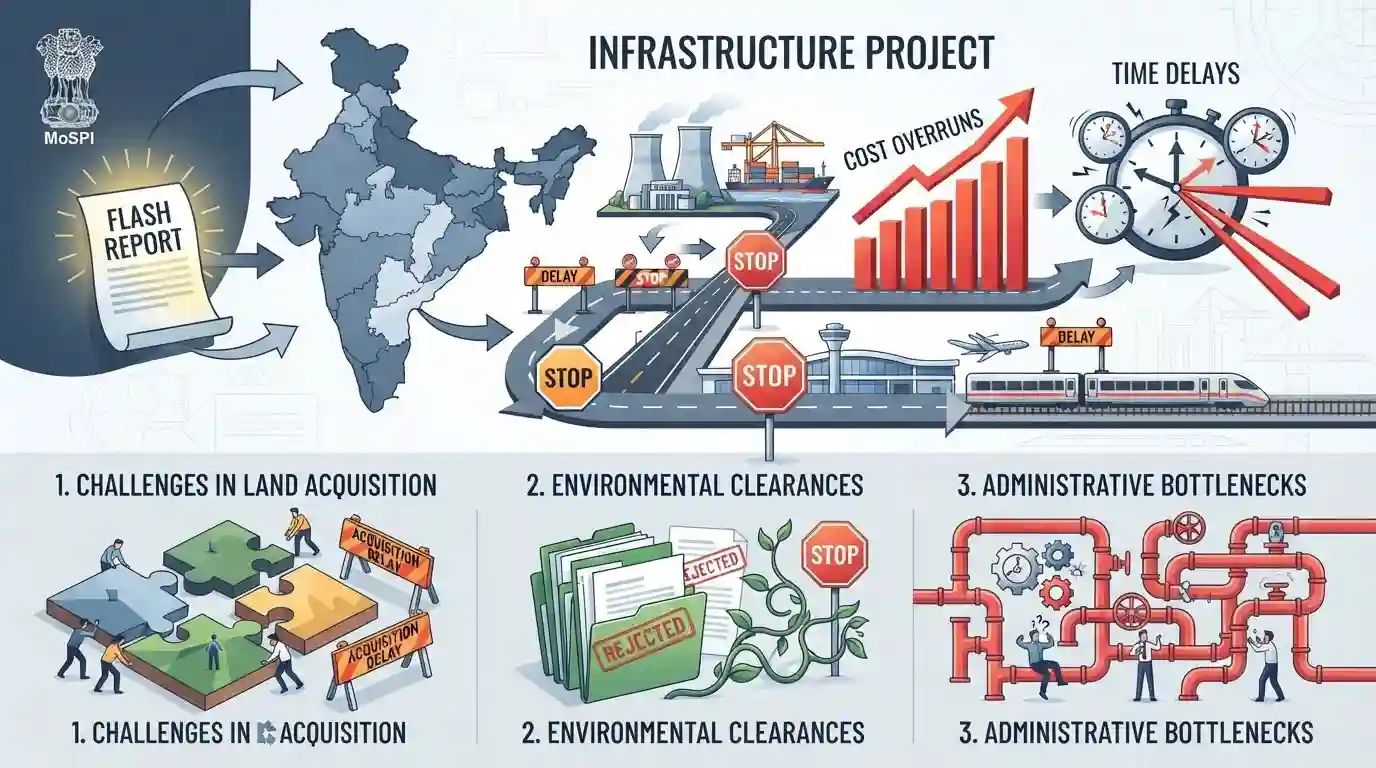
The Ministry of Statistics & Programme Implementation (MoSPI) releases a Flash Report on Central Sector Infrastructure Projects costing ₹150 crore and above. The report highlights chronic issues of time and cost overruns in a large percentage of India's major infrastructure projects, driven by challenges in land acquisition, environmental clearances, and administrative bottlenecks.
ముఖ్య అంశాలు
- The Ministry of Statistics and Programme Implementation (MoSPI), through its Infrastructure and Project Monitoring Division (IPMD), releases a monthly Flash Report monitoring Central Sector Infrastructure Projects costing ₹150 crore and above.
- The report typically reveals that a significant proportion of these large-scale infrastructure projects suffer from massive cost overruns and time delays.
- Common reasons for these delays include bottlenecks in land acquisition, pending environmental and forest clearances, lack of supporting infrastructure/linkages, and delays in finalizing project financing or design.
- These inefficiencies inflate the government's fiscal burden (capital expenditure) and delay the economic dividends of the infrastructure, posing challenges to rapid economic growth.
ముఖ్యమైన పదాలు
Ministry of Statistics & Programme Implementation (MoSPI)

The nodal central ministry responsible for compiling official macroeconomic data (like GDP, CPI) and monitoring major Central Sector infrastructure projects and government programmes.
UPSC context
GS Paper 2 & 3 (Governance & Economy). Crucial for national data frameworks, inflation metrics, and infrastructure governance.
Infrastructure and Project Monitoring Division (IPMD)
A division under MoSPI's Programme Implementation Wing mandated to monitor the physical and financial progress of Central Sector Infrastructure Projects costing ₹150 crore and above.
UPSC context
GS Paper 3 (Infrastructure). Tests knowledge of bureaucratic mechanisms deployed to track asset creation and mitigate implementation bottlenecks.
Flash Report on Central Sector Projects
A monthly publication by MoSPI highlighting the status, financial expenditure, and chronic time or cost overruns of major Union Government infrastructure projects exceeding ₹150 crore.
UPSC context
GS Paper 3 (Infrastructure). Provides empirical data on execution challenges like land acquisition and clearance delays for UPSC mains answers.
PAIMANA Portal
An analytics-driven web platform (Project Assessment Infrastructure Monitoring and Analytics for Nation-building) launched by MoSPI for real-time tracking of central infrastructure projects, replacing OCMS.
UPSC context
GS Paper 2 & 3 (E-Governance). An excellent case study of using digital tools and data analytics to improve transparency and project governance.
Central Sector Infrastructure Projects
Large-scale developmental initiatives—such as national highways, ports, and power plants—that are entirely funded, planned, and executed directly by the Union Government.
UPSC context
GS Paper 3 (Economy). Important for analyzing Union capital expenditure and distinguishing these from state-shared Centrally Sponsored Schemes.
ప్రిలిమ్స్ ఉచ్చు
The Flash Report on project overruns is published by the Ministry of Finance and tracks all private and public infrastructure projects.
It is published monthly by MoSPI (specifically IPMD) and monitors only Central Sector Infrastructure Projects costing ₹150 crore and above.
అనుసంధానమైన స్థిర భావనలు
What is the Capital Expenditure Multiplier Effect?
- CapEx definition: Refers to government spending on creating physical assets like highways and power grids that yield long-term economic returns.
- Multiplier mechanism: CapEx carries a high multiplier (estimated at ~2.5 to 4.5), meaning every rupee spent yields multiple rupees in overall GDP growth.
- Overrun erosion: Delays and cost escalations directly erode this multiplier, reducing public spending efficiency and delaying structural economic dividends.
How does PM GatiShakti address infrastructure bottlenecks?
- Integrated planning: It is a GIS-based digital platform designed to break ministerial silos and coordinate planning across 16 infrastructure-related ministries.
- Clearance acceleration: By offering synchronized spatial visibility of forest land, existing utilities, and boundaries, it expedites statutory clearances and land acquisition.
అంతర-అంశ నమూనాలు
Infrastructure overruns + Fiscal deficit
Project delays inflate capital expenditure requirements, forcing supplementary budgetary allocations that strain the fiscal deficit target and crowd out private sector borrowing.
Project delays + Environmental clearances
Chronic clearance delays highlight the structural governance friction between accelerating capital-intensive growth and enforcing stringent environmental impact assessment (EIA) norms.

Mains questions will likely link MoSPI's overrun data to PM GatiShakti's role in resolving inter-ministerial coordination bottlenecks.
అనుసంధాన PYQలు · 3
అనుసంధాన PYQలు · 3
- 2021MainsGS3
“Investment in infrastructure is essential for more rapid and inclusive economic growth.” Discuss in the light of India's experience.
- 2014MainsGS3
Explain how Private Public Partnership arrangements, in long gestation infrastructure projects, can transfer unsustainable liabilities to the future. What arrangements need to be put in place to ensure that successive generations' capacities are not compromised?
- 2013MainsGS3
Adoption of PPP model for infrastructure development of the country has not been free of criticism. Critically discuss pros and cons of the model.
