DRDO Missile Systems Technology Transfer for Defense Indigenization
Source:PIB ↗
Why It Matters
Showcases a major policy mechanism (Technology Transfer) used by the government to foster a domestic military-industrial complex, vital for national security and economic growth.
Summary
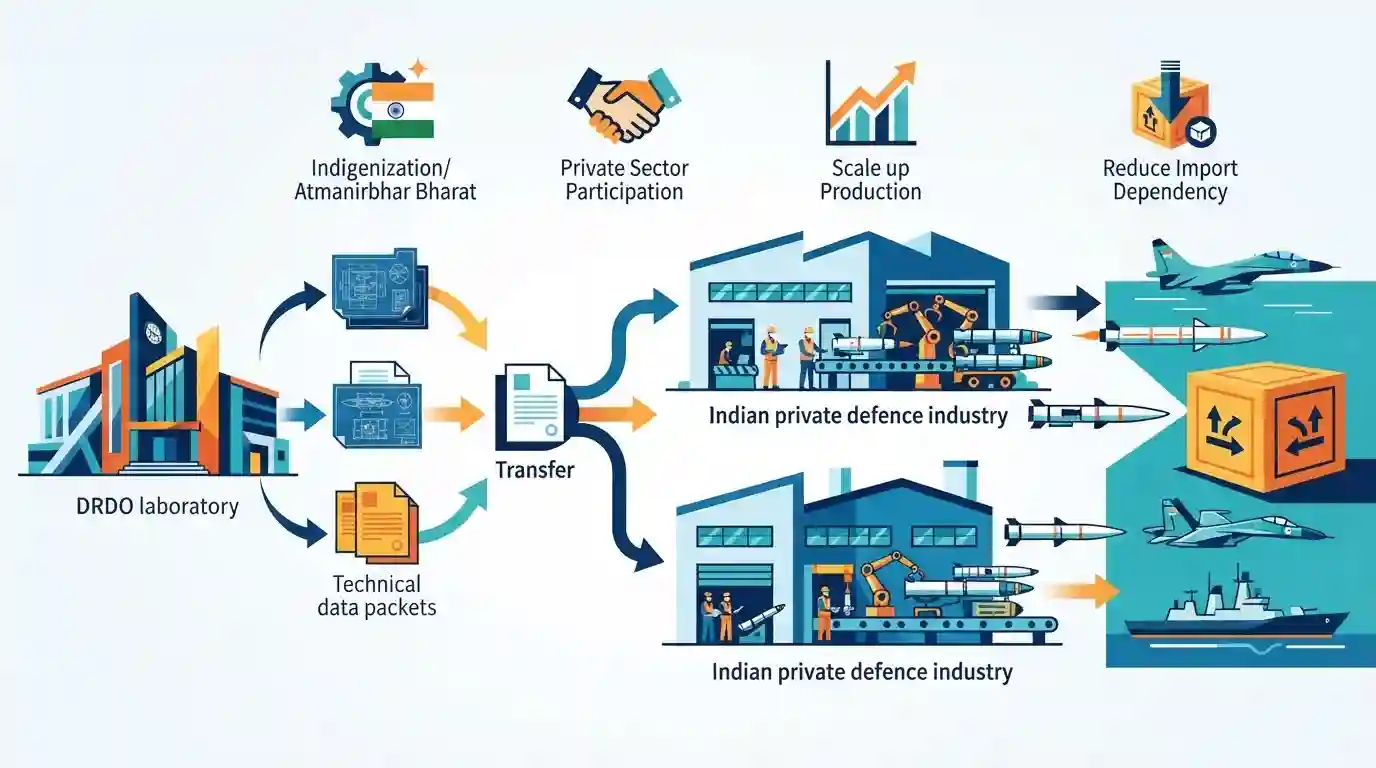
The Ministry of Defence has approved the Transfer of Technology (ToT) of DRDO-developed missile systems to the Indian defence industry. This strategic decision is designed to boost indigenous manufacturing, strengthen the 'Atmanirbhar Bharat' (Self-Reliant India) initiative, and increase private sector involvement in the production of complex military hardware. By sharing critical missile technology with domestic manufacturers, the government aims to scale up production, reduce import dependency, and potentially enhance defence exports in the long run.
Key Points
- The Raksha Mantri has approved the Transfer of Technology (ToT) for DRDO-developed missile systems to the domestic Indian defence industry.
- This initiative aims to bolster indigenous defence manufacturing and reduce dependence on imported military hardware.
- It facilitates greater private sector participation in developing advanced strategic assets, accelerating the Atmanirbhar Bharat vision in the defence sector.
- The ToT marks a shift in DRDO's role towards enabling the broader industrial ecosystem by sharing R&D for scaled production.
Important Terms
Atmanirbhar Bharat

A comprehensive national vision launched by the Government of India in 2020 to foster self-reliance across critical sectors like defence, technology, and manufacturing by boosting domestic production.
UPSC context
GS Paper III (Economy & Security); vital for questions on economic self-reliance, indigenization of technology, and reducing strategic import vulnerabilities.
Make in India
A major national initiative launched in 2014 to encourage domestic and foreign companies to manufacture their products in India, aiming to transform the country into a global manufacturing hub.
UPSC context
GS Paper III (Economy & Security); vital for understanding manufacturing growth, employment generation, and indigenization in defence procurement.
DRDO
The premier agency under India's Ministry of Defence responsible for the design, development, and research of advanced military technologies, armaments, and systems for the armed forces.
UPSC context
GS Paper III (Science & Technology & Security); highly relevant for topics on indigenization, military R&D, and technology transfers.
Transfer of Technology
The process of sharing skills, knowledge, manufacturing blueprints, and technical expertise between research organizations and industry partners to enable commercial production of advanced technologies.
UPSC context
GS Paper III (Science & Technology / Indigenization); vital for understanding how R&D is scaled to commercial manufacturing in defence.
Ministry of Defence
The Indian government department charged with coordinating and supervising all agencies and functions directly relating to national security and the Indian Armed Forces.
UPSC context
GS Paper III (Internal Security); fundamental for questions regarding defence policy, procurement procedures, and national security administration.
Prelims Trap
DRDO technology transfers are exclusively restricted to Defence Public Sector Undertakings (DPSUs) and require payment of heavy ToT fees.
False. DRDO actively involves private sector players, and under the Development-cum-Production Partner (DcPP) model, it charges zero ToT fees to encourage ease of doing business.
Static Concepts Connected
What is the Positive Indigenisation List (PIL) in defence?
- Import Embargo: A Ministry of Defence mechanism that prohibits the import of specified weapons, platforms, and systems after staggered deadlines.
- Domestic Sourcing: It mandates domestic sourcing from Indian industry to achieve self-reliance (Atmanirbhar Bharat) and reduce the defence import bill.
- Broad Coverage: Over 4,000 items (across various sub-systems and complex military hardware) have been listed across multiple PILs.
How does DRDO classify technologies for Transfer of Technology (ToT)?
- MILTECH (Category A): Category 'A' encompasses strictly military technologies restricted to government or military use; obtaining an End User Certificate is mandatory.
- Dual-use (Category B): Category 'B' includes technologies with both military and civilian applications, which can be licensed for commercial, non-military markets.
- Licensing Agreements: DRDO uses LAToT, which explicitly prohibits the recipient company from sublicensing the proprietary know-how to third parties.
Cross-Topic Patterns
Defence Indigenization & Forex Reserves
Shifting from being a top global arms importer to a net defence exporter directly impacts macroeconomics by reducing the Current Account Deficit and boosting foreign exchange reserves.
Space vs Defence Privatization Parallels
Similar to IN-SPACe enabling private space startups to use ISRO facilities, DRDO's DcPP model opens complex strategic assets like missile manufacturing to domestic private firms.

Expect a multi-statement question on DRDO's ToT policy, its zero-fee structure under the DcPP model, and the Positive Indigenisation List.
Linked PYQs · 2
Linked PYQs · 2
- 2026PrelimsGS1
Which of the following items of defence hardware is/are manufactured in India ? 1. Su-30 MKI Fighter Jets 2. T-90 MK-III Tanks 3. Akula Class Submarine Select the answer using the code given below :
- 2014MainsGS3
Foreign Direct Investment (FDI) in the defence sector is now set to be liberalized. What influence this is expected to have on Indian defence and economy in the short and long run?
