Unified Payments Interface Decade and Digital Public Infrastructure
Source:PIB ↗
ఇది ఎందుకు ముఖ్యం
UPI is a foundational element of India's Digital Public Infrastructure and a frequent topic in UPSC exams due to its massive impact on financial inclusion, formalization of the economy, and global digital diplomacy. Understanding its operational framework (NPCI) and broader economic implications is crucial for GS-3 (Economy).
సారాంశం
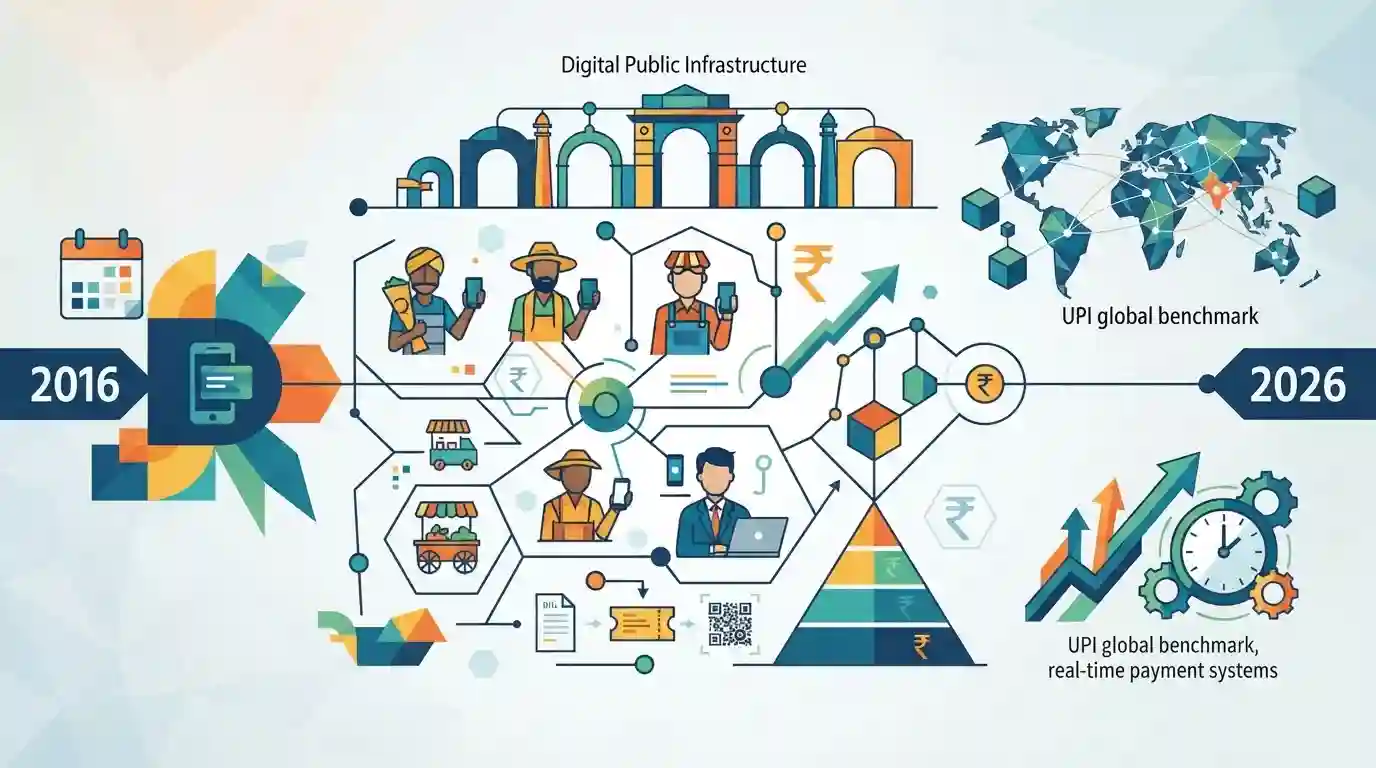
As the Unified Payments Interface (UPI) marks its tenth anniversary, Prime Minister Narendra Modi has encouraged citizens to share their stories and experiences of using the platform. Launched in 2016 by the National Payments Corporation of India (NPCI), UPI has completely transformed the digital payment ecosystem in India. It serves as a core component of the country's Digital Public Infrastructure, driving formalization of the economy, boosting financial inclusion, and setting a global benchmark for real-time payment systems.
ముఖ్య అంశాలు
- The Unified Payments Interface (UPI) completes a decade of operation, having been launched in 2016.
- Prime Minister Narendra Modi has invited citizens to share their experiences with UPI to mark the milestone.
- UPI has been central to India's digital transformation, revolutionizing peer-to-peer and merchant payments.
- The platform's success has strengthened India's Digital Public Infrastructure (DPI) and driven financial inclusion at a massive scale.
ముఖ్యమైన పదాలు
Unified Payments Interface (UPI)

An open-architecture, real-time payment system developed by the NPCI. It consolidates multiple bank accounts into a single mobile application, enabling instant peer-to-peer and merchant transactions without revealing underlying banking details.
UPSC context
Relevant for GS Paper 3 (Economy). Tests knowledge on digital payments, formalization of the economy, and technical aspects of banking infrastructure.
National Payments Corporation of India (NPCI)
A not-for-profit umbrella organization established in 2008 by the RBI and IBA. It operates India’s retail payment and settlement systems, creating robust infrastructure like UPI, RuPay, and IMPS.
UPSC context
Highly relevant for Prelims and GS Paper 3. Frequently tested on the regulatory/operational distinction in India's payment ecosystem and its digital initiatives.
Digital Public Infrastructure (DPI)
A foundational network of shared digital systems—like digital identity, payment gateways, and data-sharing frameworks—designed to facilitate seamless, scalable delivery of public and private services to citizens.
UPSC context
Critical for GS Paper 2 (Governance) and GS Paper 3 (Economy/Technology). Examines state capacity, e-governance delivery, and inclusive digital growth strategies.
Financial Inclusion
The process of ensuring affordable and widespread access to essential financial services—such as banking, credit, savings, and insurance—especially for low-income and disadvantaged populations, to foster equitable economic growth.
UPSC context
Core syllabus topic in GS Paper 3 (Inclusive Growth). Tests understanding of poverty alleviation, banking penetration, and the social impact of digital payments.
ప్రిలిమ్స్ ఉచ్చు
UPI transactions represent a direct liability of the Reserve Bank of India, bypassing commercial banks' core banking systems.
UPI transfers commercial bank deposits (bank liabilities) and routes through core banking systems. Only Digital Rupee/CBDC represents a direct RBI liability with instant, wallet-to-wallet sovereign settlement.
అనుసంధానమైన స్థిర భావనలు
What is the legal and institutional framework of the NPCI?
- Institutional Setup: Registered as a not-for-profit Section 8 company, created jointly by RBI and Indian Banks' Association (IBA).
- Statutory Basis: Formed under the Payment and Settlement Systems Act, 2007, to run retail payment and settlement systems.
How does UPI differ fundamentally from Digital Rupee (CBDC)?
- Nature of Money: UPI transfers commercial bank deposits (bank liabilities); Digital Rupee is sovereign fiat currency (direct RBI liability).
- Settlement Mechanism: UPI requires backend interbank batch clearing; CBDC features instant, final transaction-level settlement.
- Transaction Privacy: UPI transactions appear on bank statements; CBDC wallet-to-wallet transfers mimic cash and bypass standard bank logs.
అంతర-అంశ నమూనాలు
DPI + Soft Power Diplomacy
Exporting India's DPI stack (UPI, Aadhaar) serves as a key foreign policy tool, deepening bilateral ties with the Global South, the Gulf, and European partners.
UPI + Monetary Velocity
Rapid digital payment adoption increases the velocity of money, directly influencing RBI's monetary policy transmission and commercial banking liquidity management.

Multi-statement Prelims questions will highly likely contrast UPI's commercial bank liability with the CBDC's sovereign RBI liability.
అనుసంధాన PYQలు · 5
అనుసంధాన PYQలు · 5
- 2026PrelimsGS1
Which one of the following statements about Unified Payments Interface (UPI) and Central Bank Digital Currency (Digital Rupee) is not correct ?
- 2017PrelimsGS1
Which of the following is a most likely consequence of implementing the 'Unified Payments Interface (UPI)'?
- 2025PrelimsGS1
Consider the following countries : I. United Arab Emirates II. France III. Germany IV. Singapore V. Bangladesh How many countries amongst the above are there other than India where international merchant payments are accepted under UPI?
- 2018PrelimsGS1
With reference to digital payments, consider the following statements: 1. BHIM app allows the user to transfer money to anyone with a UPI-enabled bank account. 2. While a chip-pin debit card has four factors of authentication, BHIM app has only two factors of authentication. Which of the statements given above is/are correct?
- 2017PrelimsGS1
Consider the following statements: 1. National Payments Corporation of India (NPCI) helps in promoting the financial inclusion in the country. 2. NPCI has launched RuPay, a card payment scheme. Which of the statements given above is/are correct?
