CSIR-CRRI Workshop Promotes Road Asset Management Systems
Source:PIB ↗
हे का महत्त्वाचे आहे
Maintaining India's rapidly growing road network requires a transition from manual, reactive methods to scientific, data-driven frameworks. RAMS is a key technology-led governance tool that ensures durability, reduces national logistic costs, and optimizes capital expenditure on infrastructure.
सारांश
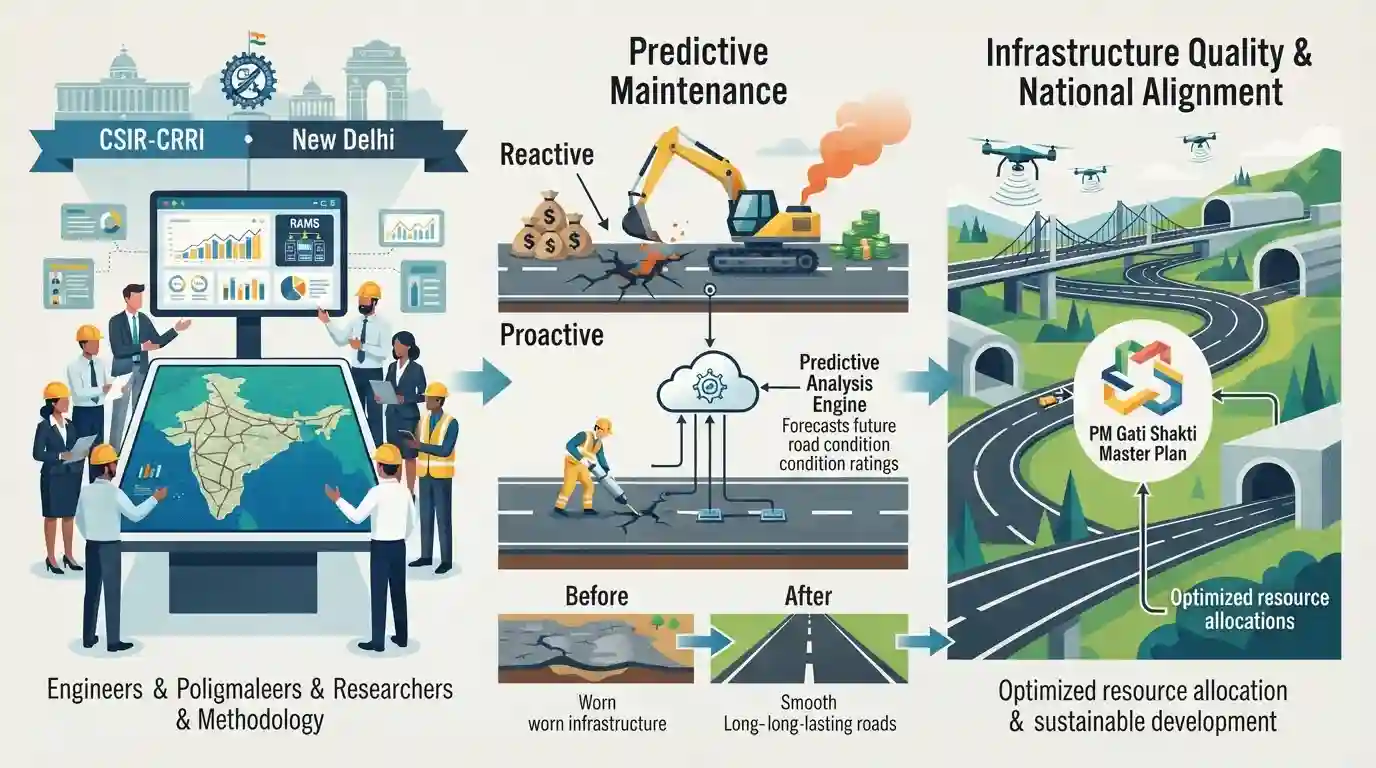
The CSIR-Central Road Research Institute (CSIR-CRRI) hosted a one-day national workshop in New Delhi focusing on Road Asset Management Systems (RAMS) and Predictive Analysis. The event aimed to promote scientific and data-driven methodologies for managing and maintaining India's expansive road network. By integrating RAMS and predictive degradation models, road agencies can transition from expensive, reactive road repairs to proactive, preventive maintenance. This technological shift optimizes budgetary spending, improves infrastructure quality, and aligns with national infrastructure targets like the PM Gati Shakti Master Plan.
मुख्य मुद्दे
- CSIR-CRRI organized a national workshop to promote the adoption and development of Road Asset Management Systems (RAMS) and Predictive Analysis for road maintenance.
- RAMS facilitates a paradigm shift from traditional reactive maintenance (repairing roads after damage occurs) to proactive, predictive, and preventive maintenance.
- Predictive analysis uses mathematical and engineering models to forecast pavement distress and deterioration patterns, allowing authorities to optimize resource allocation over time.
- Implementing digital asset management solutions helps extend the structural life of roads, minimizes vehicle operating costs, and enhances overall road safety across India's highways.
- The initiative aligns with India's focus on high-quality, sustainable, and cost-effective physical infrastructure under national frameworks like PM Gati Shakti.
महत्त्वाच्या संज्ञा
Road Asset Management Systems (RAMS)

A systematic, data-driven framework combining software tools and condition data to proactively monitor, plan, and optimize the life-cycle maintenance of road infrastructure.
UPSC context
GS Paper 3 (Infrastructure). Tests knowledge of tech-driven governance and efficient public expenditure in maintaining national road networks.
PM Gati Shakti National Master Plan
A GIS-based digital platform integrating 16 government ministries to ensure unified planning and coordinated implementation of multimodal infrastructure connectivity projects across India.
UPSC context
GS Paper 3 (Infrastructure). Highlights efforts to break departmental silos, reduce logistics costs, and optimize infrastructure deployment.
CSIR-Central Road Research Institute (CSIR-CRRI)
A premier national laboratory under the Council of Scientific and Industrial Research (CSIR) dedicated to advancing research and development in road design, construction, and transport engineering.
UPSC context
GS Paper 3 (Science & Technology). Demonstrates India's institutional R&D capacity for developing sustainable and efficient public infrastructure technologies.
Council of Scientific and Industrial Research (CSIR)
India's largest autonomous public R&D organization, operating numerous national laboratories to drive scientific advancement and industrial application under the Ministry of Science and Technology.
UPSC context
GS Paper 3 (Science & Tech). Frequently tested regarding its role in indigenous innovation and applying science to national development.
Predictive Analysis
The use of statistical algorithms, machine learning, and historical data to forecast future infrastructure degradation, shifting management strategies from reactive repair to proactive maintenance.
UPSC context
GS Paper 3 (Technology & E-Governance). Tests the application of data science to enhance public service delivery and reduce lifecycle costs.
पूर्वपरीक्षा सापळा
"Steel slag roads require thicker pavements than traditional bituminous roads to achieve the necessary load resistance."
Steel slag roads are actually up to 30% *thinner* and 30% *cheaper* while offering higher load resistance. UPSC often reverses such technical attributes.
संबंधित स्थिर संकल्पना
What are the core pillars and engines of the PM Gati Shakti Master Plan?
- Seven Engines: Powered by roads, railways, airports, ports, mass transport, waterways, and logistics infrastructure.
- Six Pillars: Comprehensiveness, Prioritization, Optimization, Synchronization, Analytical, and Dynamic.
- Core Objective: Aims to reduce India's high logistics cost from roughly 13-14% of GDP down to global benchmarks of 7-8% of GDP.
How does GNSS-based electronic tolling differ from the FASTag system?
- Core Technology: GNSS uses satellite tracking via an On-Board Unit (OBU) for dynamic tracking, whereas FASTag relies on fixed-point RFID scanners at designated toll plazas.
- Fare Calculation: GNSS enables barrier-free tolling based on the exact distance traveled by the vehicle, rather than flat rates applied between discrete tolling points.
- Distance Exemption: The new rules offer a zero-user fee for the first 20 km of a daily journey for non-National Permit vehicles on GNSS lanes.
आंतर-विषय नमुने
GIS Mapping & E-Governance Integration
RAMS relies heavily on GIS and Network Survey Vehicles (NSVs). UPSC frequently tests how space technology and GIS databases are deployed in e-governance and physical infrastructure planning (e.g., SVAMITVA, PM Gati Shakti).
Circular Economy & Industrial Waste
CSIR-CRRI's Steel Slag Road technology exemplifies the 'Waste to Wealth' initiative. This connects directly to UPSC's recurring focus on the circular economy, industrial byproducts, and solid waste management rules.

Expect a multi-statement question combining CSIR-CRRI's Steel Slag Road tech, GNSS tolling dynamics, and PM Gati Shakti logistics targets.
संबंधित PYQ · 2
संबंधित PYQ · 2
- 2024MainsGS3
What is the technology being employed for electronic toll collection on highways? What are its advantages and limitations? What are the proposed changes that will make this process seamless? Would this transition carry any potential hazards?
- 2021MainsGS3
“Investment in infrastructure is essential for more rapid and inclusive economic growth.” Discuss in the light of India's experience.
