NSS Conference 2026 in New Delhi Addresses Internal Security
Source:PIB ↗
આ શા માટે મહત્વનું છે
The NSS Conference outlines India's macro-level internal security priorities and the operational shifts required to tackle next-generation threats. Questions frequently appear in GS3 on institutional mechanisms, emerging threats (AI, cyber warfare), and counter-naxalism strategies. Understanding MHA directives offers robust, government-backed points for Mains answers.
સારાંશ
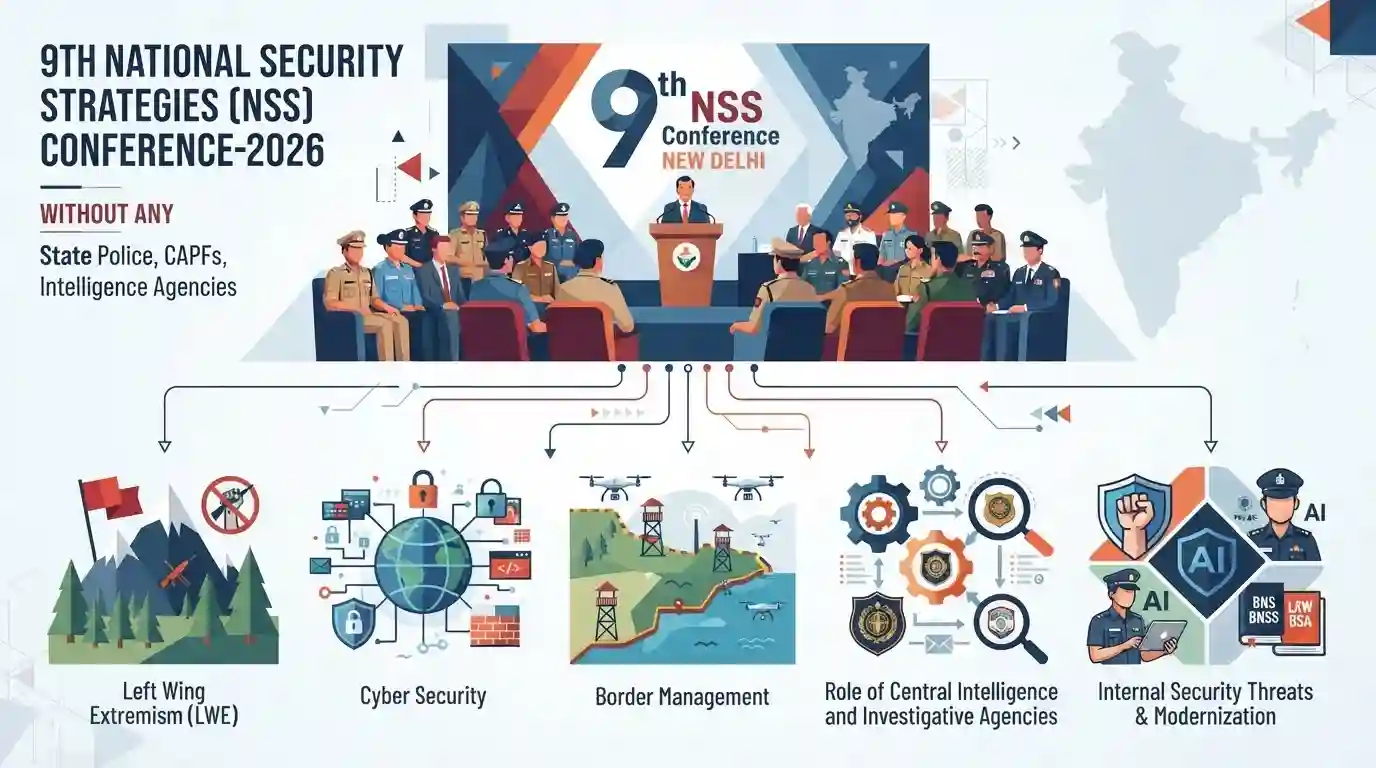
The Union Home Minister and Minister of Cooperation inaugurated the 9th National Security Strategies (NSS) Conference-2026 in New Delhi, a premier forum bringing together heads of State Police, Central Armed Police Forces (CAPFs), and intelligence agencies to deliberate on evolving security challenges. Discussions focused on neutralizing multi-dimensional internal security threats such as cybercrime, narco-terrorism, Left Wing Extremism (LWE), and radicalization. Emphasis was laid on enhancing coordination between state and central investigative agencies, leveraging modern technology and AI in policing, implementing new criminal justice frameworks (like the BNS, BNSS, BSA), and upgrading the overall national security architecture to ensure holistic border and internal security management.
મુખ્ય મુદ્દા
- The 9th NSS Conference serves as a critical platform for strategic deliberation among DGPs, IGPs, CAPF heads, and Central intelligence agencies on national security paradigms.
- Focus on contemporary security threats including cross-border cyber attacks, artificial intelligence misuse (e.g., deepfakes), cryptocurrency fraud, and narco-terrorism.
- The Union Home Minister stressed the need for a 'Whole of Government' approach and seamless coordination between the Centre and States via mechanisms like the Multi-Agency Centre (MAC) and National Intelligence Grid (NATGRID).
- Reiteration of the Government's commitment to achieving a 'Zero Terror' architecture and eliminating Left Wing Extremism (LWE) from affected districts.
- Emphasis on adopting modern technology, bolstering the Inter-operable Criminal Justice System (ICJS), and effective rollout of the new criminal laws at the grassroots level.
મહત્વપૂર્ણ શબ્દો
Bharatiya Nyaya Sanhita (BNS)

India's official substantive criminal code, enacted to modernize the justice system by replacing the colonial-era Indian Penal Code (IPC) of 1860, introducing new offenses like organized crime, terrorism, and community service punishments.
UPSC context
GS Paper II & III: Judicial reforms and internal security. Tests understanding of modernized penal provisions replacing colonial laws.
Bharatiya Nagarik Suraksha Sanhita (BNSS)
India's primary procedural law for criminal justice, which replaced the Code of Criminal Procedure (CrPC) of 1973, mandating strict timelines, forensic evidence collection, and digitalized judicial and investigative processes.
UPSC context
GS Paper II & III: Police and criminal justice reforms. Tests knowledge of procedural safeguards, forensic integration, and digital modernization.
Bharatiya Sakshya Adhiniyam (BSA)
India’s modernized law of evidence, replacing the 1872 Indian Evidence Act, designed to grant parity to electronic and digital records, streamline admissibility rules, and ensure fair, technologically integrated court trials.
UPSC context
GS Paper II & III: Legal and technological reforms in judiciary. Tests understanding of digital evidence admissibility and fair trial principles.
Ministry of Home Affairs (MHA)
The nodal Union ministry of India responsible for preserving internal security, border management, Centre-State relations, administration of Union Territories, and management of police and central forces.
UPSC context
GS Paper II & III: Governance and Internal Security. Tests familiarity with security administrative frameworks and constitutional mandates under Article 355.
Central Armed Police Forces (CAPFs)
A group of seven armed police forces (including CRPF, BSF, CISF, and ITBP) operating under the Ministry of Home Affairs to safeguard borders, handle internal counterinsurgency, and maintain public order.
UPSC context
GS Paper III: Security forces and their mandate. Tests knowledge of specialized police units in managing internal security threats.
Intelligence Bureau (IB)
India's premier internal intelligence and counter-intelligence agency under the Ministry of Home Affairs, established in 1887, responsible for assessing security threats, counter-terrorism, and sharing intelligence with security forces.
UPSC context
GS Paper III: Intelligence and security agencies. Tests knowledge of domestic intelligence networks, national security, and coordinating mechanisms.
પ્રિલિમ્સ ટ્રેપ
The National Security Strategies (NSS) Conference is convened and chaired by the National Security Advisor (NSA).
Despite its name suggesting the NSA's domain, this internal security and policing conference is convened and chaired by the Union Home Minister.
સંલગ્ન સ્થિર ખ્યાલો
What is the distinction between MAC and NATGRID?
- MAC: A nodal intelligence-sharing platform under the Intelligence Bureau (IB) for real-time coordination across central and state agencies.
- NATGRID: An integrated intelligence grid connecting standalone databases (banking, telecom, immigration) for authorized agencies to track terror suspects.
What constitutes the Inter-operable Criminal Justice System (ICJS)?
- Core Objective: Creates a seamless digital backbone linking the various organs of the criminal justice delivery system.
- Five Pillars: Integrates Police (CCTNS), e-Forensics, e-Courts, e-Prosecution, and e-Prisons on a 'One Data, One Entry' principle.
આંતર-વિષય પેટર્ન
Tech-driven internal security threats
The focus on AI, deepfakes, and crypto-fraud in terror financing overlaps Internal Security with Science & Technology applications.
Federalism and law enforcement
Pushing for MAC and NATGRID utilization highlights the functional necessity of cooperative federalism, balancing Police (State List) with national security (Union List).

Expect a multi-statement question distinguishing MAC, NATGRID, and CCTNS, or evaluating the five pillars of the ICJS platform.
સંલગ્ન PYQ · 4
સંલગ્ન PYQ · 4
- 2023MainsGS3
What are the internal security challenges being faced by India? Give out the role of Central Intelligence and Investigative Agencies tasked to counter such threats.
- 2022MainsGS3
Naxalism is a social, economic and developmental issue manifesting as a violent internal security threat. In this context, discuss the emerging issues and suggest a multilayered strategy to tackle the menace of Naxalism.
- 2021MainsGS3
Keeping in view India's internal security, analyse the impact of cross-border cyber attacks. Also discuss defensive measures against these sophisticated attacks.
- 2020MainsGS3
Discuss different types of cyber crimes and measures required to be taken to fight the menace.
