National Conclave on Tribal Languages in Mysuru Focuses on Heritage
Source:PIB ↗
हे का महत्त्वाचे आहे
The preservation of tribal languages and heritage is directly relevant to GS Paper 1 (Indian Heritage and Culture, Diversity of India) and GS Paper 2 (Governance regarding vulnerable sections). Understanding the uniqueness of tribal knowledge systems and the threats to linguistic diversity are recurring themes in UPSC Prelims and Mains examinations.
सारांश
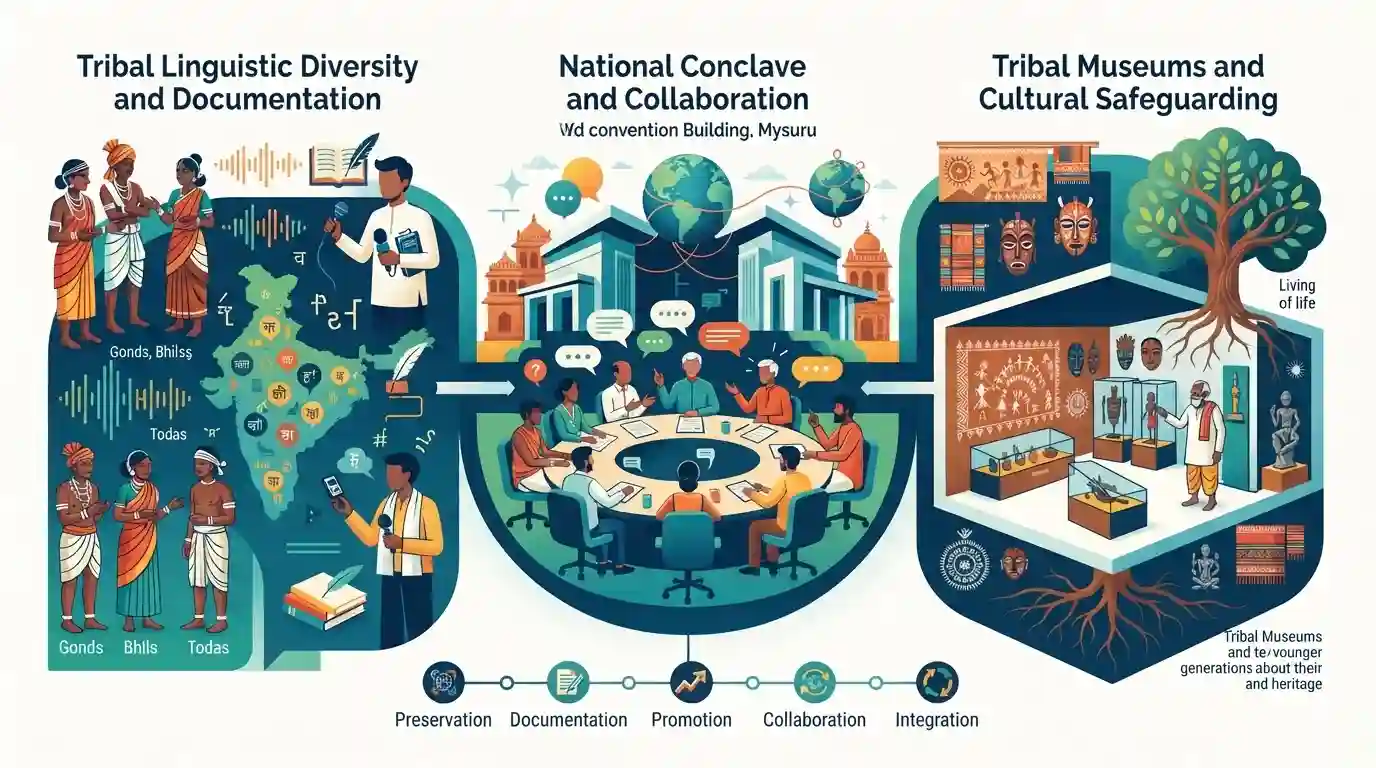
The National Conclave on Tribal Languages and Museums commenced in Mysuru, Karnataka, focusing on the preservation, documentation, and promotion of India's tribal linguistic and cultural heritage. The conclave addressed the critical need to protect endangered tribal languages and underscored the role of tribal museums in safeguarding indigenous knowledge systems, art, and history. It brought together experts, linguists, and community representatives to foster collaboration and develop sustainable strategies for conserving tribal identity and integrating their unique cultural narratives into the national heritage framework.
मुख्य मुद्दे
- The conclave focused on formulating strategies for the documentation and revitalization of endangered tribal languages in India.
- It highlighted the significance of tribal museums as dynamic institutions for conserving indigenous art, heritage, and unique knowledge systems.
- The event emphasized the urgent need to protect the cultural uniqueness and linguistic diversity of tribal communities from the impacts of rapid modernization.
- It provided a collaborative platform for linguists, anthropologists, and tribal representatives to share best practices in cultural preservation.
महत्त्वाच्या संज्ञा
Central Institute of Indian Languages (CIIL)

Founded in 1969 in Mysuru under the Ministry of Education, CIIL coordinates the development of Indian languages, protects endangered vernaculars, and documents India's linguistic heritage, including unscripted tribal dialects.
UPSC context
Important for GS-1 (Culture) and GS-2 (Government Policies) regarding language preservation, linguistic minorities, and the Eighth Schedule.
Ministry of Tribal Affairs (MoTA)
Created in 1999, this nodal Central ministry oversees the holistic socio-economic development, cultural preservation, and welfare of India’s Scheduled Tribes, separating from the Ministry of Social Justice and Empowerment.
UPSC context
Relevant for GS-2 (Social Justice) covering tribal welfare policies, Scheduled Areas administration, and Forest Rights Act implementation.
Endangered Tribal Languages
Languages facing extinction due to dwindling speakers and lack of scripts, like Majhi or Birhor. India has 197 endangered languages, risking the loss of unique indigenous knowledge systems and identities.
UPSC context
A key topic in GS-1 (Indian Society) and Anthropology, testing linguistic diversity and the Scheme for Protection of Endangered Languages.
Adi Vaani Platform
A government-backed digital initiative and mobile application designed to document, translate, and provide learning resources for India's tribal languages, facilitating multilingual education and cultural preservation.
UPSC context
Fits into GS-2 (E-governance) and GS-3 (Technology) as an example of leveraging digital tools for cultural preservation.
Tribal Freedom Fighter Museums (TFFMs)
Dedicated museums sanctioned by the Ministry of Tribal Affairs across multiple states to research, curate, and honor the history and anti-colonial resistance of India's tribal communities.
UPSC context
Crucial for GS-1 (Modern Indian History) focusing on tribal uprisings and their overlooked contributions to the freedom struggle.
पूर्वपरीक्षा सापळा
"The Central Institute of Indian Languages (CIIL) operates under the Ministry of Tribal Affairs to preserve endangered tribal dialects."
CIIL is actually a subordinate office of the Ministry of Education, despite its heavy involvement in tribal language preservation and collaborations with the Tribal Ministry.
संबंधित स्थिर संकल्पना
What is the SPPEL and how does it define an endangered language?
- Endangerment Criteria: Focuses exclusively on languages or dialects spoken by fewer than 10,000 people in India.
- Nodal Agency: Executed by the Central Institute of Indian Languages (CIIL) located in Mysuru.
- Core Objectives: Involves grammatical description, dictionary formulation, and digital archiving of endangered tongues to prevent extinction.
Which major linguistic families do India's tribal languages belong to?
- Austric Family: Includes Munda languages (e.g., Santali, Mundari, Ho) which are prevalent among tribes in Central and Eastern India.
- Sino-Tibetan: Spoken mainly by indigenous communities in the North-East and Himalayan regions (e.g., Bodo, Naga, Lepcha).
- Dravidian: Includes major tribal languages like Gondi, Kurukh, and Kui, found primarily in Central and Southern India.
आंतर-विषय नमुने
AI in Cultural Preservation
The 'Adi Vaani' tool bridges Science & Tech (NLP for low-resource languages) with Heritage Conservation, reflecting a trend of using AI for the digital inclusion of marginalized dialects.
Article 275(1) & Tribal History
Funding for Tribal Freedom Fighter Museums connects GS2 (Constitutional grants-in-aid under Article 275) directly to GS1 (Modern Indian History and the legacy of tribal uprisings).

Expect a multi-statement question mixing SPPEL criteria (<10,000 speakers), CIIL's parent ministry, and AI tools like 'Adi Vaani'.
संबंधित PYQ · 4
संबंधित PYQ · 4
- 2021PrelimsGS1
With reference to India, the terms 'Halbi, Ho and Kui' pertain to
- 2018MainsGS1
Safeguarding the Indian art heritage is the need of the moment. Discuss.
- 2021MainsGS1
Examine the uniqueness of tribal knowledge system when compared with mainstream knowledge and cultural systems.
- 2022MainsGS1
Given the diversities among tribal communities in India, in which specific contexts should they be considered as a single category ?
