PMFME Bazaar Promotes Micro Food Processing Enterprises
Source:PIB ↗
কেন এটি গুরুত্বপূর্ণ
The unorganized micro food processing sector accounts for a significant portion of India's food industry. The PMFME scheme's role in formalizing these units is highly relevant for UPSC GS3 (Food processing and related industries in India), touching upon scope, significance, upstream/downstream requirements, and employment generation.
সারসংক্ষেপ
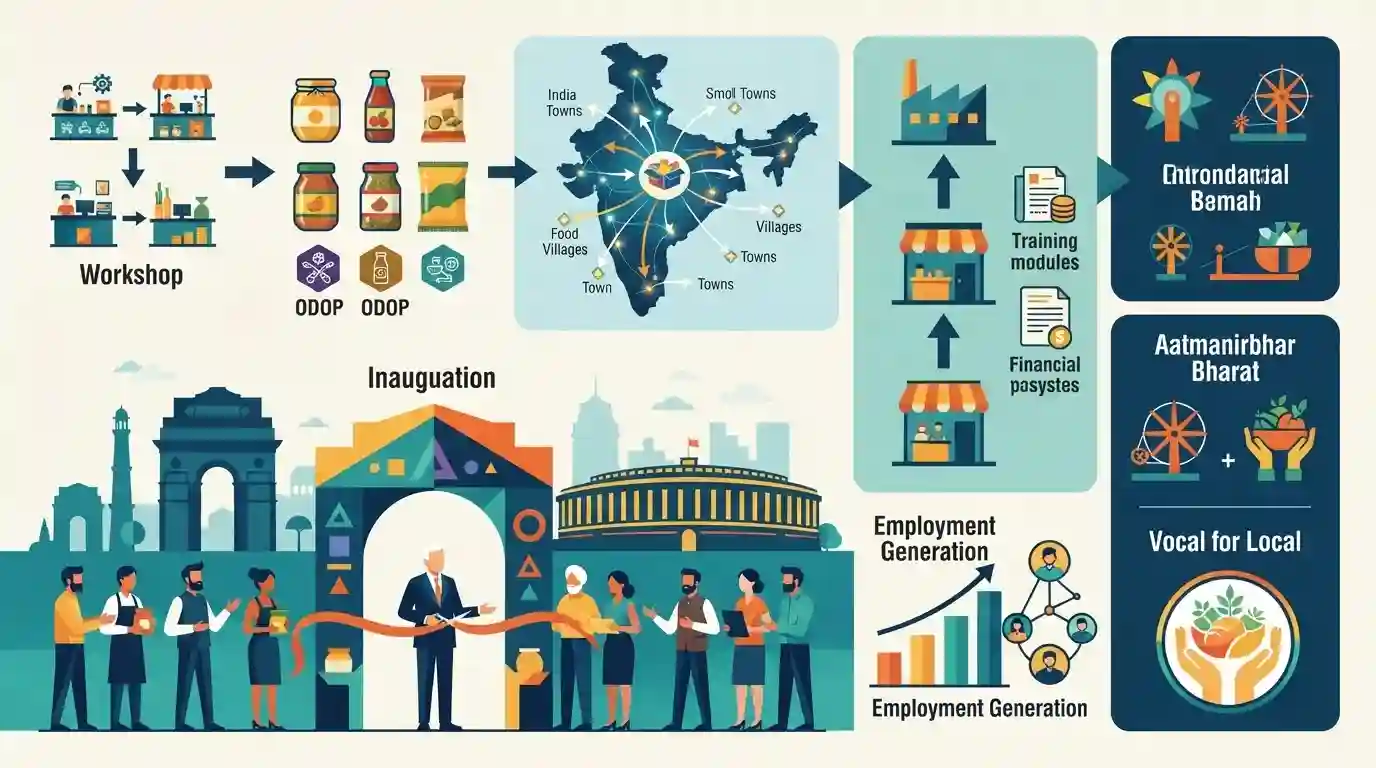
The Union Minister of Food Processing Industries inaugurated the ‘PMFME Bazaar’ in New Delhi to highlight and support India's diverse micro food processing enterprises. Organized under the Pradhan Mantri Formalisation of Micro food processing Enterprises (PMFME) scheme, the event aligns with the 'Aatmanirbhar Bharat', 'Vocal for Local', and 'One District One Product' (ODOP) initiatives. By providing a national platform for small and unorganized food processing businesses, the bazaar aims to enhance their market linkages, offer branding support, and encourage formalization, thereby driving local economic growth and employment generation.
মূল বিষয়
- Union Minister of Food Processing Industries, Shri Chirag Paswan, inaugurated the 'PMFME Bazaar' in New Delhi.
- The exhibition showcases diverse food products manufactured by micro enterprises supported under the PMFME scheme.
- The initiative champions the visions of 'Vocal for Local', 'Aatmanirbhar Bharat', and 'One District One Product' (ODOP).
- The bazaar aims to provide national-level market access, branding opportunities, and formalization support to unorganized micro food processing units.
- It plays a significant role in empowering local entrepreneurs, promoting regional agricultural produce, and generating rural employment.
গুরুত্বপূর্ণ শব্দ
Pradhan Mantri Formalisation of Micro food processing Enterprises (PMFME) Scheme

A centrally sponsored scheme under MoFPI to formalize and upgrade unorganized micro-food enterprises through financial, technical, and business support, using the One District One Product approach.
UPSC context
GS Paper III (Economics/Food Processing); tests government policies, value addition, and rural livelihood promotion.
One District One Product (ODOP)
A government initiative to identify, brand, and promote one unique product from each district, aiming to drive local economic growth, preserve heritage, and foster balanced regional development.
UPSC context
GS Paper III (Economy/Growth); tests balanced regional development, export promotion, and MSME competitiveness.
Vocal for Local
A strategic campaign emphasizing self-sufficiency and economic growth by encouraging consumer support for indigenous products, thereby empowering MSMEs, artisans, and rural industries.
UPSC context
GS Paper III (Economic Development); tests grassroots economic models, employment generation, and self-reliance policies.
Aatmanirbhar Bharat
A national mission and vision launched to make India self-reliant by strengthening local manufacturing, integrating global supply chains, and driving structural economic reforms across key sectors.
UPSC context
GS Paper III (Indian Economy); tests growth strategies, industrial reforms, and domestic manufacturing initiatives.
Ministry of Food Processing Industries
The nodal Union ministry formulating and implementing policies to develop India's food processing sector, enhance value addition, minimize post-harvest agricultural losses, and augment farmer incomes.
UPSC context
GS Paper III (Food Processing/Agriculture); tests institutional frameworks, infrastructure schemes, and supply chain management.
প্রিলিমস ফাঁদ
PMFME is a Central Sector Scheme providing 100% capital funding for unorganized micro food enterprises.
It is a Centrally Sponsored Scheme (60:40 funding for general states) and provides a 35% credit-linked capital subsidy, not 100% direct funding.
সংযুক্ত স্থির ধারণা
What are the supply chain constraints in India's food processing sector?
- Upstream bottlenecks: Fragmented landholdings, poor cold chain logistics at the farm gate, seasonality of crops, and lack of quality raw material aggregation.
- Downstream bottlenecks: Inadequate market linkages, complex quality certification compliance (FSSAI), and lack of branding or packaging capabilities for informal micro-enterprises.
How do Central Sector Schemes differ from Centrally Sponsored Schemes?
- Central Sector: 100% funded by the Union government and implemented directly by Central government machinery.
- Centrally Sponsored: Funded jointly by the Centre and States (usually 60:40 or 90:10 for special category) and implemented by State governments.
আন্তঃবিষয় প্যাটার্ন
SHGs, Seed Capital & Rural Women
PMFME’s ₹40,000 seed capital for SHG members links the formalization of food processing directly to the economic empowerment of rural women and micro-finance initiatives (GS2/GS3 intersection).
ODOP and GI Tag overlaps
ODOP products under PMFME often overlap with GI-tagged agricultural items, bridging MSME cluster development with intellectual property rights and export promotion policies.

Expect a multi-statement question mixing PMFME's 35% credit-linked subsidy, its Centrally Sponsored nature, and ODOP integration.
সংযুক্ত PYQ · 4
সংযুক্ত PYQ · 4
- 2022MainsGS3
Elaborate the scope and significance of the food processing industry in India.
- 2025MainsGS3
Examine the scope of the food processing industries in India. Elaborate the measures taken by the government in the food processing industries for generating employment opportunities.
- 2025MainsGS3
Elaborate the scope and significance of supply chain management of agricultural commodities in India.
- 2023PrelimsGS1
Consider the following statements with reference to India: 1. According to the 'Micro, Small and Medium Enterprises Development (MSMED) Act, 2006', the 'medium enterprises' are those with investments in plant and machinery between ₹ 15 crore and ₹ 25 crore. 2. All bank loans to the Micro, Small and Medium Enterprises qualify under the priority sector. Which of the statements given above is/are correct?
