India Post Upgrades Digital Applications for Enhanced Public Delivery
Source:PIB ↗
આ શા માટે મહત્વનું છે
This development is highly relevant for GS Paper 2 (e-Governance, transparency, and accountability). It serves as an excellent case study of a legacy institution (India Post) leveraging interactive service models and digital technology to improve citizen-centric delivery and operational efficiency.
સારાંશ
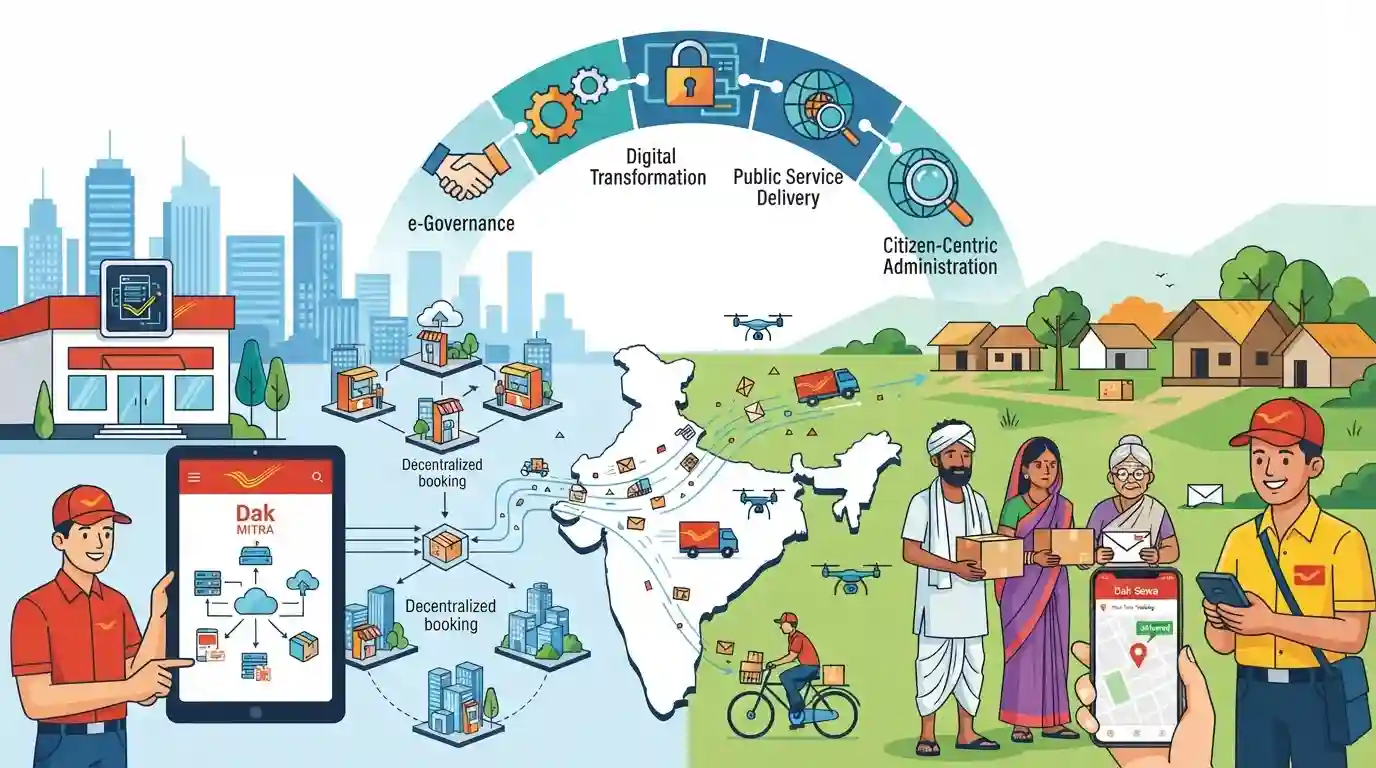
India Post has taken a major step in its digital and infrastructure transformation journey with the launch of the upgraded Dak MITRA and Dak Sewa apps. These platforms are designed to enhance the efficiency of postal operations, facilitate real-time tracking, and improve last-mile connectivity. By leveraging technology for better backend integration and enabling decentralized service booking, the Department of Posts aims to provide more transparent, accountable, and citizen-centric services in alignment with the broader Digital India vision.
મુખ્ય મુદ્દા
- India Post has rolled out upgraded versions of the Dak MITRA and Dak Sewa apps to modernize its service delivery mechanisms.
- The Dak MITRA app empowers citizens and Common Service Centres (CSCs) to act as postal agents, expanding accessibility to postal services at the grassroots level.
- The Dak Sewa app enhances backend integration and operational efficiency for postal staff, streamlining logistics and package tracking.
- These digital interventions align with e-Governance objectives by increasing transparency, accountability, and the speed of public service delivery.
મહત્વપૂર્ણ શબ્દો
Dak MITRA App

An indigenously developed, unified operational mobile platform under India Post's modernization that enables rural postmasters to perform paperless, real-time banking, insurance, and mail transactions at the doorstep.
UPSC context
GS Paper II & III: E-governance applications, rural developmental infrastructure, and digital financial inclusion.
Dak Sewa App
A citizen-centric mobile application by India Post offering 24/7 access to services like booking, real-time tracking, e-money orders, and complaints in 23 Indian languages, integrated with digital payments.
UPSC context
GS Paper II: E-governance platforms and citizen-centric public service delivery.
Department of Posts
A central department under the Ministry of Communications that operates the national postal network, delivering mail, small savings schemes, and retail services across rural and urban India.
UPSC context
GS Paper II: Structure, organization, and functioning of executive departments and administrative bodies.
India Post
The brand and operating system of the Department of Posts, comprising the largest physical postal network in the world, facilitating connectivity, logistics, and social security distribution.
UPSC context
GS Paper III: Economic infrastructure, logistics, and financial inclusion in rural areas.
Digital India
A flagship Union Government initiative launched to transform India into a digitally empowered society and knowledge economy by improving digital infrastructure, literacy, and online public service delivery.
UPSC context
GS Paper II & III: National e-governance policies and ICT-driven socioeconomic growth.
Ministry of Communications
The Union Ministry of India responsible for the formulation, implementation, and regulation of policies governing the country's telecommunications and postal systems.
UPSC context
GS Paper II: Union Executive organization and the administration of national communications networks.
પ્રિલિમ્સ ટ્રેપ
Dak MITRA is the public-facing portal for booking Speed Post, while Dak Sewa is the backend platform for Gramin Dak Sevaks.
This completely reverses their roles. Dak MITRA (Rural Assistance) is the GDS-facing backend application, whereas Dak Sewa is the citizen-facing digital portal for booking services.
સંલગ્ન સ્થિર ખ્યાલો
What is India Post Payments Bank (IPPB)?
- Ownership structure: Established as a public limited company under the Department of Posts with 100% government equity.
- Operational limits: Operates as a payments bank; can accept deposits up to ₹2 lakh but cannot issue credit or loans directly.
- Inclusion model: Leverages Gramin Dak Sevaks and post offices to offer doorstep banking services using Aadhaar-enabled payments.
What is the Bhashini Mission?
- Core objective: An AI-led National Language Translation Mission under MeitY to provide digital services in local Indian languages.
- Bhasha Daan: A crowdsourcing initiative to build open-source datasets for training machine learning translation models.
આંતર-વિષય પેટર્ન
Post offices as DPI nodes
Leveraging India's massive physical post network as digital service delivery nodes bridges the rural-urban divide, integrating e-commerce and financial inclusion.
IIPA feedback in policy loops
The transition from DOP IT 1.0 to 2.0 based on IIPA's findings demonstrates how independent evaluation feedback loops shape national e-governance outlays.

Mains questions are highly likely to evaluate IPPB and DOP IT 2.0 as structural vehicles for bridging the rural digital divide.
સંલગ્ન PYQ · 4
સંલગ્ન PYQ · 4
- 2024MainsGS2
e-governance is not just about the routine application of digital technology in service delivery process. It is as much about multifarious interactions for ensuring transparency and accountability. In this context evaluate the role of the 'Interactive Service Model' of e-governance.
- 2023MainsGS2
e-governance, as a critical tool of governance, has ushered in effectiveness, transparency and accountability in governments. What inadequacies hamper the enhancement of these features ?
- 2025MainsGS2
e-governance projects have a built-in bias towards technology and back-end integration than user-centric designs. Examine.
- 2024MainsGS2
The Citizens' charter has been a landmark initiative in ensuring citizen-centric administration. But it is yet to reach its full potential. Identify the factors hindering the realisation of its promise and suggest measures to overcome them.
