RBI Forex Swap Facility Drives Unprecedented Capital Inflows
Source:PIB ↗
આ શા માટે મહત્વનું છે
This development is crucial for UPSC aspirants as it illustrates the practical application of RBI's monetary policy and exchange rate management instruments. It highlights how foreign exchange swap facilities are utilized to address balance of payments issues, manage rupee liquidity, and defend the national currency during external shocks, which are recurrent themes in both Prelims (macroeconomics and monetary tools) and Mains (GS Paper III - External Sector and Economic Stability).
સારાંશ
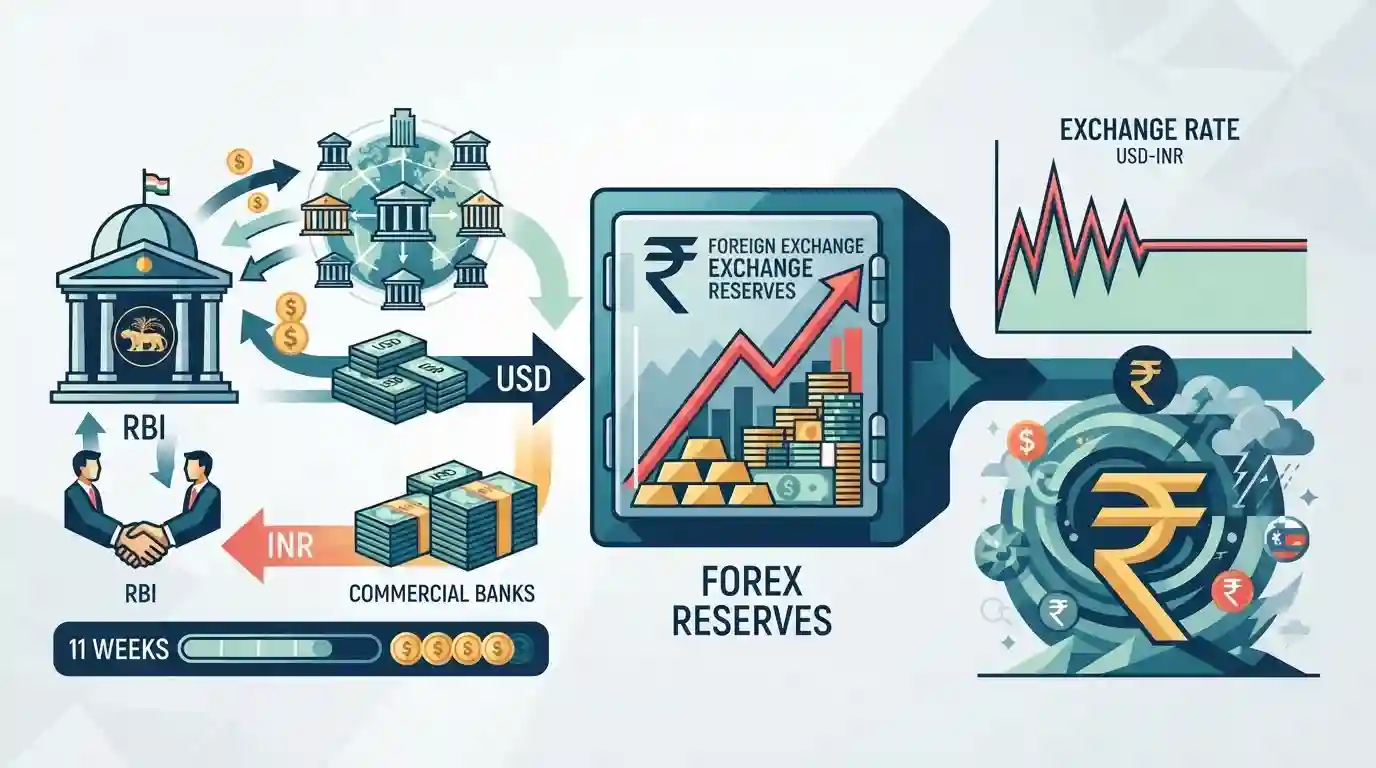
This press release highlights the remarkable success of the Reserve Bank of India’s (RBI) USD-INR swap facility, through which commercial banks in India mobilized and raised an unprecedented USD 73 billion in a span of just eleven weeks. This swap window, designed to attract foreign currency inflows and bolster India's external economic resilience, has dramatically boosted India's foreign exchange (forex) reserves, stabilized the rupee against external volatility, and infused rupee liquidity into the domestic banking system. The mechanism mirrors historical interventions (such as the 2013 FCNR-B swap scheme) but at a much larger scale, demonstrating the effectiveness of the RBI's specialized monetary and exchange rate management tools in navigating global financial uncertainties.
મુખ્ય મુદ્દા
- Commercial banks in India successfully raised an unprecedented USD 73 billion within an eleven-week period utilizing the RBI's special USD-INR swap facility.
- The USD-INR swap facility functions by allowing banks to swap foreign currency (USD) mobilized from abroad with the RBI for domestic currency (INR) at concessional or specified forward swap rates, effectively reducing hedging costs.
- This massive influx has substantially bolstered India's Foreign Exchange (Forex) Reserves, providing a strong cushion against balance of payments (BoP) shocks and external capital flight.
- The mechanism has dual macroeconomic impacts: it strengthens the exchange rate of the Indian Rupee (INR) by increasing dollar supply, and injects domestic rupee liquidity into the banking system, which may require sterilization by the RBI via Open Market Operations (OMOs) if inflationary pressures arise.
- The success of the facility showcases how strategic central bank swap windows can mobilize non-resident deposits (like FCNR-B) and foreign capital during periods of global monetary tightening or geopolitical volatility.
મહત્વપૂર્ણ શબ્દો
USD-INR Swap Facility

A foreign exchange instrument where the RBI temporarily exchanges US dollars for rupees with banks, agreeing to reverse the transaction later. It is used to manage domestic rupee liquidity and stabilize the exchange rate.
UPSC context
Highly relevant for GS Paper 3 (Economy) to understand RBI's monetary policy tools, exchange rate management, and liquidity interventions.
Foreign Currency Non-Resident (Bank) deposits [FCNR(B)]
Fixed-term deposits allowing Non-Resident Indians to maintain savings in Indian banks in designated foreign currencies. This protects depositors from exchange-rate risks and helps India build robust forex reserves.
UPSC context
Crucial for GS Paper 3 (Economy) concerning the external sector, balance of payments, and methods to counter rupee depreciation.
Reserve Bank of India (RBI)
India's central banking institution and primary regulatory authority. It formulates monetary policy, manages foreign exchange reserves, regulates commercial banking, and oversees the stability of the national financial system.
UPSC context
Core topic in GS Paper 3 (Economy), testing knowledge on monetary policy, inflation control, and central banking functions.
Commercial Banks
Financial institutions that accept public deposits, offer withdrawal facilities, and provide loans for profit. They are the primary channels through which the RBI implements liquidity measures and monetary policy.
UPSC context
Key for GS Paper 3 (Economy) regarding banking sector stability, credit creation, and the transmission of monetary policy.
પ્રિલિમ્સ ટ્રેપ
"RBI's Buy/Sell USD-INR swap absorbs domestic rupee liquidity from the banking system."
In a Buy/Sell swap, the RBI buys dollars and supplies rupees, thereby *injecting* liquidity. To absorb it, the RBI must use sterilization (OMOs).
સંલગ્ન સ્થિર ખ્યાલો
What is Sterilization in the context of RBI's forex operations?
- Core Objective: Neutralizing the macroeconomic impact of foreign exchange interventions on domestic money supply to curb inflation.
- Primary Tools: Selling government securities via Open Market Operations (OMOs) or the Market Stabilization Scheme (MSS).
- The Mechanism: When RBI buys USD (injecting INR), it simultaneously sells bonds to absorb the excess INR back from the banking system.
What are Foreign Currency Non-Resident (Bank) or FCNR(B) deposits?
- Currency & Eligibility: Term deposits opened by NRIs or PIOs strictly in designated freely convertible foreign currencies, not in Indian Rupees.
- Exchange Risk: The depositor faces no exchange rate risk; the risk is borne by the banks (often mitigated by RBI swaps).
- Repatriability: Both principal and interest are fully repatriable, making it highly attractive during global volatility and a vital BoP cushion.
આંતર-વિષય પેટર્ન
Forex interventions and Sterilization
Rapid forex inflows force the RBI to balance exchange rate defense with inflation control, directly linking Balance of Payments management to Open Market Operations (OMOs).
2013 Taper Tantrum parallels
This massive swap window mirrors the 2013 FCNR(B) scheme used during the US Fed's taper tantrum, highlighting recurrent structural defenses against sudden capital flight.

Expect a multi-statement question linking USD-INR buy/sell swaps to domestic liquidity injection and the necessity for RBI sterilization.
સંલગ્ન PYQ · 3
સંલગ્ન PYQ · 3
- 2023PrelimsGS1
Which one of the following activities of the Reserve Bank of India is considered to be part of 'sterilization'?
- 2022PrelimsGS1
Consider the following statements: 1. Tight monetary policy of US Federal Reserve could lead to capital flight. 2. Capital flight may increase the interest cost of firms with existing External Commercial Borrowings (ECBs). 3. Devaluation of domestic currency decreases the currency risk associated with ECBs. Which of the statements given above are correct?
- 2015MainsGS3
Craze for gold in Indians has led to a surge in import of gold in recent years and put pressure on balance of payments and external value of rupee. In view of this, examine the merits of the Gold Monetization Scheme.
