Ministry Reports Progressive Kharif Crop Sowing Area Coverage
Source:PIB ↗
ఇది ఎందుకు ముఖ్యం
Understanding the trends in Kharif crop sowing is crucial for analyzing India's food security, agricultural growth, and the direct impact of monsoon performance on the rural economy. It also aids in studying shifts in cropping patterns which is a recurring theme in UPSC.
సారాంశం
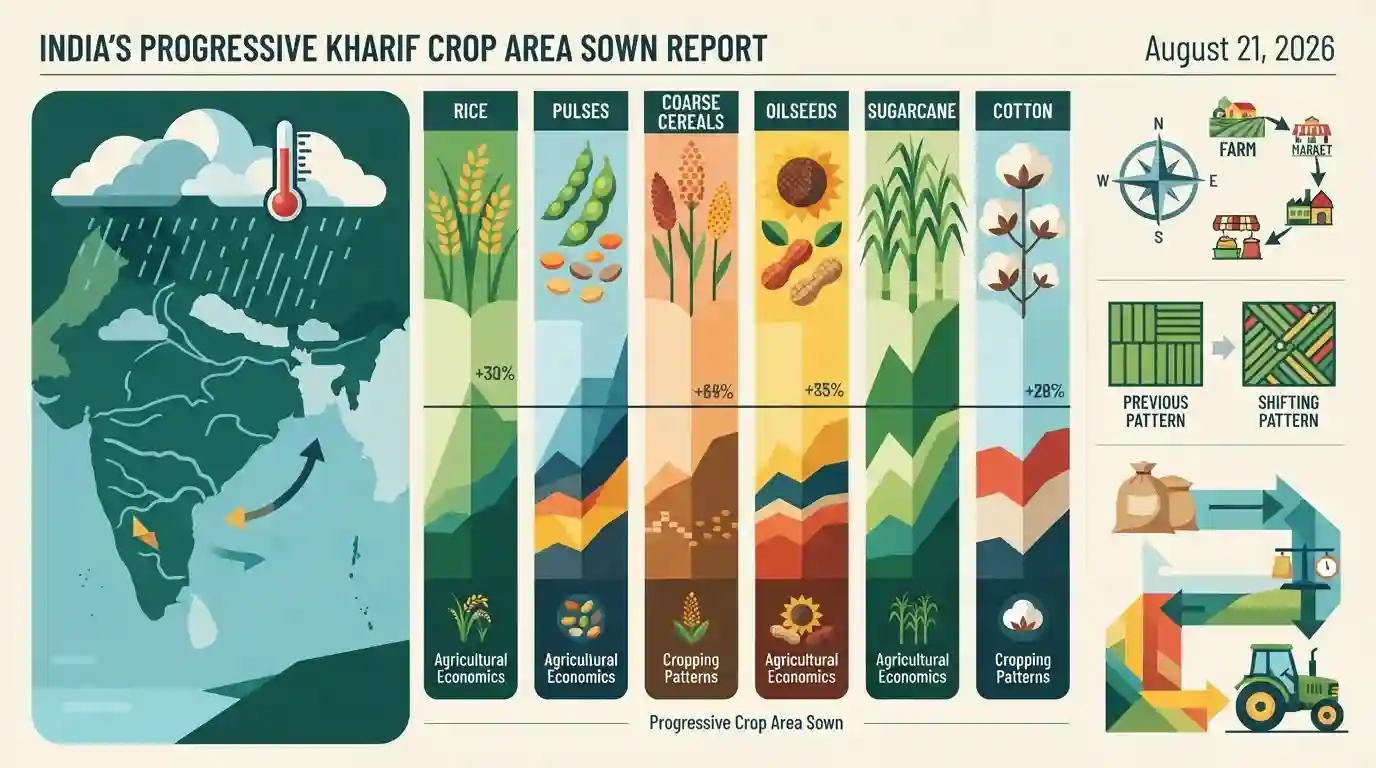
The press release provides the 'All India: Progressive Crop Area Sown Report', detailing the weekly area coverage for Kharif crops as of August 21, 2026. Issued by the Ministry of Agriculture and Farmers Welfare, the report presents data on the acreage of major crops such as rice, pulses, coarse cereals, oilseeds, sugarcane, and cotton, helping track monsoon impacts and shifts in national cropping patterns.
ముఖ్య అంశాలు
- Provides weekly statistical updates on the total area sown under Kharif crops across India as of August 21, 2026.
- Covers major crops including Rice, Pulses, Coarse Cereals (Shree Anna), Oilseeds, Sugarcane, Jute & Mesta, and Cotton.
- Facilitates comparative analysis with the corresponding period of the previous year to track agricultural growth.
- Reflects the progression and impact of the Southwest Monsoon on farming activities and national cropping patterns.
ముఖ్యమైన పదాలు
Ministry of Agriculture and Farmers Welfare

The apex Government of India body responsible for agricultural policies, schemes, and data tracking. It comprises departments focusing on research, cooperation, and farmers' welfare, and issues reports like the Progressive Crop Area Sown Report.
UPSC context
Vital for GS Paper 2 and 3, testing knowledge of agricultural governance, nodal ministries, and welfare scheme implementation.
Kharif Crops
Monsoon-season crops sown at the onset of the southwest monsoon (June-July) and harvested in autumn. Major examples include rice, maize, cotton, and soybean, making their production highly dependent on rainfall distribution.
UPSC context
Critical for GS Papers 1 and 3. Tests knowledge of Indian cropping seasons, MSP crops, and the economic impact of the monsoon.
Cropping Pattern
The yearly sequence and spatial arrangement of crops in a specific area. In India, it is influenced by factors like climate, soil type, irrigation availability, and government policies like Minimum Support Prices.
UPSC context
Core GS Paper 3 syllabus topic. Evaluates an aspirant's understanding of agricultural shifts, resource management, and regional farm economies.
Progressive Crop Area Sown Report
A weekly government report tracking the acreage of major crops across India during sowing seasons. It provides real-time data on planting progress, helping assess the impact of monsoons on cropping patterns and future yields.
UPSC context
Relevant for GS Paper 3 (Agriculture) for understanding real-time data on sowing progress, potential food security challenges, and structural shifts.
ప్రిలిమ్స్ ఉచ్చు
"A 13% Southwest Monsoon deficit caused a uniform decline in the sown area of all major Kharif crops across India."
Despite the monsoon deficit, pulses (Urad, Tur) and drought-resistant coarse cereals like Jowar and Bajra saw positive acreage growth, reflecting climate-adaptive crop substitution.
అనుసంధానమైన స్థిర భావనలు
What are the primary climatic conditions required for cultivating Sugarcane?
- Temperature: Requires a hot and humid climate with optimal growing temperatures ranging between 21°C and 27°C.
- Rainfall: Needs 75cm to 100cm of annual rainfall; consistent irrigation is required in regions experiencing lower precipitation.
- Soil requirements: Can be grown on a variety of soils but thrives best in deep, well-drained, rich loamy soil.
What characterizes the cultivation and ecological benefits of 'Shree Anna' (Millets)?
- Water efficiency: They are highly drought-resistant, requiring minimal irrigation and thriving in arid or semi-arid climatic zones.
- Soil adaptability: Millets can successfully grow in poor, infertile soils with low nutrient content where major cereals typically fail.
- Short growing season: Most millets mature quickly (70-100 days), allowing them to escape terminal drought conditions during erratic monsoons.
అంతర-అంశ నమూనాలు
Sugarcane acreage & National Biofuel Policy
Robust sugarcane sowing well above the 5-year average reflects structural shifts driven by ethanol blending mandates, linking agriculture directly to India's energy transition and import reduction strategies.
Monsoon deficits & Climate-adaptive cropping
The 13% monsoon deficit perfectly illustrates climate-adaptive substitution, as farmers shifted acreage from water-intensive paddy in deficit states toward drought-resilient crops like jowar, bajra, and pulses.

Expect a multi-statement question correlating regional monsoon deficits with specific acreage shifts toward pulses and 'Shree Anna'.
అనుసంధాన PYQలు · 4
అనుసంధాన PYQలు · 4
- 2019PrelimsGS1
With reference to the cultivation of Kharif crops in India in the last five years, consider the following statements: 1. Area under rice cultivation is the highest. 2. Area under the cultivation of jowar is more than that of oilseeds. 3. Area of cotton cultivation is more than that of sugarcane. 4. Area under sugarcane cultivation has steadily decreased. Which of the statements given above are correct?
- 2020PrelimsGS1
With reference to pulse production in India, consider the following statements: 1. Black gram can be cultivated as both kharif and rabi crop. 2. Green-gram alone accounts for nearly half of pulse production. 3. In the last three decades, while the production of kharif pulses has increased, the production of rabi pulses has decreased. Which of the statements given above is/are correct?
- 2013PrelimsGS1
Consider the following crops : 1. Cotton 2. Groundnut 3. Rice 4. Wheat Which of these are Kharif crops?
- 2023MainsGS3
Explain the changes in cropping pattern in India in the context of changes in consumption pattern and marketing conditions.
