India Invites Japanese Business Federation Investment in Manufacturing
Source:PIB ↗
কেন এটি গুরুত্বপূর্ণ
India-Japan economic relations are a core component of India's Act East Policy and Indo-Pacific strategy. Japanese investments and technology transfers are crucial for India's manufacturing ambitions and supply chain resilience.
সারসংক্ষেপ
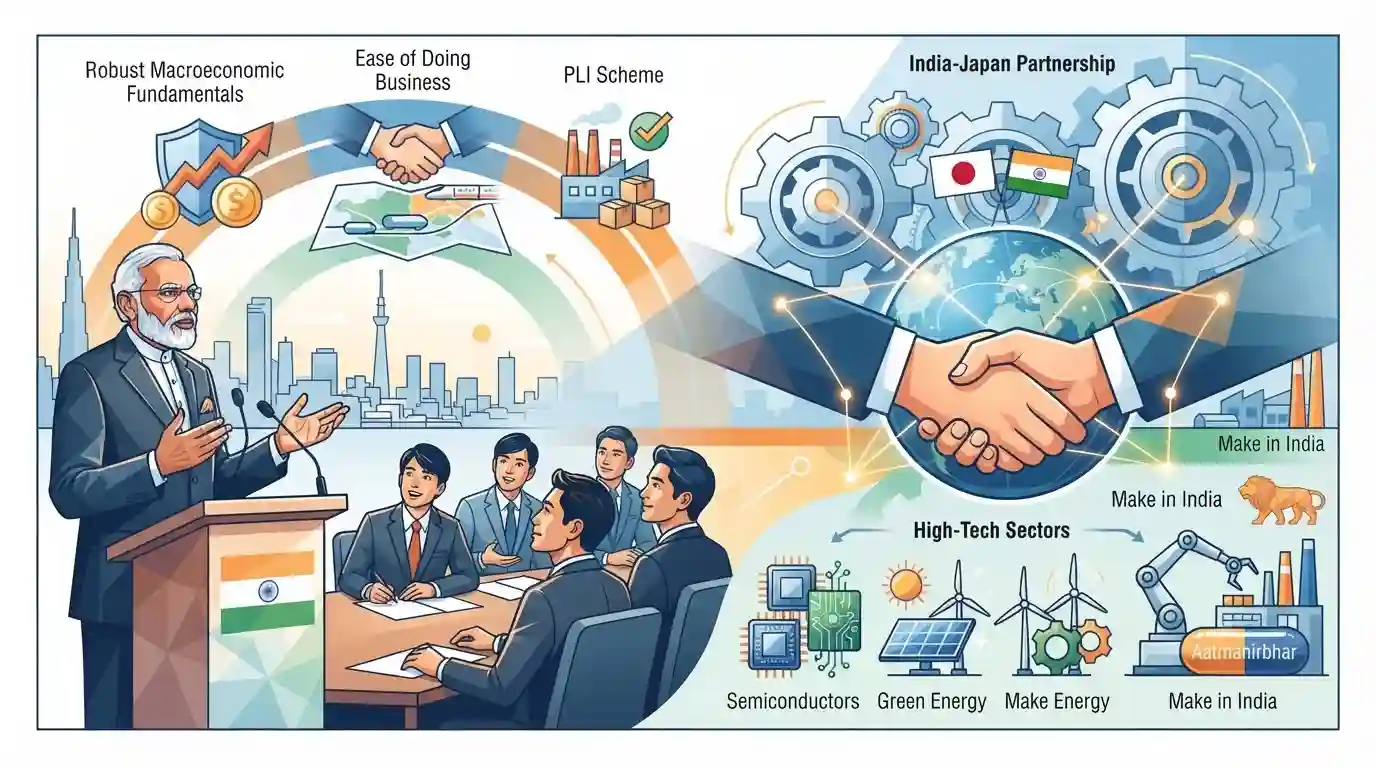
Commerce and Industry Minister Piyush Goyal addressed the Japanese Business Federation (Keidanren) in Tokyo, advocating for deeper economic ties and increased bilateral investments. He highlighted India's robust macroeconomic fundamentals, improvements in the ease of doing business, and lucrative opportunities under the Production Linked Incentive (PLI) scheme. The Minister urged Japanese industries to partner with India to build resilient global supply chains, particularly in high-tech sectors like semiconductors and green energy, reinforcing the broader strategic and global partnership between the two nations.
মূল বিষয়
- Commerce and Industry Minister Piyush Goyal invited Japanese businesses to invest in India, leveraging initiatives like the PLI scheme and Make in India.
- Emphasized the strategic alignment between India and Japan for building resilient global supply chains.
- Highlighted India's stable macroeconomic environment, ease of doing business, and emerging opportunities in sectors like semiconductors and green technologies.
- Underscored the need to expand bilateral trade and economic cooperation under the broader India-Japan Special Strategic and Global Partnership.
প্রিলিমস ফাঁদ
The Supply Chain Resilience Initiative (SCRI) is a Quad-led initiative comprising India, Japan, Australia, and the US.
The SCRI is a trilateral initiative of India, Japan, and Australia. Despite being a Quad partner, the USA is not a member of SCRI.
সংযুক্ত স্থির ধারণা
What is the Supply Chain Resilience Initiative (SCRI) and its core objectives?
- Trilateral Origin: Launched in 2021 by India, Japan, and Australia in response to Indo-Pacific supply vulnerabilities.
- Key Objective: Aims to reduce heavy, concentrated dependency on any single manufacturing nation like China.
- Mechanisms: Promotes investment diversification, digital trade facilitation, and joint industrial infrastructure projects.
What is India-Japan CEPA and its structural trade challenges?
- Bilateral Trade Pact: A Comprehensive Economic Partnership Agreement implemented in 2011 covering goods, services, and investment rules.
- Trade Deficit: Despite zero-duty access for major tariff lines, India's trade deficit with Japan has steadily widened.
- Non-Tariff Barriers: Indian pharma and agricultural exports face stringent non-tariff barriers and phytosanitary rules in Japan.
আন্তঃবিষয় প্যাটার্ন
Green Hydrogen + Indo-Pacific Supply Chains
India's National Green Hydrogen Mission leverages Japanese technology capital via SCRI to build resilient, domestic alternative energy hardware manufacturing hubs.
Semiconductor Diplomacy under Quad Framework
The India-Japan semiconductor MoU complements the Quad’s Critical Technology Agenda, diversifying supply chain dependencies away from high-risk East Asian choke points.

Multi-statement questions on India-Japan relations will likely test the exclusions in SCRI membership and bilateral CEPA performance.
সংযুক্ত PYQ · 2
সংযুক্ত PYQ · 2
- 2019MainsGS2
‘The time has come for India and Japan to build a strong contemporary relationship, one involving global and strategic partnership that will have a great significance for Asia and the world as a whole.’ Comment.
- 2025MainsGS3
Discuss the rationale of the Production Linked Incentive (PLI) scheme. What are its achievements? In what way can the functioning and outcomes of the scheme be improved?
