Election Commission Revamps Electoral Literacy Clubs for Youth
Source:PIB ↗
Why It Matters
This demonstrates the Election Commission of India's evolving strategies to ensure long-term democratic participation. It provides concrete examples (ELC 2.0, ECINet, SVEEP) that can be cited in Mains answers regarding electoral reforms, youth engagement, and the institutional role of the ECI in strengthening democratic values.
Summary
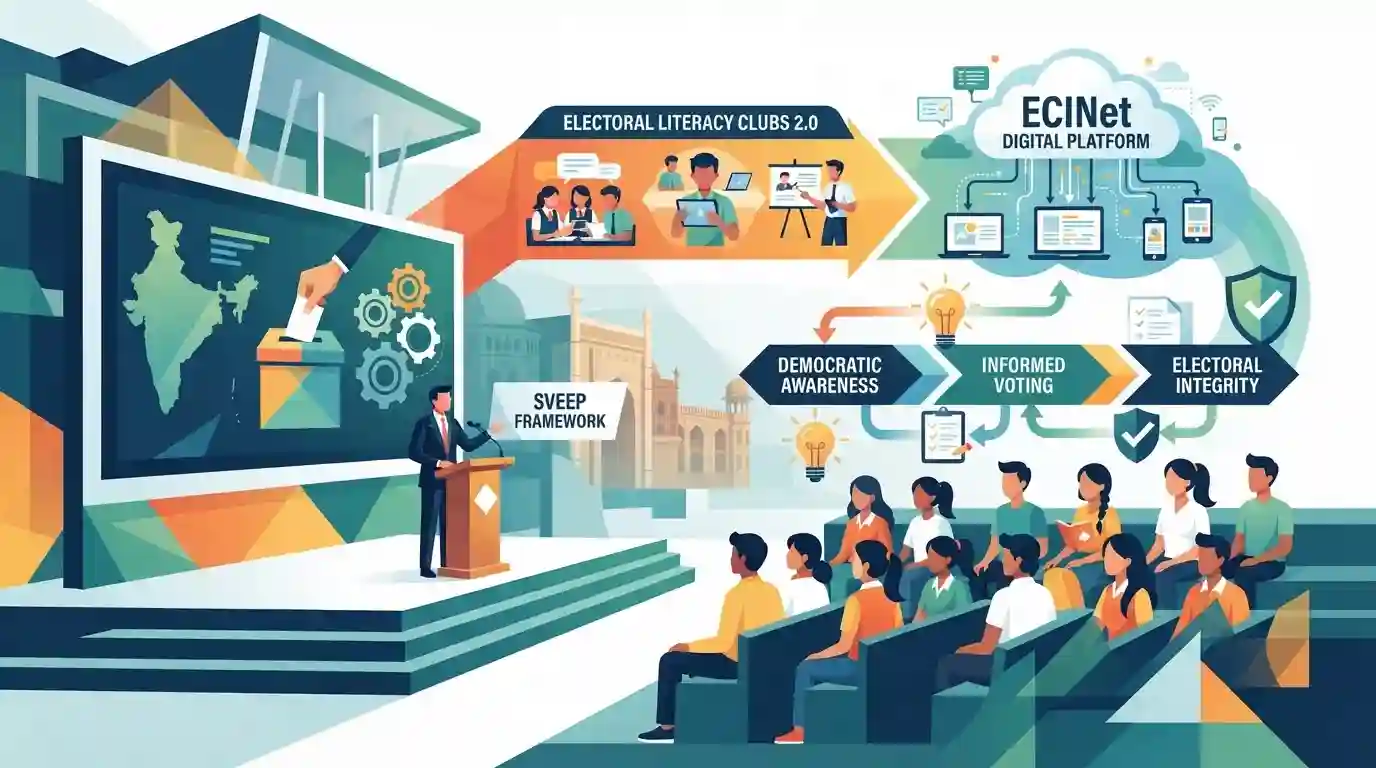
During a regional conference in Lucknow, Chief Election Commissioner Gyanesh Kumar highlighted the critical role of students in sustaining India's democracy. He announced the rollout of revamped Electoral Literacy Clubs (ELC 2.0) alongside the ECINet digital platform to institutionalize electoral education in schools and colleges. The initiative, part of the Systematic Voters' Education and Electoral Participation (SVEEP) framework, aims to foster continuous democratic awareness, promote informed voting, and educate young citizens about the transparency and integrity of the electoral system.
Key Points
- The ECI is revitalizing Electoral Literacy Clubs (ELC 2.0) to provide structured and digitally enabled electoral awareness in schools and colleges.
- The ECINet digital platform will support ELC 2.0 by providing accessible, engaging, and age-appropriate content for students.
- Chief Election Commissioner Gyanesh Kumar emphasized that youth participation is vital for strengthening the transparency and credibility of the world's largest democracy.
- The initiative shifts the focus from election-eve awareness campaigns to continuous, institutionalized civic education under the SVEEP framework.
- A regional conference in Lucknow convened electoral officers and education stakeholders to coordinate the rollout of ELC 2.0.
Important Terms
Electoral Literacy Clubs (ELC 2.0)

A revamped initiative by the ECI establishing structured, digitally enabled, year-round platforms in educational institutions to educate young citizens on democratic processes, voter registration, and electoral integrity.
UPSC context
GS Paper II (Polity/Elections): Tests knowledge of electoral reforms, citizen engagement, and strategies for promoting participatory democracy among youth.
ECINet
A comprehensive, unified digital platform launched by the ECI integrating over 40 election services to facilitate voter registration, real-time tracking, and seamless communication for citizens and officials.
UPSC context
GS Paper II (e-Governance): Explores technological interventions in election management, improving administrative transparency, and digitizing citizen services.
Systematic Voters’ Education and Electoral Participation (SVEEP)
The flagship voter education and literacy program launched by the ECI in 2009, designed to increase awareness and encourage informed, ethical, and universal participation in democratic elections.
UPSC context
GS Paper II (Elections & Polity): Essential for studying voter registration strategies, tackling youth apathy, and improving overall democratic turnout.
Election Commission of India (ECI)
An autonomous constitutional authority established under Article 324 of the Constitution of India, responsible for administering free, fair, and transparent national and state-level elections.
UPSC context
GS Paper II (Constitutional Bodies): Focuses on the structure, powers, independence, and critical role of the ECI in securing democratic governance.
Prelims Trap
Electoral Literacy Clubs (ELCs) are established in schools under a statutory framework managed by the Union Ministry of Education.
ELCs are not a statutory mandate of the Education Ministry; they are an informal, structured initiative established under the Election Commission of India's SVEEP program.
Static Concepts Connected
What is the constitutional and legal basis of the Right to Vote in India?
- Article 326: Guarantees universal adult suffrage, mandating that elections to the Lok Sabha and State Legislative Assemblies be based on adult franchise.
- Nature of Right: The Supreme Court has clarified that the right to vote is a constitutional and statutory right (under the Representation of the People Act, 1951), not a Fundamental Right.
- 61st Amendment (1988): Reduced the voting age from 21 to 18 years, expanding the demographic base of young voters.
What are the broad categories of powers exercised by the Election Commission of India?
- Administrative: Determining electoral constituencies (via Delimitation Commission), registering political parties, and preparing electoral rolls.
- Advisory: Advising the President or Governor on matters relating to the disqualification of sitting members of Parliament or State Legislatures.
- Quasi-Judicial: Acting as a court for settling disputes related to the recognition of political parties and the allotment of election symbols.
Cross-Topic Patterns
Civic engagement and the demographic dividend
India's youth bulge is frequently linked to economic outcomes, but the ECI highlights its political dimension—requiring institutionalized civic education (ELC 2.0) to actively counter urban and youth voter apathy.
ECINet and e-governance consolidation
The consolidation of 40+ ECI apps into the ECINet platform mirrors the broader e-governance push (like the UMANG app) to reduce digital fragmentation and enhance citizen participation.

Expect a multi-statement question fusing Article 326 (Right to Vote), the 61st Amendment, and ECI's non-statutory SVEEP initiative.
Linked PYQs · 4
Linked PYQs · 4
- 2022MainsGS2
Discuss the role of the Election Commission of India in the light of the evolution of the Model Code of Conduct.
- 2024MainsGS2
Examine the need for electoral reforms as suggested by various committees with particular reference to "one nation one election" principle.
- 2017MainsGS2
To enhance the quality of democracy in India the Election Commission of India has proposed electoral reforms in 2016. What are the suggested reforms and how far are they significant to make democracy successful?
- 2017PrelimsGS1
Consider the following statements: 1. The Election Commission of India is a five-member body. 2. Union Ministry of Home Affairs decides the election schedule for the conduct of both general elections and bye-elections. 3. Election Commission resolves the disputes relating to splits/mergers of recognised political parties. Which of the statements given above is/are correct?
