India Mauritius Administrative Reforms and E Governance Cooperation
Source:PIB ↗
ఇది ఎందుకు ముఖ్యం
Showcases practical examples of India's 'soft power' and 'Neighborhood First' policy through capacity-building assistance. It is highly relevant for GS Paper 2 answers on e-governance best practices, civil service reforms, and bilateral cooperation with Indian Ocean Island nations.
సారాంశం
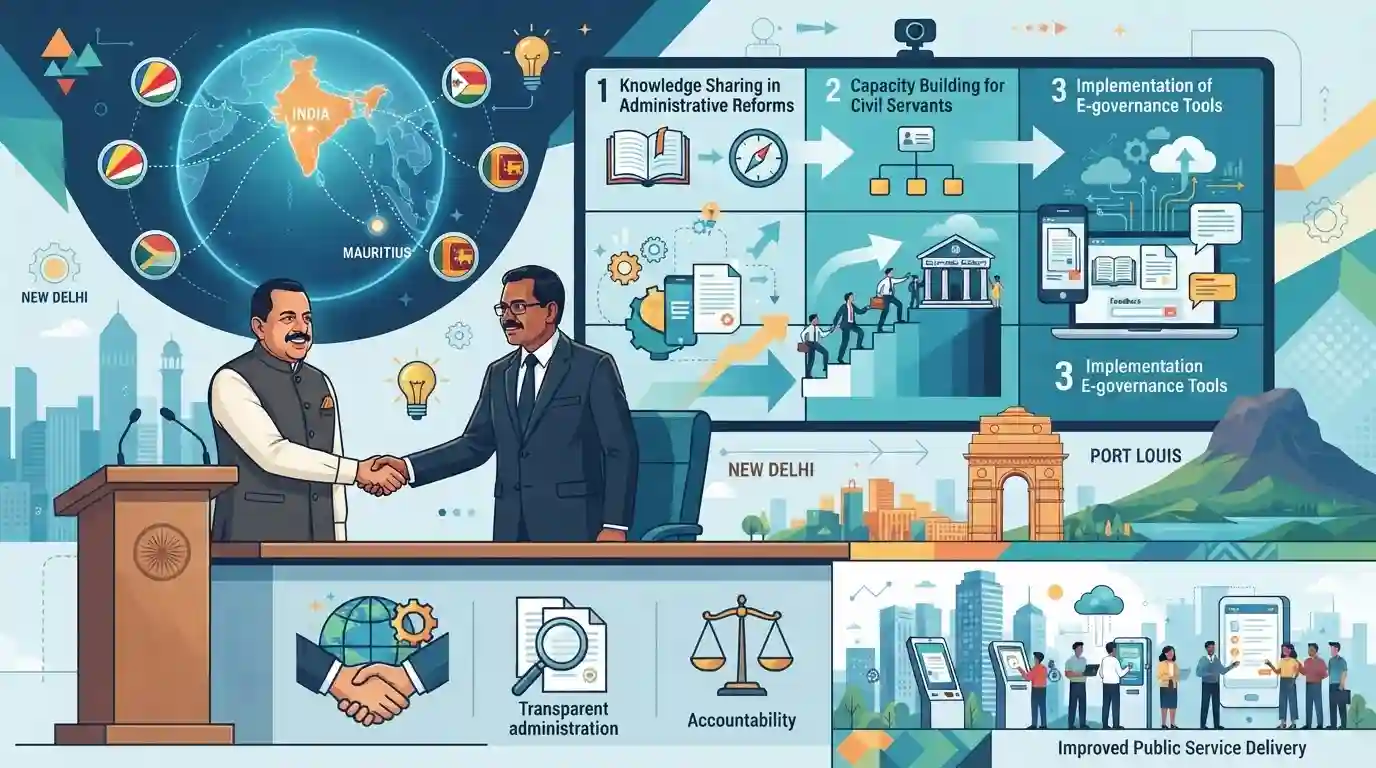
Mauritius Minister of Public Service and Administrative Reforms, Lutchmanah Raj Pentiah, met with India's Minister Dr. Jitendra Singh to strengthen bilateral cooperation in governance. The dialogue focused on knowledge-sharing in administrative reforms, capacity building for civil servants, and the implementation of e-governance tools to improve public service delivery. The collaboration emphasizes India's commitment to supporting administrative capacity building in partner nations, specifically within the Indian Ocean region and the broader Global South, further cementing historical and strategic bilateral ties.
ముఖ్య అంశాలు
- A bilateral meeting took place between India's Minister of State for Personnel, Public Grievances and Pensions and the Mauritius Minister of Public Service and Administrative Reforms.
- Discussions centered on sharing best practices in administrative reforms, e-governance, and public service delivery to enhance transparency and efficiency.
- India offered support in capacity building for Mauritian civil servants, potentially leveraging institutions like the National Centre for Good Governance (NCGG).
- The engagement highlights India's ongoing diplomatic strategy to assist Global South countries, particularly Indian Ocean neighbors, through institutional development and digital governance expertise.
ముఖ్యమైన పదాలు
Centralised Public Grievance Redress and Monitoring System (CPGRAMS)

A 24/7 web-enabled digital platform developed by NIC and DARPG, enabling citizens to lodge, track, and appeal grievances against government departments to ensure transparent and accountable public service delivery.
UPSC context
GS Paper 2 (E-governance, Transparency). Tests knowledge of digital platforms promoting citizen-centric governance and administrative accountability.
National Centre for Good Governance (NCGG)
An autonomous apex institution under DARPG, established in 2014. It focuses on policy research, governance reforms, and conducting capacity-building training for civil servants from India and other developing nations.
UPSC context
GS Paper 2 (Governance, Bilateral Relations). Highlights India's soft power and diplomacy via civil service capacity building for the Global South.
Department of Administrative Reforms and Public Grievances (DARPG)
The nodal agency under the Ministry of Personnel, Public Grievances and Pensions responsible for driving administrative reforms, citizen-centric e-governance policies, and overseeing public grievance redressal mechanisms in India.
UPSC context
GS Paper 2 (Role of Civil Services, Governance). Crucial for understanding the institutional frameworks that mandate administrative efficiency and grievance redressal.
ప్రిలిమ్స్ ఉచ్చు
The National Centre for Good Governance (NCGG) is a statutory body functioning under the Ministry of Home Affairs.
NCGG is an autonomous society, not a statutory body. Furthermore, it operates under the Ministry of Personnel, Public Grievances and Pensions (DARPG), not the Ministry of Home Affairs.
అనుసంధానమైన స్థిర భావనలు
What is the mandate and structure of the National Centre for Good Governance (NCGG)?
- Institutional Setup: An autonomous institute operating under the Department of Administrative Reforms and Public Grievances (DARPG), Ministry of Personnel, Public Grievances and Pensions.
- Origin: Traces its origin to the National Institute of Administrative Research (NIAR), which was established by LBSNAA in 1995.
- Global Role: Trains civil servants from India and developing nations, promoting South-South cooperation through shared administrative models and digital governance practices.
What is the core philosophy of Mission Karmayogi?
- Role-based training: Shifts civil service capacity building from a traditional 'rule-based' administrative approach to a dynamic 'role-based' continuous learning system.
- iGOT Platform: Utilizes the Integrated Government Online Training (iGOT) platform to deliver continuous, on-the-job, digital learning tailored to specific civil service competencies.
- Diplomatic Export: India is now exporting this architecture to partner nations (e.g., 'iGOT Karmayogi Mauritius') as a form of institutional diplomatic assistance.
అంతర-అంశ నమూనాలు
DPI as a Diplomatic Tool
Exporting platforms like iGOT and CPGRAMS shifts India's soft power strategy from traditional cultural diplomacy to digital governance leadership and capacity building in the Global South.
ITEC and SAGAR Synergy
Training Mauritian civil and defense personnel through the ITEC programme directly reinforces India’s SAGAR vision, securing its strategic footprint in the critical Indian Ocean Region.

The NCGG's nodal ministry and status, combined with Mission Karmayogi's foreign extensions, form a prime multi-statement Prelims target.
అనుసంధాన PYQలు · 4
అనుసంధాన PYQలు · 4
- 2024MainsGS2
e-governance is not just about the routine application of digital technology in service delivery process. It is as much about multifarious interactions for ensuring transparency and accountability. In this context evaluate the role of the 'Interactive Service Model' of e-governance.
- 2023MainsGS2
e-governance, as a critical tool of governance, has ushered in effectiveness, transparency and accountability in governments. What inadequacies hamper the enhancement of these features ?
- 2025MainsGS2
India-Africa digital partnership is achieving mutual respect, co-development and long-term institutional partnerships. Elaborate.
- 2017MainsGS2
Indian diaspora has an important role to play in South-East Asian countries' economy and society. Appraise the role of Indian diaspora in South-East Asia in this context.
