NCSK Marks Foundation Day Focusing on Mechanized Sanitation
Source:PIB ↗
हे का महत्त्वाचे आहे
Manual scavenging is a persistent social and human rights issue in India that intersects with caste-based discrimination, labor exploitation, and public health. Understanding legislative frameworks like the MS Act, 2013, institutions like the NCSK, and modern schemes like the NAMASTE scheme is highly crucial for questions related to vulnerable sections, governance, and technology-driven social welfare in GS2 and GS1.
सारांश
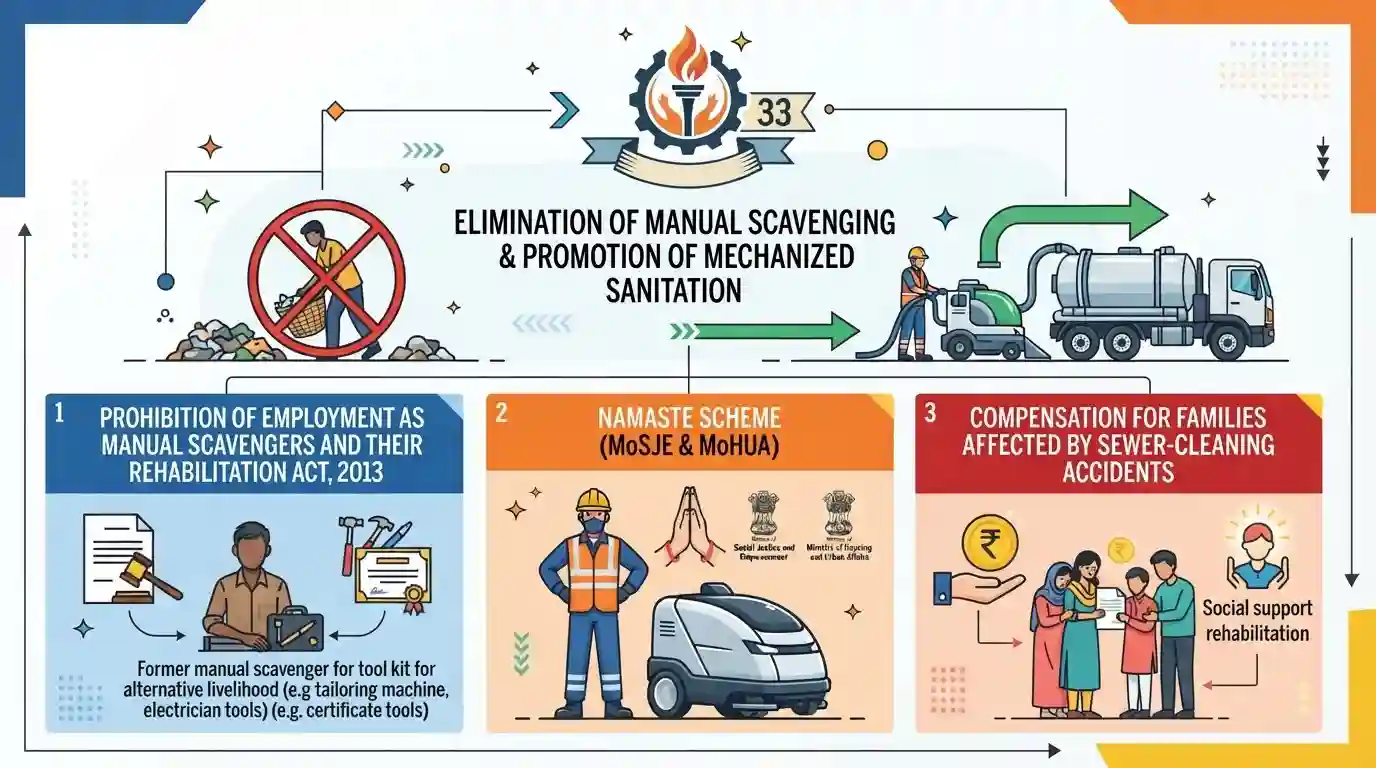
The National Commission for Safai Karamcharis (NCSK) marked its 33rd Foundation Day with an event emphasizing the elimination of manual scavenging and the promotion of mechanized sanitation in India. Highlighted initiatives include the Prohibition of Employment as Manual Scavengers and their Rehabilitation Act, 2013, the joint MoSJE and MoHUA NAMASTE Scheme, and the ongoing efforts to compensate families affected by sewer-cleaning accidents.
मुख्य मुद्दे
- The National Commission for Safai Karamcharis (NCSK) celebrated its 33rd Foundation Day, reaffirming its commitment to the safety, dignity, and socio-economic empowerment of sanitation workers.
- A central goal highlighted at the event is the 100% elimination of hazardous manual cleaning of sewers and septic tanks, driving a transition towards fully mechanized sanitation systems.
- Out of 1,377 identified sewer and septic tank death cases across India, the government has successfully disbursed compensation to 1,223 families.
- The Prohibition of Employment as Manual Scavengers and their Rehabilitation Act, 2013 (MS Act, 2013) serves as the primary legal framework banning hazardous cleaning and expanding the mandate of the NCSK to monitor its implementation.
- The NAMASTE Scheme (National Action for Mechanised Sanitation Ecosystem)—a joint initiative of MoSJE and MoHUA—is being actively promoted to provide sanitation workers with safety gear, training, mechanized tools, and alternative livelihood opportunities.
महत्त्वाच्या संज्ञा
National Commission for Safai Karamcharis

A non-statutory body under the Ministry of Social Justice and Empowerment that monitors schemes, investigates grievances, and advises the government on the welfare of sanitation workers (Safai Karamcharis).
UPSC context
GS Paper II (Polity & Governance); tests understanding of executive bodies and welfare of vulnerable groups.
NAMASTE Scheme
A Central Sector joint initiative of MoSJE and MoHUA aiming to achieve zero fatalities in sanitation work by promoting mechanized cleaning of sewers and septic tanks and rehabilitation of workers.
UPSC context
GS Paper II (Social Justice & Schemes); tests knowledge of central interventions for marginalized communities.
Prohibition of Employment as Manual Scavengers and their Rehabilitation Act, 2013
An Indian legislation that completely bans manual scavenging, outlaws hazardous cleaning of sewers and septic tanks without protective gear, and provides for the mandatory rehabilitation of affected workers.
UPSC context
GS Paper II (Social Justice); tests legal frameworks protecting marginalized sanitation communities and Article 17.
National Commission for Safai Karamcharis Act, 1993
The initial parliamentary legislation that established the NCSK as a statutory body in 1994. The Act lapsed in February 2004, causing the commission to become non-statutory.
UPSC context
GS Paper II (Polity & Statutory Bodies); tests history and evolution of human rights institutions in India.
Ministry of Social Justice and Empowerment
The nodal Union Ministry responsible for welfare, social justice, and empowerment of disadvantaged sections, including Scheduled Castes, OBCs, persons with disabilities, and senior citizens.
UPSC context
GS Paper II (Governance & Welfare); tests knowledge of structures and ministries targeting socio-economic inequalities.
पूर्वपरीक्षा सापळा
The National Commission for Safai Karamcharis is a permanent statutory body possessing civil court powers to summon officers.
Aspirants assume NCSK is still a statutory body because of its name and its role in the MS Act, or confuse its powers with the NCSC.
संबंधित स्थिर संकल्पना
Constitutional vs Non-Statutory commissions: NCSC vs NCSK
- Constitutional basis: NCSC is established under Article 338 of the Constitution, granting it permanent status and civil court powers to investigate violations.
- Executive status: NCSK's original statutory act lapsed in 2004; it currently functions as a non-statutory body extended periodically through cabinet resolutions.
- Power differential: Unlike NCSC/NCST, NCSK lacks civil court powers but holds a statutory monitoring mandate specifically under Section 31 of the MS Act, 2013.
What are the key definitions and exceptions under the MS Act, 2013?
- Conditional exclusion: Persons using appropriate protective gear and mechanized cleaning devices as notified by government rules are excluded from the definition of a "manual scavenger".
- Sewer/Septic cleaning: The Act strictly prohibits hazardous cleaning of sewers and septic tanks without protective gear and safety equipment.
- Rehabilitation: Includes provisions for one-time cash assistance, scholarship for children, and alternative livelihood training for identified manual scavengers.
आंतर-विषय नमुने
Mechanized Sanitation + Urban Local Bodies
Links the NAMASTE scheme's 100% mechanization goal to the fiscal and functional capacity of Municipal Corporations under the 74th Constitutional Amendment Act.
Waste Pickers + Circular Economy
Connecting the 2024 expansion of the NAMASTE scheme to Solid Waste Management Rules, merging environmental recycling goals with informal labor social security.

Expect a GS-2 statement testing the non-statutory nature of NCSK, its lack of civil court powers, and the protective gear legal exception.
संबंधित PYQ · 2
संबंधित PYQ · 2
- 2016PrelimsGS1
'Rashtriya Garima Abhiyaan' is a national campaign to
- 2019MainsGS2
Performance of welfare schemes that are implemented for vulnerable sections is not so effective due to absence of their awareness and active involvement at all stages of policy process. Discuss.
