National Conclave on Tribal Languages and Museums Held in Mysuru
Source:PIB ↗
ఇది ఎందుకు ముఖ్యం
Tribal studies regularly feature in UPSC GS Paper 1 (Art & Culture, Modern History, and Social Issues) and GS Paper 2 (Welfare of Vulnerable Sections). This conclave connects institutional efforts to safeguard tribal heritage (museums and languages) with socio-educational empowerment (NEP 2020) and historical recognition of tribal resistance movements, making it a critical current affairs update.
సారాంశం
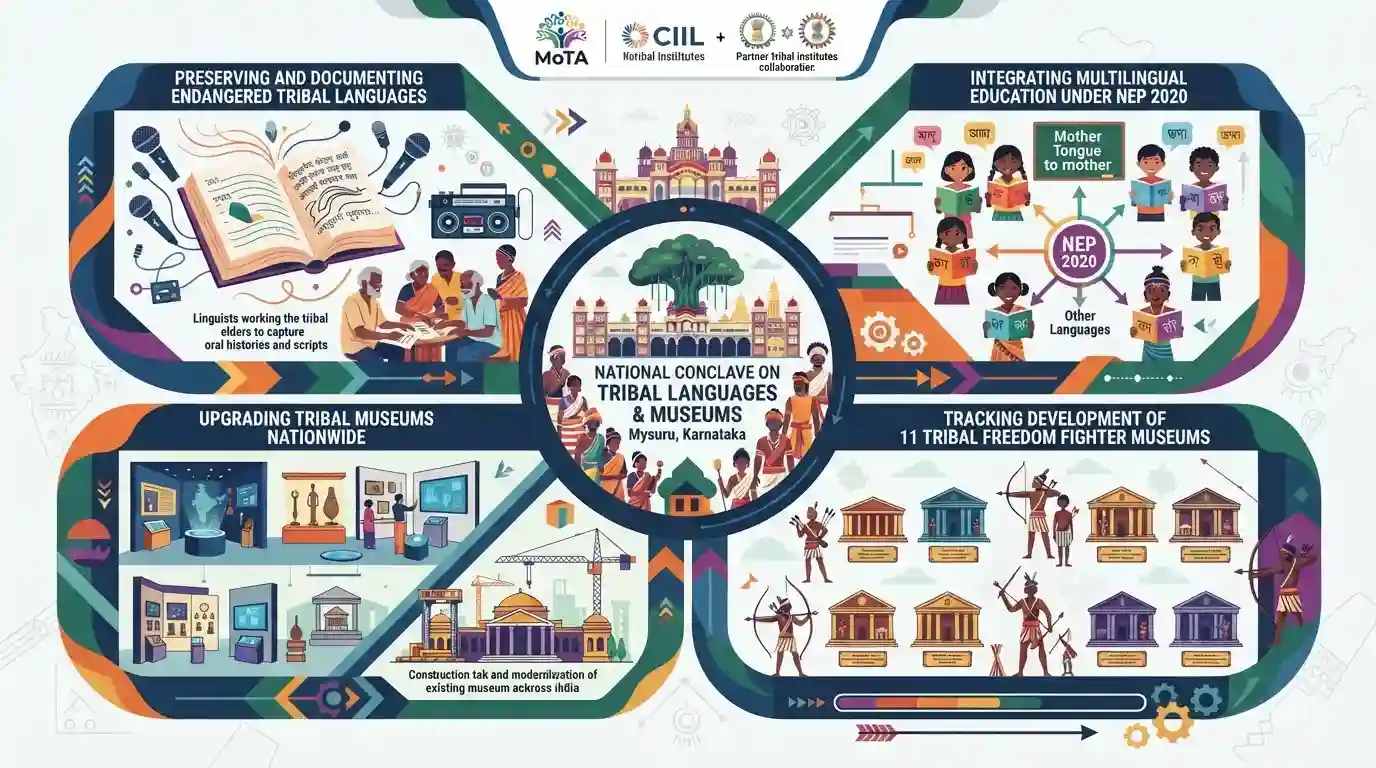
The Ministry of Tribal Affairs (MoTA) is organizing a three-day National Conclave on Tribal Languages & Museums in Mysuru, Karnataka, in collaboration with the Central Institute of Indian Languages (CIIL) and other tribal institutes. The conclave serves as a platform to formulate strategies for preserving and documenting endangered tribal languages, integrating multilingual education under NEP 2020, upgrading tribal museums nationwide, and tracking the development of 11 Tribal Freedom Fighter Museums to honor tribal leaders.
ముఖ్య అంశాలు
- The National Conclave on Tribal Languages & Museums is being organized in Mysuru, Karnataka, to address the documentation, preservation, and revitalization of India's diverse tribal languages.
- A key focus is aligning tribal education with the National Education Policy (NEP) 2020 by promoting Multilingual Education (MLE) using mother-tongues/local dialects to reduce high dropout rates in tribal schools.
- The conclave highlights technology integration, including the development of digital language archives, interactive chatbots, and the 'Adi Vaani' portal to document endangered languages (especially of PVTGs).
- It reviews the progress of the 11 sanctioned Tribal Freedom Fighter Museums (TFFMs) across the country to celebrate the historic contributions of unsung tribal heroes to India's freedom struggle.
- The event emphasizes upgrading existing tribal museums through interactive curation and digitization to preserve both tangible and intangible tribal heritage (folklore, art, ethno-medicine, and traditional tools).
- It aims to safeguard the Traditional Knowledge Systems (TKS) of tribals, particularly their ecological wisdom and sustainable agricultural/medicinal practices, protecting them from biopiracy.
ముఖ్యమైన పదాలు
Tribal Freedom Fighter Museums Scheme

A Ministry of Tribal Affairs scheme establishing 11 nationwide museums to honor tribal leaders' roles in India's independence. They function as vibrant centers for storytelling, cultural preservation, and community-rooted heritage representation.
UPSC context
GS-I (Modern History/Culture). Highlights tribal uprisings (like Birsa Munda's) and institutionalizes the recognition of unsung indigenous freedom fighters.
Adi Vaani
India's first AI-powered translator tool for tribal languages (e.g., Gondi, Bhili, Santali), launched by the Ministry of Tribal Affairs. It digitizes folklore and facilitates education, healthcare, and civic access in native languages.
UPSC context
GS-II (Tribal Welfare) & GS-III (Technology). Tests the use of Artificial Intelligence for inclusive governance and safeguarding endangered linguistic heritage.
Central Institute of Indian Languages (CIIL)
A Mysuru-based institute under the Ministry of Education, established in 1969. It coordinates the development of Indian languages, protects endangered tribal languages, and facilitates multilingual education and language policy implementation.
UPSC context
GS-I (Art & Culture) & GS-II (Education). Important for questions on institutional mechanisms for linguistic diversity and classical language promotion.
Tribal Research Institutes (TRIs)
State-level academic and research bodies supported by the Ministry of Tribal Affairs. They document indigenous cultures, evaluate welfare schemes, and act as advisory nodes for tribal policy planning and heritage preservation.
UPSC context
GS-II (Governance/Social Justice). Tests the institutional capacity for evidence-based policymaking and safeguarding the socio-cultural rights of Scheduled Tribes.
National Education Policy (NEP) 2020
India's overarching educational framework that mandates foundational learning in the mother tongue or local language. In tribal contexts, it emphasizes multilingual education, integrating indigenous knowledge systems to bridge early learning gaps.
UPSC context
GS-II (Education). Highly relevant for addressing drop-out rates among vulnerable sections and promoting inclusive, culturally rooted pedagogy.
ప్రిలిమ్స్ ఉచ్చు
The Central Institute of Indian Languages (CIIL) is an administrative body under the Ministry of Tribal Affairs.
CIIL was established in 1969 and operates under the Language Bureau of the Ministry of Education, not the Ministry of Tribal Affairs.
అనుసంధానమైన స్థిర భావనలు
What is the significance of Article 275(1) of the Constitution regarding tribal development?
- Statutory Grants: Article 275(1) mandates statutory grants-in-aid from the Consolidated Fund of India to states for tribal welfare and promoting administration of Scheduled Areas.
- Proviso Clause: The proviso specifically earmarks funds for schemes approved by the Central Government to raise administration standards of Scheduled Areas.
Who were Shaheed Veer Narayan Singh and Ramji Gond in India's anti-colonial struggle?
- Veer Narayan Singh: Binjwar tribal leader from Chhattisgarh who redistributed looted grain during the 1856 famine and led an armed resistance in the 1857 Revolt.
- Ramji Gond: Led a combined Gond and Rohilla rebellion in 1860 against British colonial expansion and Nizam's oppression in the Adilabad region.
అంతర-అంశ నమూనాలు
AI Technology + Linguistic Preservation
Using AI portals like Adi Vaani integrates digital technology with Article 350A, showcasing how modern deep learning can preserve indigenous oral traditions.
NEP 2020 + Tribal Dropouts
Multilingual education using native dialects solves the primary linguistic barrier in early learning, directly addressing high dropout rates in Scheduled Areas.

Match-the-following questions pairing unsung tribal leaders (e.g., Ramji Gond, Veer Narayan Singh) with their regions are highly probable.
అనుసంధాన PYQలు · 3
అనుసంధాన PYQలు · 3
- 2021MainsGS1
Examine the uniqueness of tribal knowledge system when compared with mainstream knowledge and cultural systems.
- 2023MainsGS1
How did the colonial rule affect the tribals in India and what was the tribal response to the colonial oppression?
- 2021PrelimsGS1
With reference to India, the terms 'Halbi, Ho and Kui' pertain to
