GRSE and YIL Expansion Projects Boost Defence Self-Reliance
Source:PIB ↗
हे का महत्त्वाचे आहे
The article addresses the strategic push for defence self-reliance and industrial expansion. The concept of the 'Capacity Paradox' in global shipbuilding highlights a critical opportunity for India to build robust MRO and shipbuilding infrastructure, directly aligning with GS3 topics on industrial policies, infrastructure development, and indigenization of defence technology.
सारांश
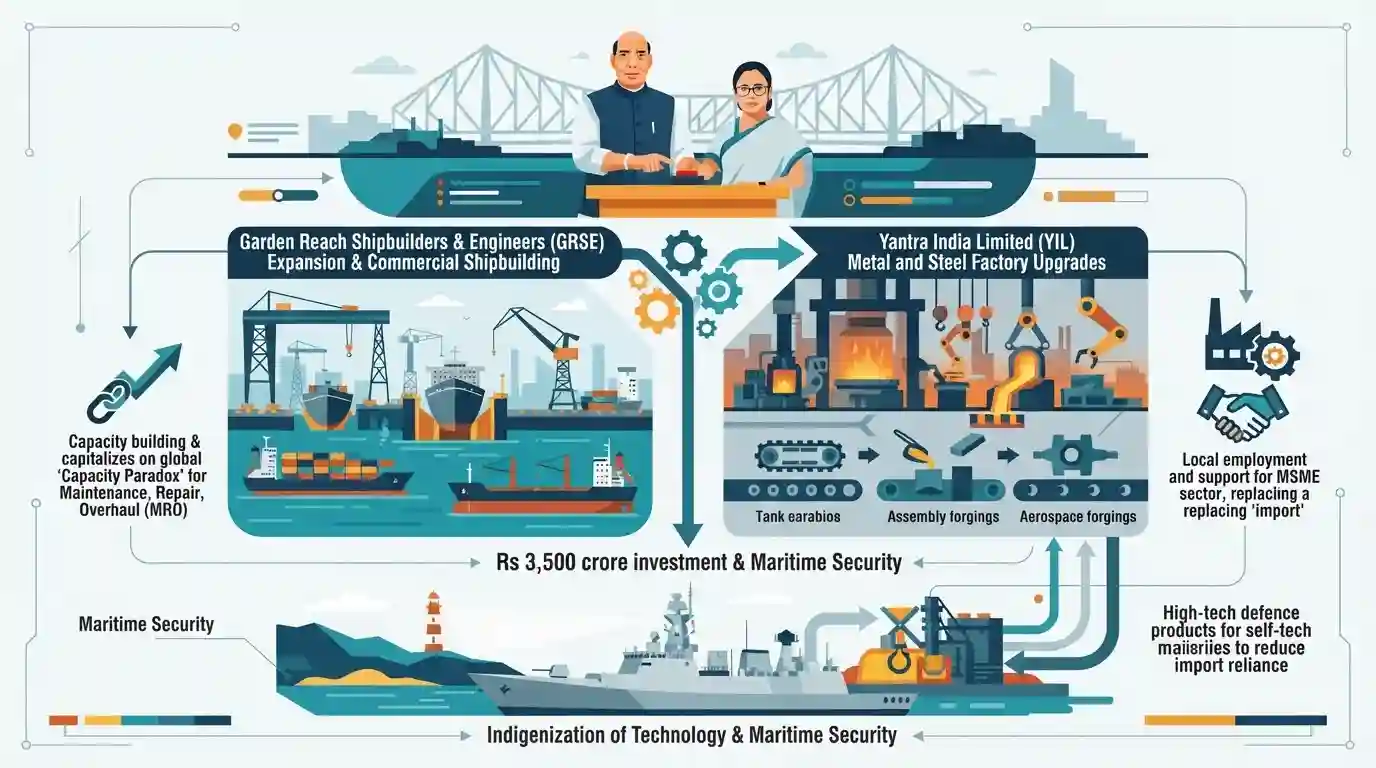
Raksha Mantri Rajnath Singh and West Bengal Chief Minister Mamata Banerjee launched Rs 3,500 crore expansion projects for Garden Reach Shipbuilders & Engineers (GRSE) and Yantra India Limited (YIL) in Kolkata. These projects aim to bolster India's shipbuilding and metallurgical capabilities, aligning with the vision of an 'Aatmanirbhar Bharat'. The expansion seeks to capitalize on the global 'Capacity Paradox' by transforming India into a prominent hub for commercial shipbuilding, maintenance, and repair (MRO). Concurrently, enhancements at YIL's Metal and Steel Factory will promote the indigenous manufacturing of critical defence forgings, reducing import reliance while stimulating local employment and the MSME sector.
मुख्य मुद्दे
- Expansion projects worth Rs 3,500 crore were launched for GRSE and YIL in West Bengal to boost India's shipbuilding, ship repair, and metallurgical capacities.
- The initiative aims to address the global 'Capacity Paradox', capitalizing on the declining capacity of traditional shipbuilding nations amidst rising global demand for vessels.
- GRSE's facility expansions at Raichak, Kidderpore, and Shalimar aim to build next-generation warships and establish India as a commercial shipbuilding and MRO (Maintenance, Repair, and Overhaul) hub.
- YIL's expansion at the Metal and Steel Factory (MSF) in Ishapore will enable the indigenous manufacturing of guns, ammunition, and heavy defence forgings, significantly reducing import dependence.
- The projects are expected to generate substantial employment, empower MSMEs, save foreign exchange, and strengthen self-reliance in strategic and critical sectors.
महत्त्वाच्या संज्ञा
Capacity Paradox

The gap in the global shipbuilding sector where rising demand for naval and commercial vessels meets declining manufacturing and repair capacity in traditional shipbuilding nations.
UPSC context
Relevant for GS-3 (Economy/Infrastructure/Maritime Security), highlighting India's opportunity to become a global hub for shipbuilding and MRO.
Yantra India Limited (YIL)
A major Defence Public Sector Undertaking (DPSU) formed from the Ordnance Factory Board in 2021. It produces ammunition hardware, metal, steel components, and equipment for the Indian Armed Forces.
UPSC context
Important for GS-3 (Defence Manufacturing/Indigenisation), demonstrating India's structural reforms in defence production and export capabilities.
Garden Reach Shipbuilders & Engineers (GRSE)
A Miniratna Defence PSU and major shipbuilder under the Ministry of Defence, manufacturing and repairing warships, commercial vessels, and equipment for the maritime forces.
UPSC context
Key for GS-3 (Defence Indigenisation), showcasing India's efforts toward self-reliance in maritime security and naval infrastructure.
Make in India
A flagship government initiative launched in 2014 to boost domestic manufacturing, attract foreign investment, and position India as a global manufacturing hub.
UPSC context
Critical for GS-3 (Indian Economy/Industrial Policy), focusing on job creation, economic growth, and the shift toward domestic production.
Aatmanirbhar Bharat
An Indian government policy aiming for economic self-reliance by reducing import dependence and strengthening domestic capabilities across critical sectors like defence and technology.
UPSC context
Essential for GS-2 and GS-3, frequently tested in essays and questions on strategic autonomy and national economic resilience.
पूर्वपरीक्षा सापळा
"GRSE's mandate is exclusively restricted to constructing and repairing vessels for the Indian Navy and Coast Guard."
GRSE is actively expanding into commercial shipbuilding and global Maintenance, Repair, and Overhaul (MRO) to capitalize on the worldwide 'Capacity Paradox', not just military vessels.
संबंधित स्थिर संकल्पना
What was the strategic rationale behind the 2021 corporatisation of the Ordnance Factory Board (OFB)?
- Enhanced Autonomy: Transformed a subordinate government department into 100% government-owned corporate entities (DPSUs) to improve independent decision-making and operational efficiency.
- Competitiveness & Accountability: Designed to resolve legacy issues of poor quality control and delayed delivery timelines by enforcing strict corporate accountability.
- Specialized DPSUs: The 41 legacy factories were consolidated into seven specialized DPSUs (including Yantra India Limited) to focus on distinct defence manufacturing verticals.
How is India positioning itself to become a global maritime MRO hub?
- Maritime India Vision 2030: Targets making India a top-tier destination for ship repair by upgrading shipyard infrastructure and clustering allied maritime industries.
- Leveraging Capacity Paradox: Exploits the declining physical construction capacity in traditional Western maritime nations by offering lower labor costs and modern dry docks.
- Policy Incentives: Grants infrastructure status to shipyards and rationalizes GST on repair services to lower capital costs and attract foreign commercial vessels.
आंतर-विषय नमुने
Defence DPSUs & MSME indigenization
The transformation of OFB into entities like YIL is frequently tested alongside initiatives like SRIJAN and GAINS, highlighting how major DPSUs integrate MSMEs into the strategic supply chain.
Riverine ports & shipbuilding geography
Kolkata's shipyard expansions (Kidderpore, Raichak) link to geography questions on Hooghly's riverine port challenges, specifically the reliance on continuous dredging to maintain navigable draughts for large vessels.

The 'Capacity Paradox' in shipbuilding and structural outcomes of the OFB corporatisation are prime targets for an Economy-Defence MCQ.
संबंधित PYQ · 4
संबंधित PYQ · 4
- 2014MainsGS3
Foreign Direct Investment (FDI) in the defence sector is now set to be liberalized. What influence this is expected to have on Indian defence and economy in the short and long run?
- 2023MainsGS3
Faster economic growth requires increased share of the manufacturing sector in GDP, particularly of MSMEs. Comment on the present policies of the Government in this regard.
- 2025MainsGS3
Why is maritime security vital to protect India's sea trade? Discuss maritime and coastal security challenges and the way forward.
- 2022MainsGS3
What are the maritime security challenges in India ? Discuss the organisational, technical and procedural initiatives taken to improve the maritime security.
