Commerce Minister Leads Business Delegation to Deepen IndiaJapan Ties
Source:PIB ↗
ఇది ఎందుకు ముఖ్యం
Japan is a cornerstone of India's strategic and economic architecture in the Indo-Pacific. Accelerating industrial cooperation, securing FDI in semiconductors, and establishing resilient supply chains are pivotal for India's economic security, make it a recurring theme in both GS2 (Bilateral Relations) and GS3 (Economy & High-Technology Manufacturing).
సారాంశం
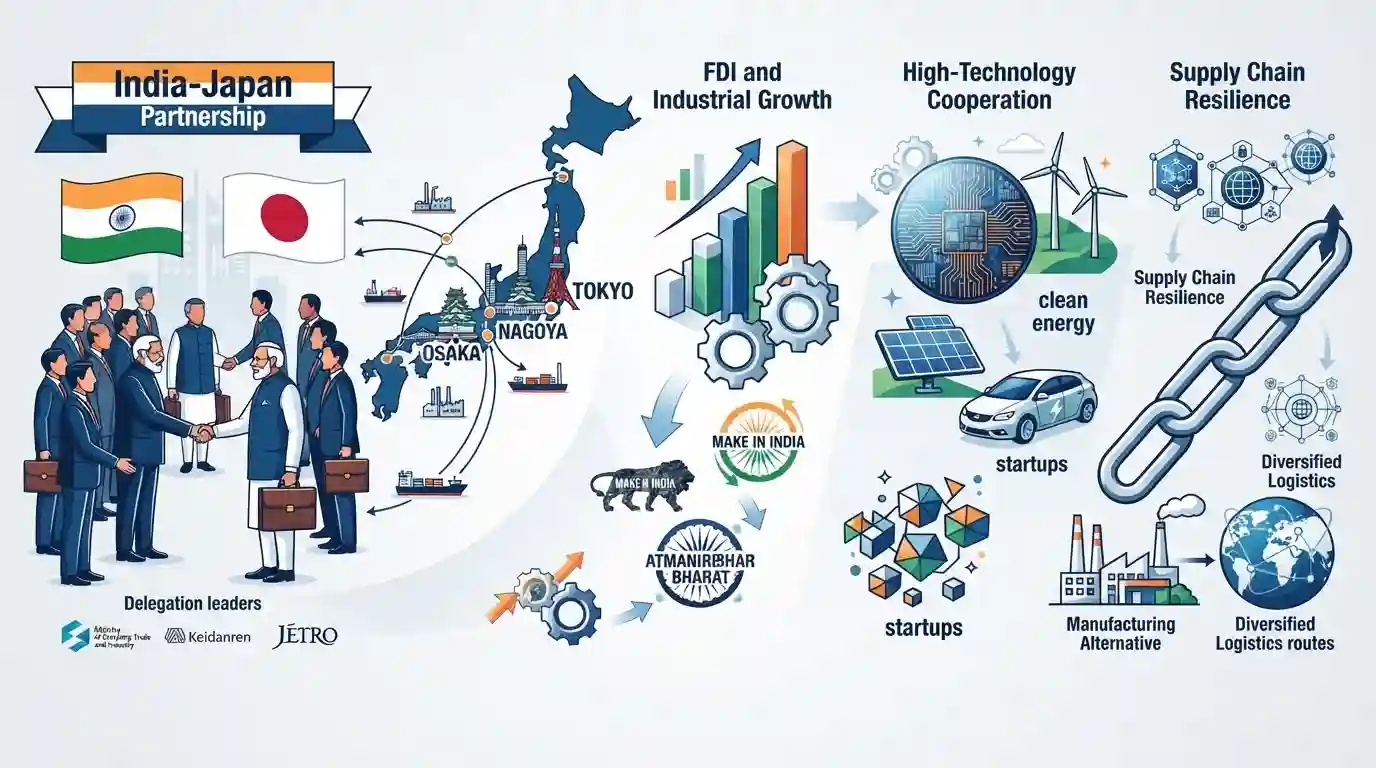
Union Minister for Commerce and Industry Shri Piyush Goyal is leading a landmark 200-member business delegation to Japan to bolster the India-Japan Special Strategic and Global Partnership. Covering the major industrial hubs of Tokyo, Osaka, and Nagoya, the delegation is focusing on increasing bilateral trade, attracting Japanese FDI, and strengthening high-technology cooperation in areas like semiconductors, clean energy, electric vehicles, and startups. Key interactions with the Japanese Ministry of Economy, Trade and Industry (METI), Keidanren, and JETRO aim to pitch India as a highly resilient, reliable manufacturing and supply chain alternative under the Make in India and Atmanirbhar Bharat initiatives.
ముఖ్య అంశాలు
- Union Minister Piyush Goyal leads a robust 200-member business delegation to Japan, covering key industrial hubs including Tokyo, Nagoya, and Osaka.
- The delegation aims to deepen the India-Japan Special Strategic and Global Partnership through targeted trade and investment discussions.
- Core collaboration areas include high-technology manufacturing, specifically semiconductor supply chains, clean energy (such as green hydrogen and solar), electric vehicles (EVs), steel, and digital startups.
- The visit features bilateral dialogues with the Japanese Minister of Economy, Trade and Industry (METI) and major business chambers like Keidanren and JETRO.
- India is pitched as a resilient alternative for global supply chains, aligning with the objectives of Atmanirbhar Bharat, Make in India, and the India Semiconductor Mission.
- Discussions also highlight the facilitation of skilled labor mobility under the Specified Skilled Workers (SSW) and Technical Intern Training Program (TITP) frameworks.
ముఖ్యమైన పదాలు
Special Strategic and Global Partnership

The highest tier of India-Japan bilateral relations, established in 2014. It encompasses deep cooperation across defense, high technology, and economic growth to ensure peace and prosperity in the Indo-Pacific.
UPSC context
GS Paper 2 (IR). Essential for understanding India's strategic alignments and its Indo-Pacific foreign policy framework.
Supply Chain Resilience Initiative (SCRI)
A 2021 trilateral pact by India, Japan, and Australia to diversify global supply chains, reduce dependence on China, and ensure sustainable economic growth across the Indo-Pacific region.
UPSC context
GS Paper 2 & 3. Key to Indo-Pacific geoeconomics, Quad-related economic strategies, and global trade resilience.
India-Japan Industrial Competitiveness Partnership (IJICP)
A bilateral framework launched to boost India's manufacturing capabilities and attract Japanese FDI. It uses sector-specific working groups to enhance industrial cooperation, infrastructure, and supply chain efficiency.
UPSC context
GS Paper 2 & 3. Showcases concrete bilateral steps to drive Make in India and foreign direct investment.
Specified Skilled Workers (SSW)
A Japanese residency status allowing certified foreign nationals, including Indians under a 2021 bilateral agreement, to work in specific industrial sectors facing labor shortages without needing a professional degree.
UPSC context
GS Paper 2 (Indian Diaspora). Important for topics on cross-border labor mobility and demographic dividends.
Atmanirbhar Bharat
India's flagship initiative for economic self-reliance. It focuses on strengthening domestic manufacturing, creating resilient supply chains, and reducing import dependency while maintaining active engagement with the global economy.
UPSC context
GS Paper 3 (Economy). The fundamental policy framework underlying India's industrial growth and global supply chain integration.
ప్రిలిమ్స్ ఉచ్చు
The Supply Chain Resilience Initiative (SCRI) is a Quad-led framework that includes the United States, India, Japan, and Australia.
While all three SCRI participants (India, Japan, Australia) are Quad members, the United States is NOT a member of SCRI. Aspirants often mistake SCRI for a full Quad-led initiative.
అనుసంధానమైన స్థిర భావనలు
What is the India-Japan CEPA and how does it function?
- Broad Scope: Signed in 2011, it is a comprehensive bilateral agreement covering trade in goods, services, investment, intellectual property rights, and custom procedures.
- Rules of Origin: It features stringent rules of origin to prevent third-party trade diversion (e.g., routing Chinese goods through Japan to exploit lower tariffs).
- Asymmetric Tariffs: Japan was granted immediate tariff elimination on steel and machinery components, while India gained preferential access for pharmaceuticals and textiles.
What are the TITP and SSW frameworks for labor mobility?
- TITP Role: Launched to transfer technical skills from Japan to developing countries like India through structured, on-the-job internship programs lasting up to five years.
- SSW Status: A bilateral status created in 2019 to address Japan's severe labor shortages by employing skilled foreign workers who pass professional and Japanese language tests.
అంతర-అంశ నమూనాలు
Supply chain de-risking as geopolitics
Trilateral mechanisms like SCRI (India-Japan-Australia) demonstrate how trade diversification is utilized as a geopolitical strategy to reduce economic dependency on China without forming explicit military blocs.
Semiconductor diplomacy and domestic manufacturing
Bilateral semiconductor partnerships with Quad nations (US, Japan) directly augment the domestic India Semiconductor Mission, transforming technology supply chains into core diplomatic leverage.

Multi-statement questions likely to test the structural difference between SCRI (trilateral) and Quad, alongside India-Japan Clean Energy targets.
అనుసంధాన PYQలు · 2
అనుసంధాన PYQలు · 2
- 2019MainsGS2
‘The time has come for India and Japan to build a strong contemporary relationship, one involving global and strategic partnership that will have a great significance for Asia and the world as a whole.’ Comment.
- 2025MainsGS3
India aims to become a semiconductor manufacturing hub. What are the challenges faced by the semiconductor industry in India? Mention the salient features of the India Semiconductor Mission.
