Growth of Indian Space Startups Following Sector Privatization Reforms
Source:PIB ↗
Why It Matters
This interaction highlights the transformative outcomes of India's space sector reforms. It provides concrete examples of indigenous technological advancements by private startups (e.g., Skyroot, space debris removal, space pharma) and their socio-economic applications. This aligns closely with the UPSC syllabus on 'Indigenization of technology', 'Awareness in the field of Space', and 'Science and Technology in everyday life.'
Summary
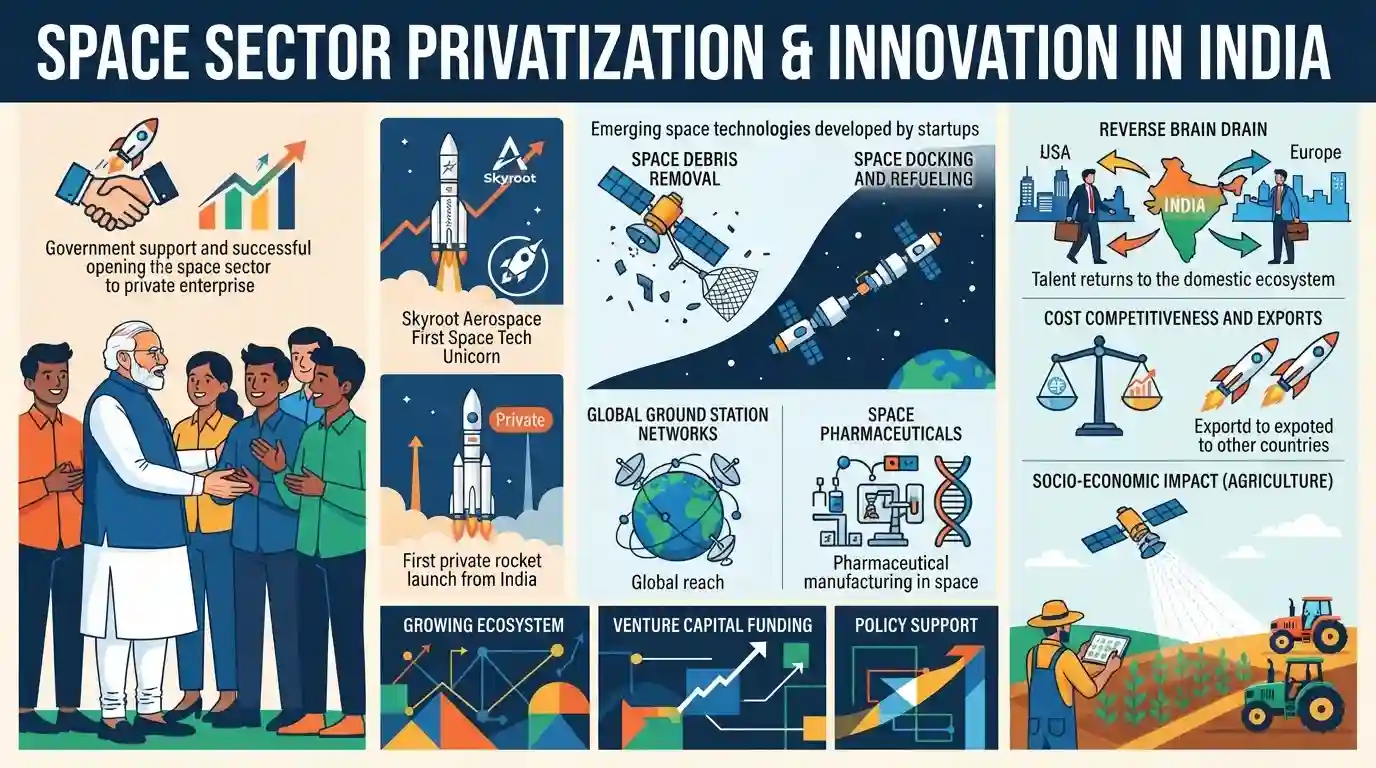
Prime Minister Narendra Modi interacted with CEOs of Indian Space Startups, underscoring the success of opening the space sector to private enterprises. The discussions highlighted key milestones, such as Skyroot Aerospace becoming India's first Space Tech Unicorn and launching the first private rocket. Startups in the sector are venturing into cutting-edge domains like space debris removal, space docking and refueling, and space pharmaceuticals, while also expanding global ground station networks. The supportive policy environment has boosted cost competitiveness, spurred space engine exports, and triggered a reverse brain drain, attracting talent back from the West. Furthermore, the application of space technology in sectors like agriculture demonstrates its broader socio-economic impact.
Key Points
- The government's decision to open the space sector to private entities has fostered trust and driven innovation among Indian startups.
- Skyroot Aerospace has emerged as India's first Space Tech Unicorn, having successfully launched the country's first private rocket.
- Indian space startups are pioneering emerging technologies, including robotic spacecraft for space debris removal, in-orbit space docking and refueling, and space-based pharmaceutical manufacturing.
- The favorable ecosystem is facilitating the export of space engines and triggering a 'reverse brain drain,' attracting skilled talent back to India from the US and Europe.
- Space technology is being leveraged for socio-economic benefits, such as applications in agriculture impacting millions of farmers.
Important Terms
IN-SPACe

An autonomous, single-window nodal agency under the Department of Space, established to promote, authorize, and regulate the participation of private sector entities and startups in India's space activities.
UPSC context
GS Paper III (Science & Technology). Essential for questions on space reforms, privatization, and private sector participation.
Skyroot Aerospace
A leading Indian private aerospace company that became India’s first Space Tech Unicorn, famous for launching Vikram-S (first private rocket) and Vikram-1 (first private orbital launch vehicle).
UPSC context
GS Paper III (S&T/Economy). Tests knowledge of private-sector indigenization, private launch capabilities, and the space startup ecosystem.
Antariksh Venture Capital Fund
India's first dedicated ₹1,000-crore sovereign venture capital fund, operationalized under SEBI regulations, designed to catalyze private investment and support emerging space-tech startups.
UPSC context
GS Paper III (S&T/Economy). Highly relevant for questions on startup funding, space reforms, and commercialization.
Bharatiya Antariksh Station
India's planned modular space station to be constructed and operated by ISRO in low-Earth orbit, with the first module (BAS-01) targeted for launch by 2028.
UPSC context
GS Paper III (S&T). Tests concepts regarding human spaceflight (Gaganyaan), orbital docking, and indigenous space infrastructure.
NewSpace India Limited
A Central Public Sector Enterprise established in 2019 under the Department of Space, functioning as ISRO's commercial arm to scale up domestic industry participation.
UPSC context
GS Paper III (S&T). Crucial for understanding space commercialization and technology transfer to private industry.
Prelims Trap
"IN-SPACe regulates private space entities but its decisions are purely advisory for ISRO."
IN-SPACe is an autonomous nodal agency whose regulatory decisions are final and binding on ALL stakeholders, explicitly including ISRO, not just private startups.
Static Concepts Connected
What are the private sector provisions under the Indian Space Policy 2023?
- End-to-End Activities: Non-Governmental Entities (NGEs) can undertake full-scale space activities, including establishing launchpads, operating satellites, and offering launch services.
- Resource Ownership: NGEs are explicitly permitted to engage in the commercial recovery of asteroid or space resources, including owning and selling them.
- FDI Liberalization: Automatic route FDI is permitted up to 100% for space components, 74% for satellite operations, and 49% for launch vehicles.
What is the Kessler Syndrome and how is India mitigating space debris?
- Kessler Syndrome: A theoretical scenario where the density of objects in LEO triggers a cascading chain of collisions, exponentially increasing space debris.
- ISRO NETRA: Network for space object Tracking and Analysis (NETRA) is ISRO's early warning system to detect space debris and protect satellites.
- Private Interventions: Indian space startups are now pioneering robotic spacecraft specifically designed for active space debris removal and in-orbit docking/refueling.
Cross-Topic Patterns
Microgravity Pharma & Precision Agriculture
Private space innovation is expanding beyond launch vehicles into niche commercial applications like space-based pharmaceutical manufacturing (leveraging microgravity) and utilizing satellite Earth observation data for precision agriculture.
Defense iDEX and Space Liberalization
The structural liberalization of the space sector mirrors defense indigenization initiatives (like iDEX), aiming to transition India into an exporter of high-tech engines while triggering a strategic reverse brain drain.

Expect a multi-statement question mixing IN-SPACe's binding authority over ISRO with the specific automatic FDI limits (49/74/100%).
Linked PYQs · 2
Linked PYQs · 2
- 2016MainsGS3
Discuss India's achievements in the field of Space Science and Technology. How the application of this technology has helped India in its socio-economic development?
- 2026PrelimsGS1
Consider the following statements with regard to involvement of private entities in India's space programme : 1. The Indian National Space Promotion and Authorisation Centre (IN-SPACe) is an autonomous agency formed to facilitate participation of private entities. 2. Agnikul Cosmos launched the world's first flight using 3D-printed rocket engine. 3. Skyroot Aerospace has developed liquid fuel for GSLV. Which of the statements given above is/are correct ?
