National Mission on Natural Farming and Regenerative Agriculture Push
Source:PIB ↗
हे का महत्त्वाचे आहे
Agriculture in India is highly vulnerable to the climate crisis. This article provides critical policy details, statistical targets, and practical methods of Regenerative Agriculture and Integrated Farming Systems (IFS). These details are directly applicable for answering GS3 Mains questions on agricultural sustainability, soil health, water-use efficiency, and crop diversification.
सारांश
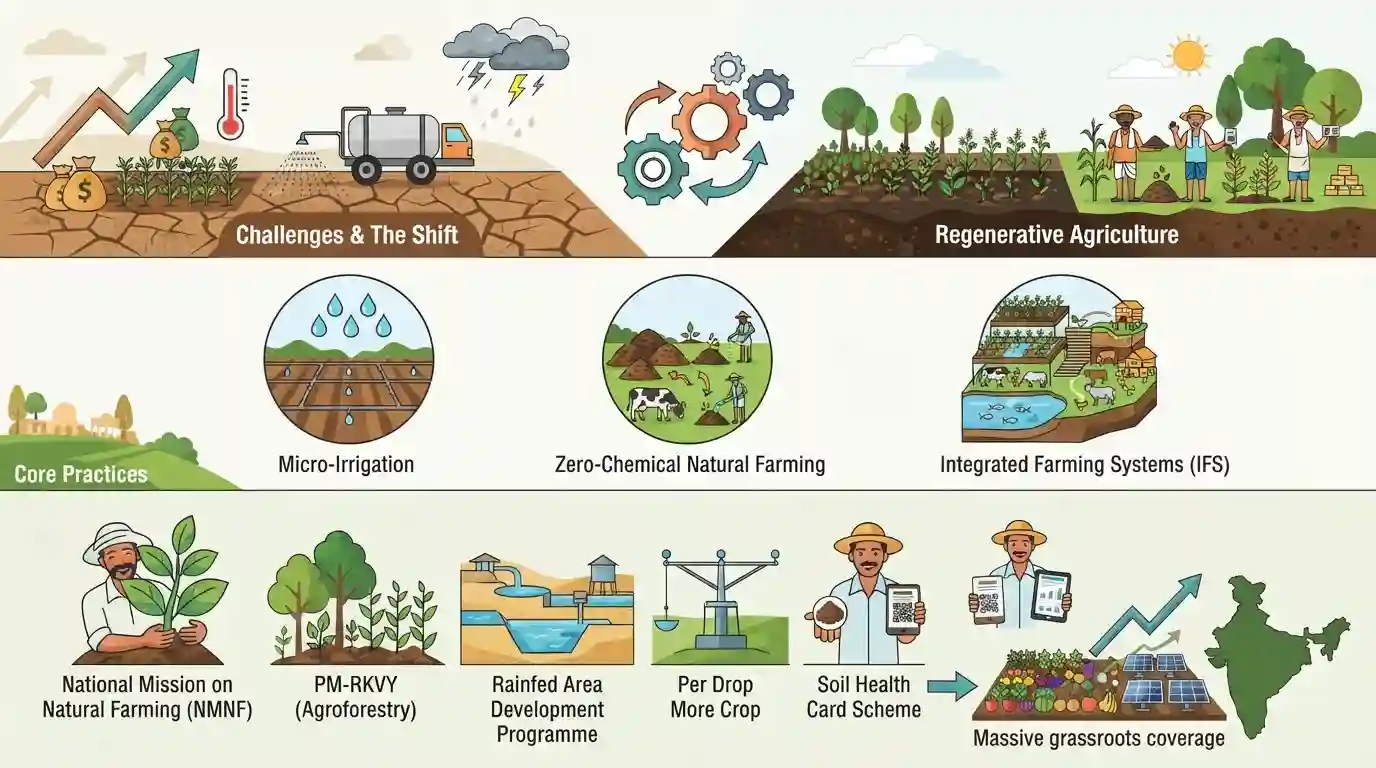
This PIB backgrounder details India's strategic push towards Regenerative Agriculture to restore depleted soil health, promote biodiversity, and mitigate climate change. Though India’s agriculture and allied sectors saw a decadal growth of 4.45% (FY16–FY25), decades of intensive chemical inputs and erratic weather have degraded soils, driving up input costs. Regenerative agriculture moves beyond mere sustainable conservation to actively repair ecosystems using micro-irrigation, zero-chemical natural farming, and Integrated Farming Systems (IFS). The transition is backed by comprehensive government schemes including the National Mission on Natural Farming (NMNF), PM-RKVY (Agroforestry), Rainfed Area Development Programme, Per Drop More Crop, and the Soil Health Card Scheme, which have registered massive grassroots coverage as of early 2026.
मुख्य मुद्दे
- Concept and Distinction: Regenerative agriculture is a holistic system aimed at actively rebuilding and restoring soil health and enhancing biodiversity. While sustainable farming focuses on maintaining current conditions, regenerative agriculture goes further to actively improve and rehabilitate ecosystem services.
- Core Principles: Restive practices are built on six pillars: minimizing soil disturbance, protecting living roots of perennial crops, maintaining soil cover, integrating livestock, limiting chemical inputs, and enhancing crop/biological biodiversity.
- Key Structural Practices: 1) Water Efficiency: Micro-irrigation systems (sprinklers/drips) under Per Drop More Crop. 2) Nutrient Management: Leaf color charts, deep placement of supergranular urea, and biological inputs (cyanobacteria). 3) Natural Farming: On-farm organic formulations like Beejamrut, Jeevamrut, Neemastra, and Dashparni. 4) Integrated Farming Systems (IFS): Diversification of farm enterprises (crops, fisheries, livestock, apiculture) to mitigate climate/market risks. 5) Agroforestry: Utilizing perennial tree systems to restore degraded rainfed soils.
- National Mission on Natural Farming (NMNF): Launched in 2024 to support transitions to chemical-free agriculture. Provides an incentive of ₹4,000/acre/year for two years (up to 1 acre per farmer). It supports 10,000 Bio-input Resource Centres and operates via community-led clusters (18,786 clusters covering 8.80 lakh hectares as of March 2026).
- Paramparagat Krishi Vikas Yojana (PKVY): Supports organic transition with ₹31,500/hectare over three years; 16.90 lakh hectares covered as of October 2025.
- Rainfed Area Development (RAD): Promotes Integrated Farming Systems (IFS) with ₹30,000 financial support per family, targeting climate-resilient mixed-farming options in rainfed clusters.
- Soil Health Card (SHC) Scheme: Formulated to prevent chemical over-fertilization by assessing soil across 12 macronutrient, micronutrient, and physical parameters every 2 years. Over 25.89 crore cards have been generated as of March 2026, supported by 70,002 trained Krishi Sakhis.
महत्त्वाच्या संज्ञा
National Mission on Natural Farming (NMNF)

A centrally sponsored scheme under the Ministry of Agriculture promoting chemical-free, climate-resilient natural farming. It emphasizes ecosystem restoration, reducing input costs, and voluntary farmer adoption using traditional knowledge.
UPSC context
Important for GS Paper 3 (Agriculture), testing knowledge of sustainable agriculture, climate-resilient practices, and natural farming vs. organic farming.
Pradhan Mantri Rashtriya Krishi Vikas Yojana (PM-RKVY)
An umbrella centrally sponsored scheme providing states the flexibility to design and implement local agricultural projects. It aims to accelerate agricultural growth, improve post-harvest infrastructure, and promote sustainability.
UPSC context
Crucial for GS Paper 3 (Agriculture). Tests understanding of decentralized agricultural planning, government umbrella schemes, and farm income augmentation.
Soil Health Card Scheme (SHC)
A government initiative issuing printed reports to farmers detailing the nutrient status of their soil across 12 parameters. It provides crop-specific fertilizer and soil amendment recommendations to reduce chemical overuse.
UPSC context
Relevant to GS Paper 3 (Agriculture). Tests knowledge of soil conservation, balanced fertilizer usage, and data-driven strategies for crop productivity.
Per Drop More Crop (PDMC)
A micro-irrigation scheme under the Pradhan Mantri Krishi Sinchayee Yojana. It provides financial assistance to farmers for adopting drip and sprinkler irrigation systems to maximize water-use efficiency at the farm level.
UPSC context
Vital for GS Paper 3 (Agriculture/Water Management). Tests awareness of water conservation techniques, micro-irrigation subsidies, and climate-resilient agriculture.
Rainfed Area Development Programme (RAD)
A sub-scheme of the National Mission for Sustainable Agriculture focused on enhancing productivity in rainfed areas. It promotes Integrated Farming Systems (IFS) by combining crops with horticulture, livestock, and agroforestry.
UPSC context
Important for GS Paper 3 (Agriculture). Evaluates understanding of sustainable farming, climate risk mitigation, and integrated farming systems in non-irrigated regions.
पूर्वपरीक्षा सापळा
"Soil Health Cards evaluate the microbial diversity and biological health of regenerative farming soils."
The SHC evaluates exactly 12 chemical and physical parameters (N, P, K, S, micronutrients, pH, EC, OC). It does not measure biological or microbial parameters.
संबंधित स्थिर संकल्पना
What are the 12 parameters assessed under the Soil Health Card (SHC) Scheme?
- Macronutrients: Nitrogen (N), Phosphorus (P), and Potassium (K).
- Secondary & Micronutrients: Sulphur (S), Zinc (Zn), Iron (Fe), Copper (Cu), Manganese (Mn), and Boron (B).
- Physical parameters: pH, Electrical Conductivity (EC), and Organic Carbon (OC).
How does Natural Farming technically differ from Organic Farming in UPSC terms?
- External Inputs: Organic farming permits off-farm procured organic inputs (e.g., packaged bio-fertilizers). Natural farming emphasizes zero-external-input, relying entirely on on-farm microbial formulations like Jeevamrut.
- Cost & Livestock: Natural farming integrates the use of indigenous cow breeds (dung and urine) for soil inoculation, making it virtually zero-cost compared to capital-intensive organic farming.
आंतर-विषय नमुने
Regenerative Agriculture + Carbon Markets
Regenerative practices actively increase Soil Organic Carbon (SOC), creating a direct pathway for Indian farmers to generate and monetize carbon credits in emerging domestic and voluntary carbon markets.
Rainfed Area Development + Nutritional Security
RAD's focus on climate-resilient mixed-farming in drylands perfectly aligns with India's push for drought-resistant millets (Shree Anna), bridging climate adaptation with nutritional security.

Expect a multi-statement question contrasting Regenerative vs Sustainable definitions, tested alongside exact Soil Health Card parameters.
संबंधित PYQ · 4
संबंधित PYQ · 4
- 2026PrelimsGS1
Which among the following is/are the objective(s) of the Rainfed Area Development (RAD) initiative under the National Mission for Sustainable Agriculture (NMSA) ? 1. Encouraging monoculture in rainfed areas 2. Increasing rice cultivation in irrigated regions 3. Enhancing productivity and minimising climatic risks through Integrated Farming Systems (IFS) Select the answer using the code given below :
- 2017PrelimsGS1
Consider the following statements: The nation-wide 'Soil Health Card Scheme' aims at 1. expanding the cultivable area under irrigation. 2. enabling the banks to assess the quantum of loans to be granted to farmers on the basis of soil quality. 3. checking the overuse of fertilizers in farmlands. Which of the above statements is/are correct?
- 2016MainsGS3
What is water-use efficiency? Describe the role of micro-irrigation in increasing the water-use efficiency.
- 2021MainsGS3
What are the present challenges before crop diversification? How do emerging technologies provide an opportunity for crop diversification?
