Siliguri Corridor Security Reviewed Through Quadrangular Approach
Source:PIB ↗
Why It Matters
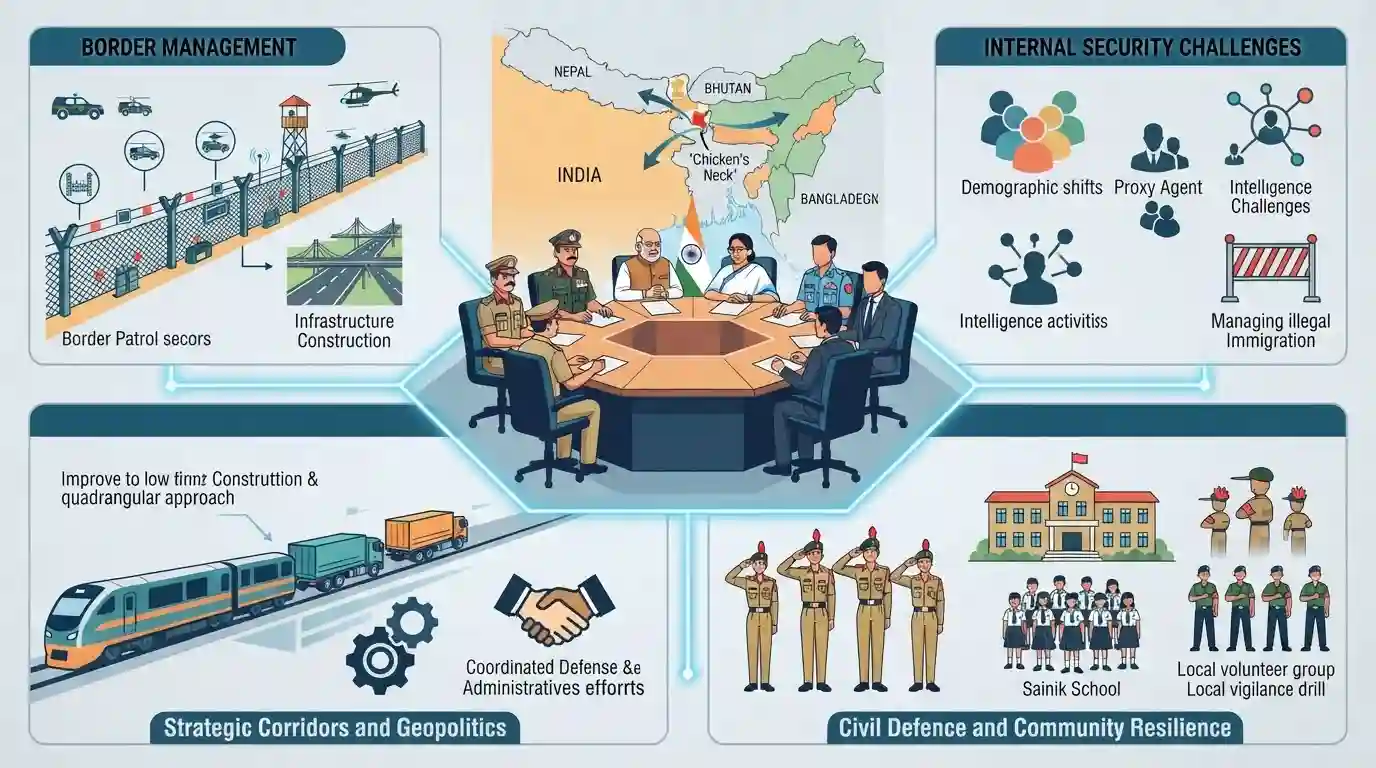
The Siliguri Corridor is India's most critical geographic choke point, making its security fundamental to territorial integrity and the defense of the Northeast. This article highlights the shifting paradigm in border management—moving from purely militaristic security to a coordinated 'quadrangular approach' that integrates infrastructure, intelligence (via MAC's SFG-SC), demographic monitoring, and community resilience (Sainik schools, NCC, and Civil Defence).
Summary
Union Home Minister Amit Shah, alongside West Bengal Chief Minister Mamata Banerjee and high-ranking defense, border-guarding, and civil administration officials, reviewed the security architecture of the strategically sensitive Siliguri Corridor ('Chicken's Neck'). The review emphasized addressing non-traditional security challenges—such as demographic shifts, illegal immigration, proxy agent activities, and infrastructure delays—through a coordinated 'quadrangular approach' to border security. Strategies to enhance local resilience, such as expanding NCC programs, establishing Sainik schools, and strengthening local Civil Defence, were also discussed to reinforce physical and community-level vigilance.
Key Points
- Union Home Minister Amit Shah undertook a comprehensive review of the security of the strategically crucial Siliguri Corridor (the 'Chicken's Neck' connecting Northeast India with the rest of the country).
- The review meeting was attended by the Chief Minister, Chief Secretary, and DGP of West Bengal, alongside senior officials from the MHA, MoRTH, Indian Army, BSF, SSB, and RPF.
- The Multi Agency Centre’s (MAC) Standing Focus Group on Siliguri Corridor (SFG-SC) presented an assessment of progress and laid down strategic recommendations to fortify the region.
- Key security threats evaluated during the meeting included proxy interest/intelligence activities (PIO activities), demographic changes, illegal immigration, and the security of Vital Installations (VIs) within the corridor.
- The Home Minister emphasized the 'Quadrangular Approach to Border Security', directing all security agencies and civil administrations to implement this coordinated framework to make the corridor's defenses impregnable.
- Directions were issued to expedite pending transport and strategic infrastructure projects in a time-bound manner, secure critical installations, and remove encroachments along the corridor.
- To build local resilience and secure community support, the Home Minister urged the West Bengal government to explore opening more Sainik schools in North Bengal, scale up senior NCC cadet participation, and reinforce local Civil Defence and Home Guard organizations.
Important Terms
Multi Agency Centre (MAC)

India’s nodal intelligence-sharing platform operated by the Intelligence Bureau (IB) under the Ministry of Home Affairs to coordinate real-time counter-terrorism inputs among various central and state agencies.
UPSC context
GS Paper III (Internal Security). Relates to counter-terrorism architecture and horizontal intelligence coordination.
Border Infrastructure and Management (BIM) Scheme
A Central Sector Umbrella Scheme of the Ministry of Home Affairs that funds infrastructure like fencing, floodlights, roads, and border outposts along India's international boundaries.
UPSC context
GS Paper III (Internal Security). Covers border management, infrastructure creation, and security of porous borders.
Sashastra Seema Bal (SSB)
A Central Armed Police Force (CAPF) under the Ministry of Home Affairs, responsible for guarding India's international borders with Nepal and Bhutan.
UPSC context
GS Paper III (Internal Security). Tests mandates, duties, and challenges of various border security forces.
Standing Focus Group on Siliguri Corridor (SFG-SC)
A specialized coordination group under the Multi Agency Centre (MAC) focused specifically on monitoring, assessing, and addressing security threats to the strategically vital Siliguri Corridor.
UPSC context
GS Paper III (Internal Security). Highlights targeted intelligence-sharing mechanisms for highly sensitive geographic chokepoints.
Border Security Force (BSF)
A Central Armed Police Force (CAPF) responsible for guarding India’s international land borders with Pakistan and Bangladesh, preventing infiltration and cross-border crimes.
UPSC context
GS Paper III (Internal Security). Evaluates the role of security forces and their trans-border challenges.
Prelims Trap
The Siliguri Corridor directly borders China (Tibet) and its security is exclusively managed by the Border Security Force (BSF).
The corridor does not touch China directly (separated by Sikkim/Bhutan). Its borders are guarded by both SSB (Nepal/Bhutan) and BSF (Bangladesh).
Static Concepts Connected
What is the Multi Agency Centre (MAC) in India?
- Origin: Created post-Kargil War under the Intelligence Bureau (IB) to streamline intelligence sharing.
- Mandate: Acts as a 24/7 multi-agency platform to share real-time counter-terrorist and security intelligence.
- Structure: Includes a national-level MAC in New Delhi and State Multi-Agency Centres (SMACs) across states.
What is the strategic significance of the Siliguri Corridor?
- Geographic Chokepoint: A narrow 20-22 km wide strip in West Bengal connecting Northeast India to the mainland.
- Sovereign Vulnerability: Bounded by Nepal, Bhutan, and Bangladesh, with China's strategic Chumbi Valley sitting close to its north.
- Economic Artery: Hosts critical rail, road, pipeline, and telecommunication links vital for the Northeast's integration.
Cross-Topic Patterns
Infrastructure vs. Strategic Chokepoints
Developing alternative regional transit routes through Bangladesh and Myanmar reduces extreme strategic dependency on the narrow Siliguri Corridor.
Demographic shifts and hybrid warfare
Uncontrolled migration alters border-area demographics, creating socio-economic friction and fertile ground for hostile proxy intelligence networks.

Mains questions will likely require linking the physical defense of Siliguri Corridor with non-traditional threats like demographic shifts.
Linked PYQs · 3
Linked PYQs · 3
- 2024MainsGS3
India has a long and troubled border with China and Pakistan fraught with contentious issues. Examine the conflicting issues and security challenges along the border. Also give out the development being undertaken in these areas under the Border Area Development Programme (BADP) and Border Infrastructure and Management (BIM) Scheme.
- 2020MainsGS3
Analyze internal security threats and transborder crimes along Myanmar, Bangladesh and Pakistan borders including Line of Control (LoC). Also discuss the role played by various security forces in this regard.
- 2020MainsGS3
For effective border area management, discuss the steps required to be taken to deny local support to militants and also suggest ways to manage favourable perception among locals.
