Mission Zero Initiative Aims to End Fatalities in Sanitation Work
Source:PIB ↗
ఇది ఎందుకు ముఖ్యం
The eradication of manual scavenging remains a critical human rights and social justice issue in India. Understanding the convergence of MoSJE and MoHUA initiatives (like the NAMASTE scheme and Swachh Bharat Mission) is vital for GS2 governance and social justice answers, specifically concerning the dignity, health, and economic rehabilitation of marginalized sanitation workers.
సారాంశం
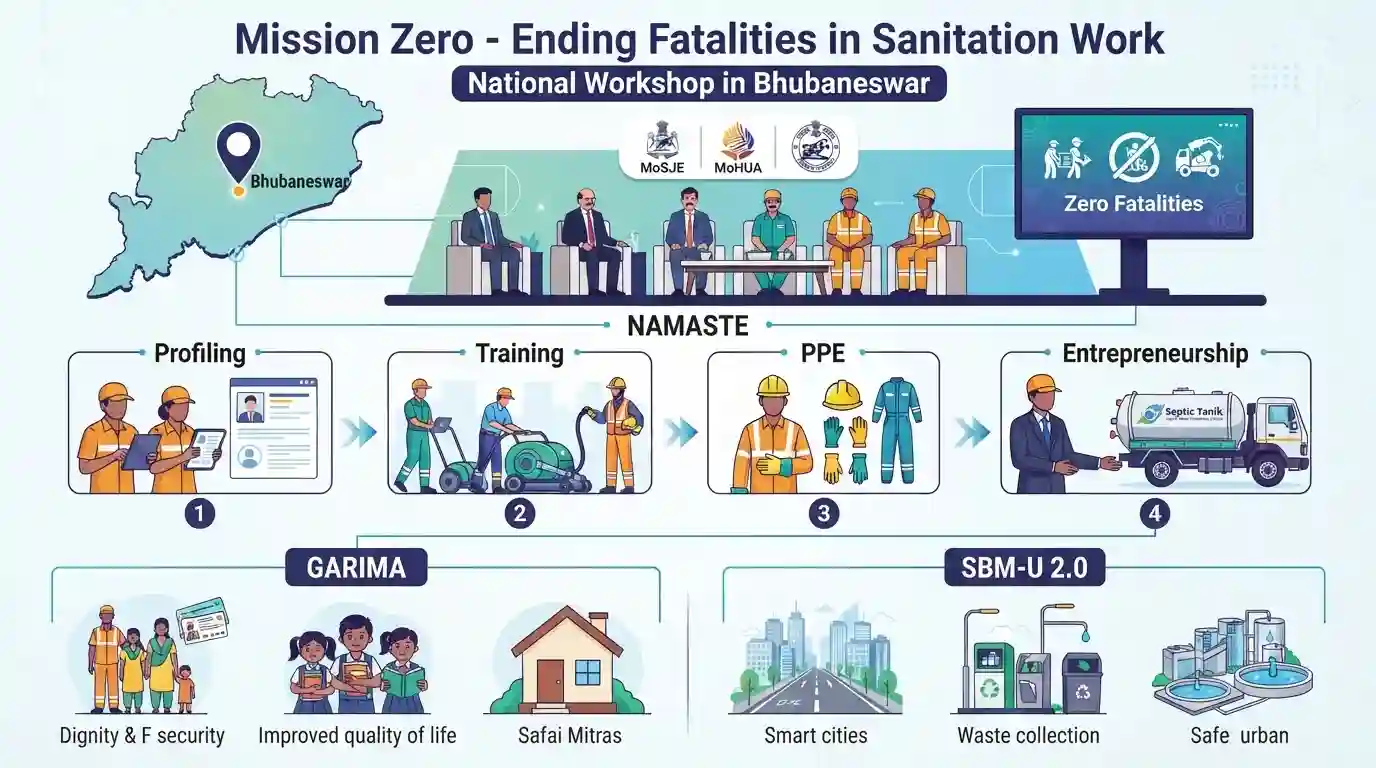
A National Workshop titled "Mission Zero – Ending Fatalities in Sanitation Work" was held in Bhubaneswar to accelerate the eradication of hazardous manual scavenging and promote mechanization. Organized collaboratively by the Ministry of Social Justice and Empowerment (MoSJE), the Ministry of Housing and Urban Affairs (MoHUA), and the Odisha government, the event underscored the critical role of the NAMASTE scheme. The scheme provides profiling, training, PPE, and financial subsidies to transform sanitation workers ('Safai Mitras') into sanitation entrepreneurs. The workshop also highlighted Odisha's GARIMA scheme and the ongoing Swachh Bharat Mission-Urban 2.0 as pivotal frameworks for ensuring the safety, dignity, and economic empowerment of sanitation workers across India's urban local bodies.
ముఖ్య అంశాలు
- A national workshop on 'Mission Zero – Ending Fatalities in Sanitation Work' was organized to promote the total eradication of hazardous manual scavenging.
- The NAMASTE scheme, a joint initiative of MoSJE and MoHUA, is spearheading the transition to 100% mechanized sewer and septic tank cleaning across India.
- Odisha's state-specific GARIMA scheme was highlighted as a successful model for institutionalizing the safety and dignity of Core Sanitation Workers.
- The workshop emphasized equipping 'Safai Mitras' with PPE kits, occupational training, health insurance, and capital subsidies for purchasing sanitation machinery.
- The initiative aligns with Swachh Bharat Mission-Urban 2.0 to achieve comprehensive sanitation coverage and mechanization at the Urban Local Body (ULB) level.
ముఖ్యమైన పదాలు
NAMASTE Scheme (National Action for Mechanised Sanitation Ecosystem)

A central sector scheme by MoSJE and MoHUA aiming to eradicate manual scavenging. It ensures zero fatalities by providing sanitation workers with occupational training, PPE kits, health insurance, and capital subsidies for mechanized cleaning equipment.
UPSC context
GS-2 (Social Justice). Tests knowledge of policies protecting vulnerable sections and eliminating the historical injustice of manual scavenging.
GARIMA Scheme
An Odisha state initiative to formalize and protect core sanitation workers. It ensures their safety, dignity, and economic security by providing protective gear, specialized training, life insurance, risk allowances, and regulated working hours.
UPSC context
GS-2 (Welfare Schemes). Acts as a highly relevant state-level case study or model intervention for the rehabilitation of sanitation workers.
National Safai Karamcharis Finance & Development Corporation (NSKFDC)
A government undertaking under the Ministry of Social Justice and Empowerment. It serves as the nodal implementing agency for the NAMASTE scheme, extending financial assistance, capital subsidies, and enterprise development support to sanitation workers.
UPSC context
GS-2 (Statutory & Regulatory Bodies). Important for understanding the institutional architecture supporting marginalized communities and self-employment initiatives.
Central Public Health and Environmental Engineering Organisation (CPHEEO)
The technical wing of the Ministry of Housing and Urban Affairs (MoHUA). It formulates policies, sets standards, and issues technical manuals for urban water supply, sanitation, and municipal solid waste management systems across India.
UPSC context
GS-2 (Governance) and GS-3 (Infrastructure). Relevant for questions on urban planning, public health engineering, and sanitation infrastructure standards.
Swachh Bharat Mission-Urban 2.0 (SBM-U 2.0)
The second phase of the national urban sanitation mission. It focuses on making all cities garbage-free and ensuring complete fecal sludge management, providing the infrastructural backbone necessary for mechanized and safe sanitation ecosystems.
UPSC context
GS-2 (Government Policies). Frequently tested regarding its objectives in urban infrastructure, public health, and integration with marginalized worker welfare.
ప్రిలిమ్స్ ఉచ్చు
The NAMASTE scheme is a Centrally Sponsored Scheme implemented solely by the Ministry of Social Justice and Empowerment.
NAMASTE is a Central Sector Scheme (100% Central funding) and is jointly administered by both MoSJE and the Ministry of Housing and Urban Affairs (MoHUA).
అనుసంధానమైన స్థిర భావనలు
What are the key features of the PEMSR Act, 2013?
- Strict Prohibition: Outlaws the employment of any individual for manual scavenging and the hazardous manual cleaning of sewers and septic tanks.
- Rehabilitation Mandates: Identified manual scavengers are entitled to one-time cash assistance, skill training, and capital subsidy for self-employment.
- Stringent Penalties: Imposes imprisonment up to two years or a fine up to two lakh rupees, or both, for first-time hazardous cleaning violations.
What is the judicial stance on sewer death compensation?
- Safai Karamchari Case: In 2014, the Supreme Court directed a mandatory compensation of Rs 10 lakh for sewer deaths occurring since 1993.
- 2023 Enhancement: The Supreme Court increased this compensation to Rs 30 lakh for sewer-related deaths and Rs 20 lakh for permanent disabilities.
- State Responsibility: Rulings establish strict liability on the state and municipal bodies, regardless of whether private contractors executed the hazardous work.
అంతర-అంశ నమూనాలు
Federalism and local welfare models
Odisha’s GARIMA scheme complementing the central NAMASTE initiative illustrates cooperative federalism, where state-specific safety allowances and social protections refine national mechanization mandates.
Article 21 and technology transition
Transitioning manual cleaning to mechanization links Article 21 (Right to Dignity) with technology-driven occupational safety, converting vulnerable sanitation workers into mechanized micro-entrepreneurs.

Multi-statement questions will likely test the dual-ministry nature of NAMASTE, its 2024 scope expansion, and the ₹30L SC compensation.
అనుసంధాన PYQలు · 3
అనుసంధాన PYQలు · 3
- 2019MainsGS2
Performance of welfare schemes that are implemented for vulnerable sections is not so effective due to absence of their awareness and active involvement at all stages of policy process. Discuss.
- 2023MainsGS2
“Development and welfare schemes for the vulnerable, by its nature, are discriminatory in approach.” Do you agree? Give reasons for your answer.
- 2017MainsGS2
To ensure effective implementation of policies addressing water, sanitation and hygiene needs the identification of the beneficiary segments is to be synchronized with the anticipated outcomes." Examine the statement in the context of the WASH scheme.
