Committee Formed to Pursue Political Solution for West Bengal Hills
Source:PIB ↗
ఇది ఎందుకు ముఖ్యం
This development represents a major step toward resolving the long-standing Gorkhaland statehood and autonomy dispute. Understanding the mechanisms used for regional conflict resolution, such as specialized committees and constitutional solutions (like the Sixth Schedule or special provisions under Article 371), is vital for UPSC aspirants studying Indian Federalism, Regionalism, and Border Area/Internal Security.
సారాంశం
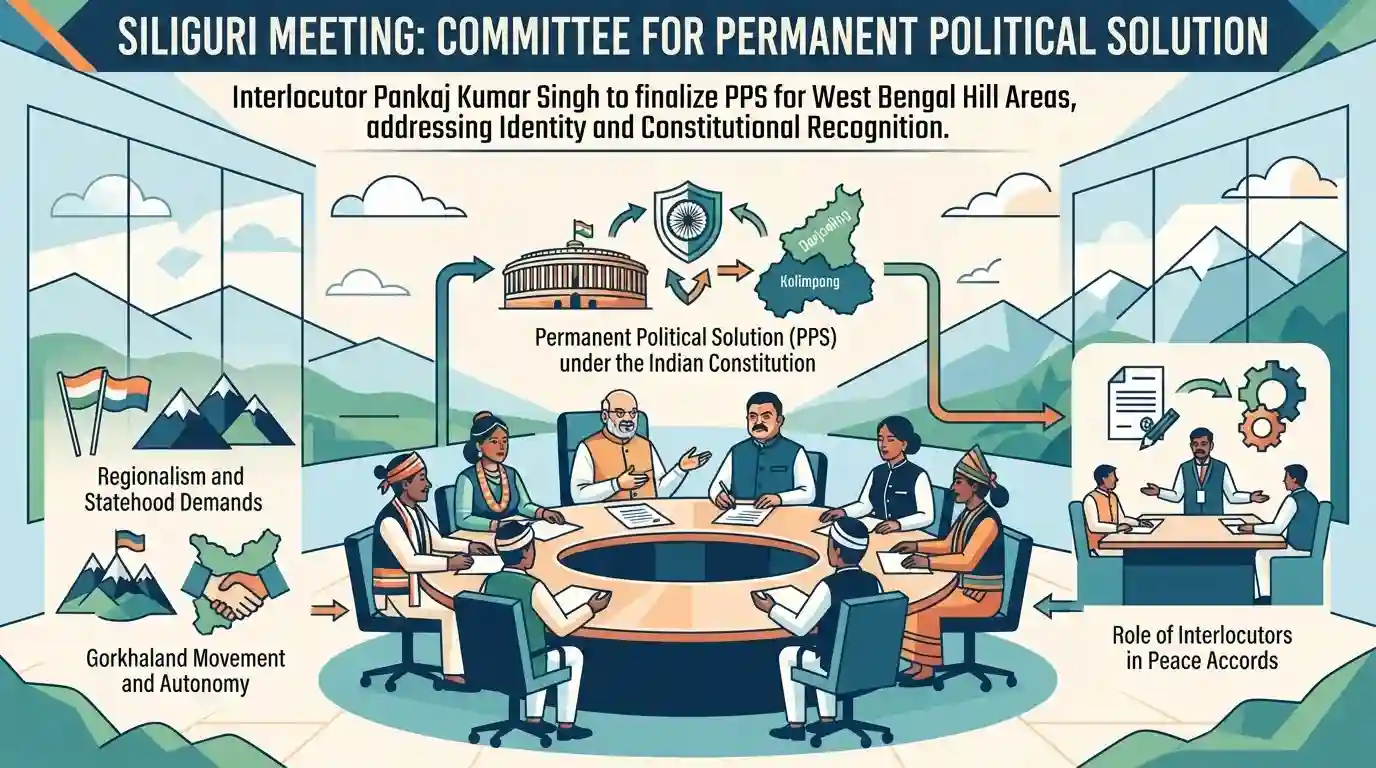
Union Home Minister Amit Shah, in a meeting in Siliguri with West Bengal Chief Minister Suvendu Adhikari and various hill community leaders, announced the formation of a committee headed by interlocutor Pankaj Kumar Singh to finalize a Permanent Political Solution (PPS) under the Indian Constitution for the West Bengal hill areas, addressing ethnic identity and constitutional recognition demands.
ముఖ్య అంశాలు
- A high-level meeting was convened in Siliguri under the chairmanship of Union Home Minister Amit Shah and West Bengal Chief Minister Suvendu Adhikari to discuss the long-pending issues of the hill population of West Bengal.
- The discussions focused on the regional demands for a distinct ethnic identity, a 'Permanent Political Solution' (PPS), and constitutional recognition for the Gorkha and other hill communities.
- A specialized committee has been constituted under the chairmanship of former Deputy National Security Advisor and current interlocutor, Shri Pankaj Kumar Singh, to draft the final agreement and finalize the administrative and legal modalities of the PPS.
- The meeting was highly representative, involving leaders from major local political entities such as the GJM, GNLF, CPRM, GoRaNiMo, and Sumetee, representing a multi-stakeholder consensus-building approach.
- The central government emphasized its commitment to resolve these regional grievances through adequate funding and constitutional mechanisms, which is vital given the region's proximity to the strategically sensitive Siliguri Corridor ('Chicken's Neck').
ముఖ్యమైన పదాలు
Permanent Political Solution (PPS) under the Constitution of India

A proposed constitutional settlement aimed at resolving long-standing demands for political autonomy, statehood, and Scheduled Tribe (ST) status for the Gorkha community in northern West Bengal.
UPSC context
GS Paper II (Federalism): Tests understanding of constitutional mechanisms for addressing ethnic autonomy and statehood demands.
Gorkhaland Territorial Administration (GTA)
A semi-autonomous administrative council established in 2011 to govern the Darjeeling and Kalimpong hill regions of West Bengal, replacing the Darjeeling Gorkha Hill Council.
UPSC context
GS Paper II (Local Governance): Tests comprehension of asymmetric federalism and institutional models of regional autonomy.
Gorkha Janmukti Morcha (GJM)
A regional political party formed in 2007 by Bimal Gurung that spearheaded the second major wave of agitations for a separate Gorkhaland state in northern West Bengal.
UPSC context
GS Paper II (Political Parties): Tests analysis of regional political actors and their impact on state-level federal dynamics.
Gorkha National Liberation Front (GNLF)
A regional political party founded in 1980 by Subhash Ghising that initiated the first major, violent mass agitation for Gorkhaland statehood in the 1980s.
UPSC context
GS Paper I (Post-Independence India): Tests awareness of historical ethnic movements and sub-national political consolidations.
Communist Party of Revolutionary Marxists (CPRM)
A regional left-wing political party formed in 1996 by CPI(M) dissidents in Darjeeling who broke away to independently champion the demand for Gorkhaland statehood.
UPSC context
GS Paper II (Pressure Groups): Tests understanding of the role of minor ideological parties in regional autonomy movements.
ప్రిలిమ్స్ ఉచ్చు
The Gorkhaland Territorial Administration (GTA) is a constitutional body established under the Sixth Schedule of the Indian Constitution.
The GTA was created via a West Bengal State Legislative Act in 2012, not the Sixth Schedule, which strictly covers Assam, Meghalaya, Tripura, and Mizoram.
అనుసంధానమైన స్థిర భావనలు
How does the Constitution facilitate regional autonomy outside the Sixth Schedule?
- Statutory councils: States can set up autonomous administrative bodies (like GTA) through ordinary state legislation.
- Article 371: Special provisions (Articles 371A to 371J) allow customized administrative and financial safeguards for specific regions without full statehood.
What are the key features of the Sixth Schedule of the Indian Constitution?
- Applicable states: It applies exclusively to tribal areas in Assam, Meghalaya, Tripura, and Mizoram under Article 244(2).
- Autonomous councils: Provides for Autonomous District Councils (ADCs) with legislative, executive, and judicial powers over specified subjects.
- Governor's role: The Governor has discretionary powers to organize, redefine boundaries, or dissolve these autonomous districts.
అంతర-అంశ నమూనాలు
Internal security + Siliguri Corridor
Unrest in Darjeeling risks choking the Siliguri Corridor, India’s vital 22km land bridge to the Northeast, elevating a local ethnic demand to a national security priority.
Asymmetrical federalism + regional identity
The evolution from DGHC to GTA illustrates India's flexible constitutional design, creating non-state-level autonomous governance structures to address sub-national aspirations.

Distinction between Sixth Schedule ADCs and statutory councils like GTA in West Bengal is a high-probability target for polity MCQ.
అనుసంధాన PYQలు · 4
అనుసంధాన PYQలు · 4
- 2013MainsGS1
Growing feeling of regionalism is an important factor in generation of demand for a separate State. Discuss.
- 2016MainsGS1
What is the basis of regionalism? Is it that unequal distribution of benefits of development on regional basis eventually promotes regionalism? Substantiate your answer.
- 2025MainsGS3
What are the major challenges to internal security and peace process in the North-Eastern States? Map the various peace accords and agreements initiated by the government in the past decade.
- 2023PrelimsGS1
With reference to 'Scheduled Areas' in India, consider the following statements: 1. Within a State, the notification of an area as Scheduled Area takes place through an Order of the President. 2. The largest administrative unit forming the Scheduled Area is the District and the lowest is the cluster of villages in the Block. 3. The Chief Ministers of the concerned States are required to submit annual reports to the Union Home Ministry on the administration of Scheduled Areas in the States. How many of the above statements are correct?
