National Biodiversity Authority Disburses ABS Funds to State Boards
Source:PIB ↗
কেন এটি গুরুত্বপূর্ণ
It provides a concrete, contemporary example of how Access and Benefit-Sharing (ABS)—a key concept under the Biological Diversity Act and Nagoya Protocol—is implemented in practice, moving from corporate payments to local conservation funding.
সারসংক্ষেপ
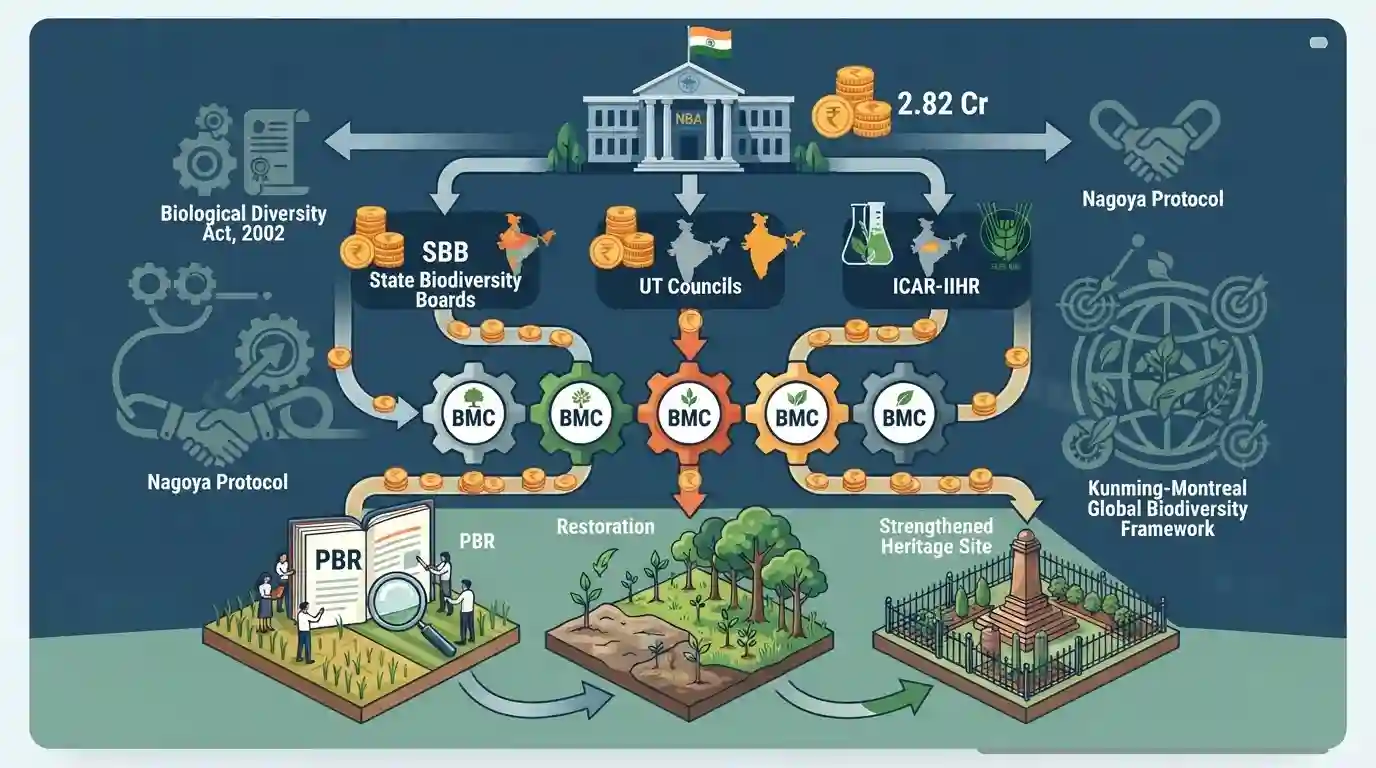
The National Biodiversity Authority (NBA) has disbursed ₹2.82 crore of Access and Benefit-Sharing (ABS) funds to multiple State Biodiversity Boards, UT Councils, and ICAR-IIHR. The funds, deposited by private companies utilizing genetic resources, will flow to local Biodiversity Management Committees (BMCs). These funds are earmarked for grassroots conservation efforts, including updating People's Biodiversity Registers, restoring degraded ecosystems, and strengthening Biodiversity Heritage Sites. This disbursement illustrates the practical implementation of India's Biological Diversity Act, 2002, and aligns with international obligations under the Nagoya Protocol and the Kunming-Montreal Global Biodiversity Framework.
মূল বিষয়
- The National Biodiversity Authority (NBA) distributed ₹2.82 crore in Access and Benefit-Sharing (ABS) funds to 27 State Biodiversity Boards, 3 UT Biodiversity Councils, and ICAR-IIHR.
- The funds were collected from corporate entities for their commercial utilization of genetic resources, specifically horticultural crop hybrids and microbial strains.
- State allocations were made proportionally based on the cultivation area of the utilized crops, with Gujarat, West Bengal, and Madhya Pradesh receiving the largest shares.
- The funds will be directed to local Biodiversity Management Committees (BMCs) to update People's Biodiversity Registers (PBRs), conserve and restore ecosystems, and manage Biodiversity Heritage Sites.
- This operationalizes the ABS mechanism under the Biological Diversity Act, 2002, fulfilling international commitments under the Nagoya Protocol and Target 13 of the Kunming-Montreal Global Biodiversity Framework.
গুরুত্বপূর্ণ শব্দ
Biological Diversity Act, 2002

Indian legislation enacted to conserve biological diversity, promote sustainable use of its components, and ensure fair and equitable sharing of benefits arising from genetic resources.
UPSC context
GS Paper III: Environmental legislation. Crucial for understanding India’s decentralized environmental governance and regulatory frameworks.
Convention on Biological Diversity (CBD)
A legally binding multilateral treaty adopted at the 1992 Earth Summit, aiming for biodiversity conservation, sustainable resource use, and fair benefit-sharing from genetic resource utilization.
UPSC context
GS Paper III: International environmental treaties. Tests knowledge of global frameworks, conservation commitments, and India's international obligations.
Nagoya Protocol
A 2010 supplementary agreement to the CBD providing a transparent, legally binding framework for the effective implementation of the fair and equitable sharing of benefits.
UPSC context
GS Paper III: International treaties and protocols. Tests understanding of global rules governing biopiracy and genetic resource rights.
Kunming-Montreal Global Biodiversity Framework (KMGBF)
A historic framework adopted at COP15 in 2022, establishing 4 global goals for 2050 and 23 targets for 2030 to halt and reverse global biodiversity loss.
UPSC context
GS Paper III: Environment. Vital for questions on global biodiversity targets, international conservation metrics, and sustainable development.
Access and Benefit-Sharing (ABS) Mechanism
A regulatory and equity framework ensuring that monetary and non-monetary benefits from utilizing biological resources and traditional knowledge are shared fairly with local communities and nations.
UPSC context
GS Paper III: Conservation. Evaluates policies balancing commercial utilization of natural resources with economic empowerment of local indigenous communities.
National Biodiversity Authority (NBA)
A statutory body established in 2003 under the Biological Diversity Act, 2002, to regulate access to India’s biological resources and ensure fair benefit-sharing.
UPSC context
GS Paper III: Statutory bodies & environment. Key for understanding regulatory oversight on biopiracy and national biodiversity governance.
Biodiversity Management Committees (BMCs)
Local-level statutory bodies in India constituted by local governments to promote biodiversity conservation, sustainable use, and prepare People’s Biodiversity Registers (PBRs).
UPSC context
GS Paper III: Conservation and local governance. Evaluates decentralised community participation in resource documentation and conservation.
প্রিলিমস ফাঁদ
Biodiversity Management Committees are advisory entities without powers to levy fees on the commercial extraction of bio-resources.
BMCs are statutory bodies under the Biological Diversity Act, 2002. They legally possess the authority to levy collection fees on entities accessing regional biological resources.
সংযুক্ত স্থির ধারণা
What is the 3-tier structure under the Biological Diversity Act, 2002?
- NBA (National): A statutory body regulating access by foreign individuals/entities to India's biological resources and traditional knowledge.
- SBBs (State): Regulate access requests by Indian citizens and domestic entities, advising state governments on conservation.
- BMCs (Local): Set up by panchayats and municipalities to prepare People's Biodiversity Registers and manage local bio-resources.
What is the Access and Benefit-Sharing (ABS) mechanism?
- Global Framework: Established by the Nagoya Protocol (under CBD) to ensure fair compensation for utilizing genetic resources.
- Fund Routing: Firms pay fees to NBA/SBBs for using genetic resources. Funds are then transferred to local BMCs for grassroots conservation.
- KMGBF Expansion: Target 13 of the Kunming-Montreal GBF expands ABS mechanisms to explicitly include digital sequence information (DSI).
আন্তঃবিষয় প্যাটার্ন
ABS + IPR & Biopiracy
The ABS mechanism is India's primary defense against biopiracy, intersecting with TRIPS by ensuring communities are compensated when corporations patent products derived from traditional knowledge.
KMGBF Target 13 + Biotech
Target 13 of the Kunming-Montreal GBF expands ABS to include Digital Sequence Information (DSI), creating a clear syllabus overlap between biodiversity conservation and biotechnology.

Expect a multi-statement question testing the statutory powers of BMCs (fee levying, PBRs) connected to Nagoya Protocol ABS.
সংযুক্ত PYQ · 2
সংযুক্ত PYQ · 2
- 2023PrelimsGS1
Consider the following statements: 1. In India, the Biodiversity Management Committees are key to the realization of the objectives of the Nagoya Protocol. 2. The Biodiversity Management Committees have important functions in determining access and benefit sharing, including the power to levy collection fees on the access of biological resources within its jurisdiction. Which of the statements given above is/are correct?
- 2015PrelimsGS1
Which one of the following is associated with the issue of control and phasing out of the use of ozone-depleting substances?
