राष्ट्रीय जैव विविधता प्राधिकरण ने राज्य बोर्डों को ABS फंड वितरित किया
स्रोत:पीआईबी ↗
क्यों मायने रखता है
It provides a concrete, contemporary example of how Access and Benefit-Sharing (ABS)—a key concept under the Biological Diversity Act and Nagoya Protocol—is implemented in practice, moving from corporate payments to local conservation funding.
सारांश
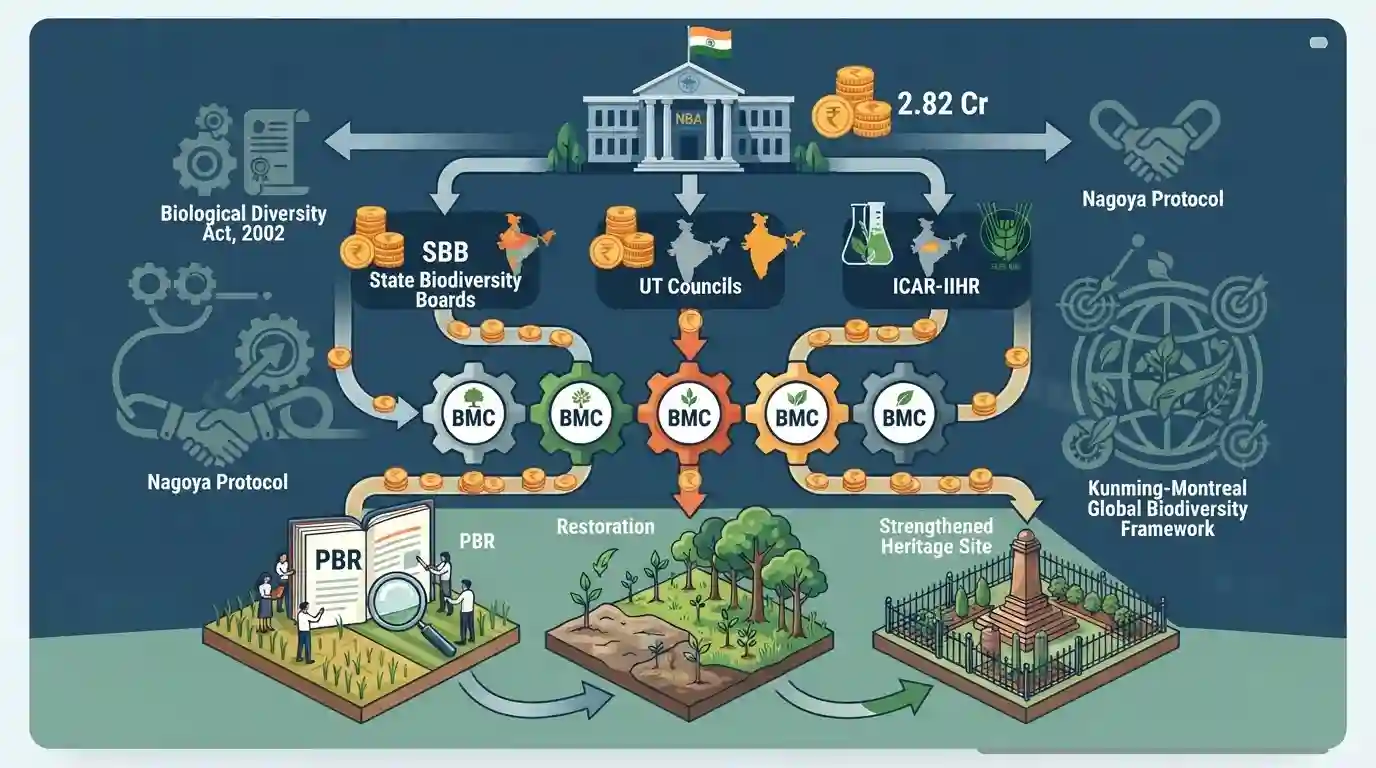
The National Biodiversity Authority (NBA) has disbursed ₹2.82 crore of Access and Benefit-Sharing (ABS) funds to multiple State Biodiversity Boards, UT Councils, and ICAR-IIHR. The funds, deposited by private companies utilizing genetic resources, will flow to local Biodiversity Management Committees (BMCs). These funds are earmarked for grassroots conservation efforts, including updating People's Biodiversity Registers, restoring degraded ecosystems, and strengthening Biodiversity Heritage Sites. This disbursement illustrates the practical implementation of India's Biological Diversity Act, 2002, and aligns with international obligations under the Nagoya Protocol and the Kunming-Montreal Global Biodiversity Framework.
मुख्य बिंदु
- राष्ट्रीय जैव विविधता प्राधिकरण (NBA) ने 27 राज्य जैव विविधता बोर्डों, 3 केंद्र शासित प्रदेश (UT) जैव विविधता परिषदों और ICAR-IIHR को पहुंच और लाभ-साझाकरण (ABS) फंड के तहत ₹2.82 करोड़ वितरित किए।
- यह धनराशि कॉर्पोरेट संस्थाओं से आनुवंशिक संसाधनों, विशेष रूप से बागवानी फसल संकरों और माइक्रोबियल स्ट्रेन्स के उनके व्यावसायिक उपयोग के लिए एकत्र की गई थी।
- राज्यों को आवंटन उपयोग की जाने वाली फसलों के कृषि क्षेत्र के आधार पर आनुपातिक रूप से किया गया था, जिसमें गुजरात, पश्चिम बंगाल और मध्य प्रदेश को सबसे अधिक हिस्सा प्राप्त हुआ।
- The funds will be directed to local Biodiversity Management Committees (BMCs) to update People's Biodiversity Registers (PBRs), conserve and restore ecosystems, and manage Biodiversity Heritage Sites.
- This operationalizes the ABS mechanism under the Biological Diversity Act, 2002, fulfilling international commitments under the Nagoya Protocol and Target 13 of the Kunming-Montreal Global Biodiversity Framework.
महत्वपूर्ण शब्द
जैव विविधता अधिनियम, 2002

जैव विविधता का संरक्षण करने, इसके घटकों के सतत उपयोग को बढ़ावा देने और आनुवंशिक संसाधनों से उत्पन्न होने वाले लाभों के निष्पक्ष और न्यायसंगत साझाकरण को सुनिश्चित करने के लिए अधिनियमित भारतीय कानून।
UPSC context
GS पेपर III: पर्यावरणीय कानून। भारत के विकेंद्रीकृत पर्यावरणीय शासन और नियामक ढांचे को समझने के लिए महत्वपूर्ण।
जैविक विविधता पर अभिसमय (CBD)
A legally binding multilateral treaty adopted at the 1992 Earth Summit, aiming for biodiversity conservation, sustainable resource use, and fair benefit-sharing from genetic resource utilization.
UPSC context
GS पेपर III: अंतर्राष्ट्रीय पर्यावरणीय संधियाँ। वैश्विक ढांचों, संरक्षण प्रतिबद्धताओं और भारत के अंतर्राष्ट्रीय दायित्वों के ज्ञान का परीक्षण करता है।
नगोया प्रोटोकॉल
A 2010 supplementary agreement to the CBD providing a transparent, legally binding framework for the effective implementation of the fair and equitable sharing of benefits.
UPSC context
GS पेपर III: अंतर्राष्ट्रीय संधियाँ और प्रोटोकॉल। बायोपायरेसी और आनुवंशिक संसाधन अधिकारों को नियंत्रित करने वाले वैश्विक नियमों की समझ का परीक्षण करता है।
कुनमिंग-मॉन्ट्रियल वैश्विक जैव विविधता फ्रेमवर्क (KMGBF)
2022 में COP15 में अपनाया गया एक ऐतिहासिक ढांचा, जो वैश्विक जैव विविधता के नुकसान को रोकने और उसे पलटने के लिए 2050 के लिए 4 वैश्विक लक्ष्य और 2030 के लिए 23 लक्ष्य निर्धारित करता है।
UPSC context
GS Paper III: Environment. Vital for questions on global biodiversity targets, international conservation metrics, and sustainable development.
पहुंच और लाभ-साझाकरण (ABS) तंत्र
एक नियामक और न्यायसंगत ढांचा जो यह सुनिश्चित करता है कि जैविक संसाधनों और पारंपरिक ज्ञान के उपयोग से प्राप्त होने वाले मौद्रिक और गैर-मौद्रिक लाभों को स्थानीय समुदायों और राष्ट्रों के साथ निष्पक्ष रूप से साझा किया जाए।
UPSC context
GS पेपर III: संरक्षण। स्थानीय स्वदेशी समुदायों के आर्थिक सशक्तिकरण के साथ प्राकृतिक संसाधनों के व्यावसायिक उपयोग को संतुलित करने वाली नीतियों का मूल्यांकन।
National Biodiversity Authority (NBA)
A statutory body established in 2003 under the Biological Diversity Act, 2002, to regulate access to India’s biological resources and ensure fair benefit-sharing.
UPSC context
GS Paper III: Statutory bodies & environment. Key for understanding regulatory oversight on biopiracy and national biodiversity governance.
Biodiversity Management Committees (BMCs)
भारत में स्थानीय सरकारों द्वारा जैव विविधता संरक्षण, सतत उपयोग को बढ़ावा देने और पीपुल्स बायोडायवर्सिटी रजिस्टर (PBRs) तैयार करने के लिए गठित स्थानीय स्तर के वैधानिक निकाय।
UPSC context
GS Paper III: Conservation and local governance. Evaluates decentralised community participation in resource documentation and conservation.
प्रारंभिक ट्रैप
जैव विविधता प्रबंधन समितियां सलाहकारी निकाय हैं जिनके पास जैव-संसाधनों के व्यावसायिक दोहन पर शुल्क लगाने की शक्ति नहीं है।
BMCs जैव विविधता अधिनियम, 2002 के तहत वैधानिक निकाय हैं। उनके पास क्षेत्रीय जैविक संसाधनों तक पहुँच प्राप्त करने वाली संस्थाओं पर संग्रह शुल्क लगाने का कानूनी अधिकार है।
संबंधित अवधारणाएँ
जैव विविधता अधिनियम, 2002 के तहत 3-स्तरीय संरचना क्या है?
- NBA (राष्ट्रीय): विदेशी व्यक्तियों/संस्थाओं द्वारा भारत के जैविक संसाधनों और पारंपरिक ज्ञान तक पहुँच को विनियमित करने वाला एक सांविधिक निकाय।
- SBBs (राज्य): भारतीय नागरिकों और घरेलू संस्थाओं द्वारा पहुंच के अनुरोधों को विनियमित करना, और संरक्षण पर राज्य सरकारों को सलाह देना।
- बीएमसी (स्थानीय): पंचायतों और नगर पालिकाओं द्वारा पीपुल्स बायोडायवर्सिटी रजिस्टर तैयार करने और स्थानीय जैव-संसाधनों का प्रबंधन करने के लिए गठित।
पहुंच और लाभ-साझाकरण (ABS) तंत्र क्या है?
- वैश्विक ढांचा: Established by the Nagoya Protocol (under CBD) to ensure fair compensation for utilizing genetic resources.
- Fund Routing: कंपनियां आनुवंशिक संसाधनों के उपयोग के लिए NBA/SBBs को शुल्क का भुगतान करती हैं। इसके बाद, इस फंड को जमीनी स्तर पर संरक्षण के लिए स्थानीय BMCs को स्थानांतरित कर दिया जाता है।
- KMGBF का विस्तार: Target 13 of the Kunming-Montreal GBF expands ABS mechanisms to explicitly include digital sequence information (DSI).
अंतर-विषय पैटर्न
ABS + IPR & Biopiracy
The ABS mechanism is India's primary defense against biopiracy, intersecting with TRIPS by ensuring communities are compensated when corporations patent products derived from traditional knowledge.
KMGBF Target 13 + Biotech
कुनमिंग-मॉन्ट्रियल GBF का लक्ष्य 13, डिजिटल सीक्वेंस इंफॉर्मेशन (DSI) को शामिल करने के लिए ABS का विस्तार करता है, जिससे जैव विविधता संरक्षण और जैव प्रौद्योगिकी के बीच एक स्पष्ट सिलेबस ओवरलैप बनता है।

Expect a multi-statement question testing the statutory powers of BMCs (fee levying, PBRs) connected to Nagoya Protocol ABS.
संबद्ध PYQ · 2
संबद्ध PYQ · 2
- 2023PrelimsGS1
Consider the following statements: 1. In India, the Biodiversity Management Committees are key to the realization of the objectives of the Nagoya Protocol. 2. The Biodiversity Management Committees have important functions in determining access and benefit sharing, including the power to levy collection fees on the access of biological resources within its jurisdiction. Which of the statements given above is/are correct?
- 2015PrelimsGS1
Which one of the following is associated with the issue of control and phasing out of the use of ozone-depleting substances?
