EPFO Urges Establishments to Utilize Employees Enrolment Campaign
Source:PIB ↗
Why It Matters
Expanding social security to the informal and unorganised sector is a core governance goal for inclusive growth. The campaign highlights how digital public infrastructure (such as UMANG and Aadhaar-based Face Authentication) can be leveraged to streamline regulatory compliance, formalize the economy, and extend crucial welfare benefits to vulnerable workers.
Summary
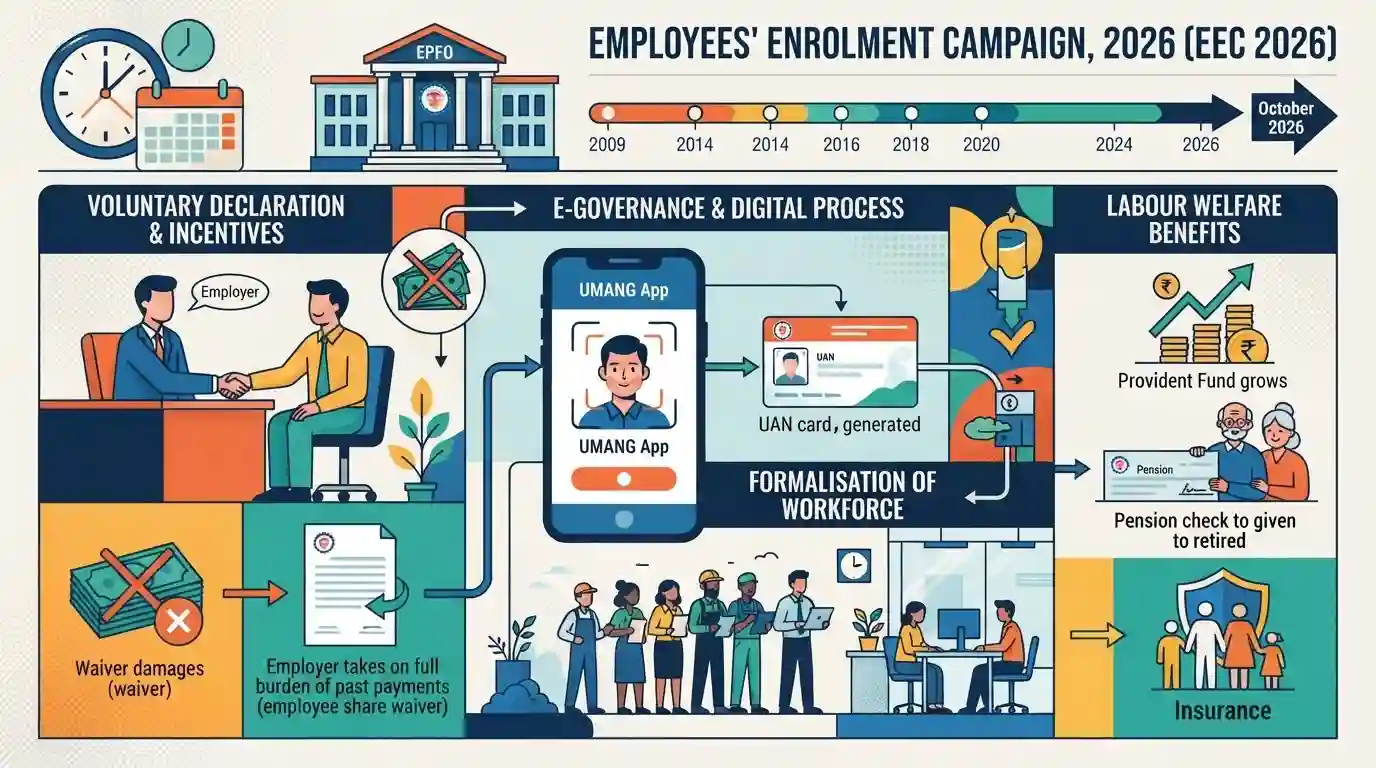
The Employees’ Provident Fund Organisation (EPFO) has initiated the Employees’ Enrolment Campaign, 2026 (EEC 2026) to extend formal social security coverage to previously excluded workers. Open until October 2026, the campaign allows employers to voluntarily declare and enroll employees who were eligible for EPF between 2009 and 2025 but were left out. To encourage compliance, the scheme offers significant incentives, including waivers on damages and the employee's share of past contributions. Emphasizing ease of doing business and e-governance, the enrolment process is completely digital, leveraging the UMANG App for Face Authentication-based UAN generation. This campaign represents a crucial step toward workforce formalization, ensuring millions of workers gain access to provident funds, pensions, and insurance benefits.
Key Points
- The EPFO launched the Employees’ Enrolment Campaign, 2026 (EEC 2026) to bring eligible but unenrolled workers into the formal social security net.
- The campaign applies to employees who were eligible for EPF coverage between April 2009 and December 2025 but were excluded.
- Employers are incentivized to participate through waivers on damages, waivers of the employee's share, and nominal interest rates for regularizing past compliance.
- The enrolment process is entirely digital, utilizing Face Authentication-based Universal Account Number (UAN) generation via the UMANG App and Electronic Challan-cum-Return (ECR).
- The initiative supports the broader goal of formalizing the Indian workforce by ensuring excluded workers receive provident fund, pension, and insurance benefits.
Important Terms
Employees’ Enrolment Campaign, 2026 (EEC 2026)

An EPFO initiative offering a one-time opportunity until October 2026 for employers to voluntarily enroll eligible employees left out of EPF coverage between April 2009 and March 2026, offering relaxations on past compliance arrears.
UPSC context
Relevant for GS Paper 2 and 3 (Labour Welfare, Social Security). Tests knowledge of workforce formalization and voluntary compliance initiatives.
UMANG (Unified Mobile Application for New-age Governance)
Developed by MeitY and NeGD, it is a unified digital platform giving citizens single-point mobile access to thousands of central, state, and local e-governance services, including EPFO functionalities.
UPSC context
Covers GS Paper 2 (e-Governance). Frequently tested regarding Digital India, transparency, and interoperable citizen-centric service delivery models.
Employees' Provident Funds and Miscellaneous Provisions Act, 1952
A primary social security law mandating regular employer and employee contributions to build a retirement corpus. It secures long-term financial stability, pension, and insurance benefits for workers in India's organized sector.
UPSC context
Core syllabus for GS Paper 2 (Social Justice). Key to answering questions on labour rights, statutory frameworks, and social welfare schemes.
Employees’ Provident Fund Organisation (EPFO)
A statutory body operating under the Ministry of Labour and Employment. It administers provident fund, pension, and insurance schemes under the EPF Act 1952 for India's organized sector workforce.
UPSC context
Relevant to GS Paper 2 (Statutory Bodies). Tests institutional mechanisms for administering retirement benefits and expanding national social security nets.
Prelims Trap
All casual and contractual workers are automatically entitled to EPF benefits regardless of establishment size.
False. Entitlement is conditional. The establishment must have 20 or more employees, and the worker's basic wage plus DA must fall below the statutory limit of ₹15,000 per month.
Static Concepts Connected
What is the statutory and administrative structure of the EPFO?
- Statutory Nature: It is a statutory body under the Ministry of Labour & Employment, established by the EPF & MP Act, 1952.
- Tripartite Administration: Administered by the Central Board of Trustees (CBT), a tripartite body comprising representatives of the Government, employers, and employees.
- Schemes Managed: EPFO manages three main schemes: the EPF Scheme (1952), the Pension Scheme (EPS, 1995), and the Deposit Linked Insurance Scheme (EDLI, 1976).
Which Ministry developed the UMANG App and what is its core objective?
- Developer Ministry: It was developed by the Ministry of Electronics and Information Technology (MeitY) and the National e-Governance Division (NeGD).
- Core Objective: It is a unified, multi-service platform providing secure access to central, state, and local government services on a single mobile application.
Cross-Topic Patterns
Formalization via Payroll Data
UPSC frequently tests formalization trends. The government uses EPFO payroll data (via new UAN registrations) as its primary, high-frequency metric to track and claim formal job creation in the economy.
Face Authentication in E-Gov
The shift from fingerprint/iris scans to Aadhaar Face Authentication Technology (FAT) via the UMANG app highlights a major governance push to eliminate hardware dependency in last-mile welfare delivery.

Statements blending EPF eligibility criteria (20+ employees, ₹15k wage cap) with MeitY’s UMANG app utility are highly probable in Prelims.
Linked PYQs · 1
Linked PYQs · 1
- 2021PrelimsGS1
With reference to casual workers employed in India, consider the following statements : 1. All casual workers are entitled for Employees Provident Fund coverage. 2. All casual workers are entitled for regular working hours and overtime payment. 3. The government can by a notification specify that an establishment or industry shall pay wages only through its bank account. Which of the above statements are correct?
