India and Mauritius Sign Long Term Petroleum Supply Pact
Source:PIB ↗
Why It Matters
Highlights India's emerging role as a regional energy anchor and net exporter of refined petroleum, critical for answering Mains GS2 questions on India's foreign policy and maritime geopolitics, as well as GS3 questions on energy security and the Global Biofuels Alliance.
Summary
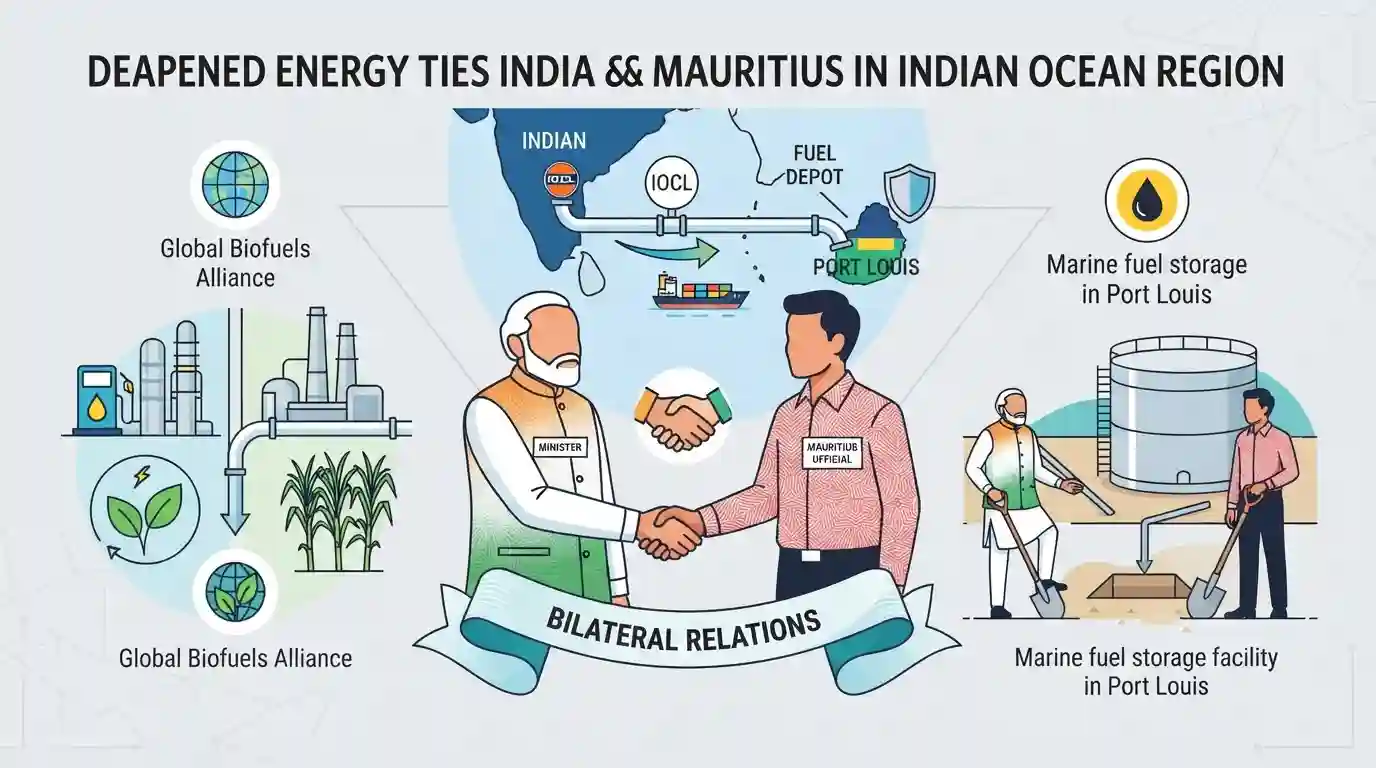
During an official visit to Mauritius by India's Minister for Petroleum and Natural Gas, Hardeep Singh Puri, the two nations significantly deepened their energy ties. A landmark 5-year Sales and Purchase agreement was signed between Indian Oil Corporation Limited (IOCL) and the State Trading Corporation (STC) of Mauritius, ensuring IOCL will supply 100% of the island nation's refined petroleum needs. This agreement—the first of its kind by an Indian public sector undertaking outside South Asia—cements India's role as a key energy security provider in the Indian Ocean Region and shields Mauritius from market volatility. Additionally, both sides broke ground on a marine fuel storage facility in Port Louis and reaffirmed their commitment to the energy transition through the Global Biofuels Alliance.
Key Points
- Union Minister Hardeep Singh Puri visited Mauritius from August 20 to 21, 2026, to sign key agreements in the energy sector.
- A long-term Sales and Purchase agreement was signed between Indian Oil Corporation Limited (IOCL) and the State Trading Corporation (STC) of Mauritius to supply Mauritius's entire requirement of Motor Spirit, High Speed Diesel, and Aviation Turbine Fuel.
- This 5-year agreement marks the first long-term supply pact by an Indian PSU outside South Asia, shielding Mauritius from international price volatility.
- India underscored its role as a global refining hub (annual output of 267 MMT across 23 refineries) and an anchor energy supplier for the Indian Ocean Region.
- A groundbreaking ceremony was held for India Oil (Mauritius) Ltd's 27.5 TMT bunker marine fuel storage facility at Mer Rouge, Port Louis.
- Cooperation in biofuels was emphasized, with Mauritius launching its Biofuels Country Landscape Policy framework, aligning with its role as a founding member of the Global Biofuels Alliance (GBA).
Important Terms
Global Biofuels Alliance (GBA)

A multilateral platform initiated by India during its 2023 G20 Presidency to accelerate global adoption of sustainable biofuels through standard-setting, technology sharing, and capacity building.
UPSC context
GS Paper 2 (Global Groupings) & GS Paper 3 (Energy Security). Tests India's leadership in the global green transition.
Indian Oil Corporation Limited (IOCL)
India’s largest state-owned oil refining and marketing public sector undertaking, playing a pivotal role in national energy security and regional energy diplomacy in the Indian Ocean.
UPSC context
GS Paper 3 (Infrastructure/Energy). Tests the role of public sector enterprises in executing India's bilateral energy diplomacy.
State Trading Corporation (STC) of Mauritius
The state-run trading arm of Mauritius responsible for importing essential commodities, acting as the primary agency securing the nation's refined petroleum needs.
UPSC context
GS Paper 2 (Bilateral Relations). Tests understanding of bilateral trade bodies executing government-to-government energy agreements.
India Oil (Mauritius) Ltd (IOML)
A key overseas subsidiary of IOCL operating in Mauritius since 2001, responsible for expanding local oil infrastructure and bunkering capabilities in the region.
UPSC context
GS Paper 2 (Bilateral/Regional Geopolitics). Tests India's SAGAR vision and energy infrastructure footprint in the Indian Ocean.
Biofuels Country Landscape Policy framework
A customized policy blueprint created by the GBA Secretariat and Mauritian Ministry to map out feedstocks, technologies, and a roadmap for Mauritius’ biofuel transition.
UPSC context
GS Paper 3 (Energy/Environment). Tests practical execution of global green partnerships and technology transfers in bilateral diplomacy.
Prelims Trap
The 5-year IOCL-Mauritius agreement is India's first-ever long-term refined petroleum supply agreement signed with any foreign nation.
India already has long-standing, long-term supply arrangements with immediate South Asian neighbors like Nepal and Bhutan. The Mauritius deal is unique as the first *outside* South Asia.
Static Concepts Connected
What is India's SAGAR Vision in the Indian Ocean?
- Origin and Objective: Launched in 2015 to deepen economic and security cooperation with India's maritime neighbors.
- Key Pillars: Focuses on maritime security, disaster response, blue economy, and counterbalancing external hegemonies in the Indian Ocean.
- Geopolitical Role: Positions India as a dependable, non-reciprocal 'net security provider' and development partner in the region.
What is the Global Biofuels Alliance (GBA)?
- Inception: Launched at the G20 New Delhi Summit in September 2023 by India, US, and Brazil.
- Secretariat and Mandate: Headquartered in New Delhi, India, facilitating global technology transfer and standard-setting for sustainable biofuels.
- Key Goals: Aims to double global biofuel trade and establish robust supply chains for ethanol and compressed biogas.
Cross-Topic Patterns
Blue Economy + Strategic Energy Hubs
India's investment in Port Louis bunkering facilities links maritime trade route security with energy diplomacy, directly serving both SAGAR goals and domestic oil public sector export strategies.
GBA + South-South Cooperation
India exporting its domestic biofuel policy templates (like SATAT and GOBARdhan) to Mauritius showcases clean energy diplomacy as a tool for developmental leadership in the Global South.

India's transition to an energy security anchor in the Western IOR via PSU diplomacy is a high-probability GS-2 bilateral relations theme.
Linked PYQs · 3
Linked PYQs · 3
- 2024MainsGS2
Discuss the geopolitical and geostrategic importance of Maldives for India with a focus on global trade and energy flows. Further also discuss how this relationship affects India's maritime security and regional stability amidst international competition ?
- 2025MainsGS2
"Energy security constitutes the dominant kingpin of India's foreign policy, and is linked with India's overarching influence in Middle Eastern countries.” How would you integrate energy security with India's foreign policy trajectories in the coming years?
- 2017PrelimsGS1
It is possible to produce algae based biofuels, but what is/are the likely limitation(s) of developing countries in promoting this industry? 1. Production of algae based biofuels is possible in seas only and not on continents. 2. Setting up and engineering the algae based biofuel production requires high level of expertise/technology until the construction is completed. 3. Economically viable production necessitates the setting up of large scale facilities which may raise ecological and social concerns. Select the correct answer using the code given below:
