Empowered Committee Reviews Growth of Women Rural Enterprises
Source:PIB ↗
কেন এটি গুরুত্বপূর্ণ
It highlights the government's strategic shift from basic microfinance to establishing growth-oriented micro-enterprises for women. The collaboration between grassroots SHG networks and premier institutes (IITs/IIMs) serves as a potent case study for Mains answers on rural development, poverty alleviation, and women's empowerment.
সারসংক্ষেপ
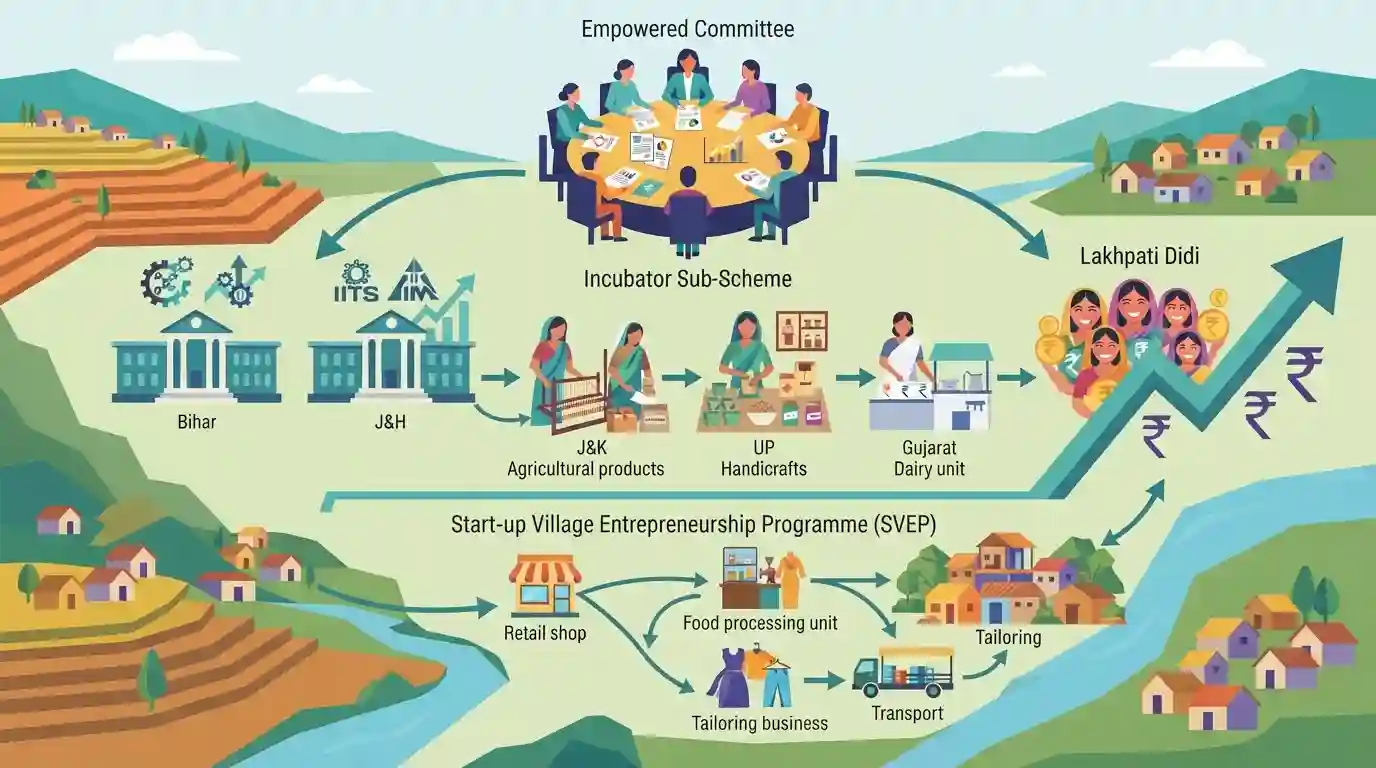
The Ministry of Rural Development's Empowered Committee has reviewed and advanced proposals under DAY-NRLM to accelerate the growth of women-led rural enterprises. In an effort to support the national "Lakhpati Didi" target, the ministry is rolling out an Incubator Sub-Scheme by partnering with premier academic institutions like IITs and IIMs in Bihar, J&K, UP, and Gujarat. These incubators will help small-scale Self-Help Group (SHG) businesses scale up. Additionally, the Start-up Village Entrepreneurship Programme (SVEP) is being expanded to strengthen rural non-farm livelihoods and grassroots entrepreneurship.
মূল বিষয়
- The Empowered Committee reviewed proposals to scale up women-led rural enterprises under the Non-Farm Livelihoods component of DAY-NRLM.
- The initiative aims to help small-scale SHG enterprises graduate into growth-oriented businesses, contributing to the national goal of creating 6 crore Lakhpati Didis.
- Four new incubator proposals from Bihar, J&K, UP, and Gujarat were approved, forming partnerships with premier institutes like IIT Patna, IIM Jammu, IIM Lucknow, and IIT Gandhinagar.
- The Start-up Village Entrepreneurship Programme (SVEP) is also being expanded in states like West Bengal and Goa to foster local business ecosystems.
গুরুত্বপূর্ণ শব্দ
DAY-NRLM (Deendayal Antyodaya Yojana-National Rural Livelihoods Mission)

A flagship poverty alleviation scheme of the Ministry of Rural Development aimed at mobilizing rural poor households into Self-Help Groups (SHGs) and promoting sustainable livelihoods.
UPSC context
GS Paper II (Governance) & GS Paper III (Inclusive Growth). Tests strategies for rural poverty alleviation and SHG-led models.
Lakhpati Didi initiative
A flagship scheme under DAY-NRLM that empowers women in Self-Help Groups to achieve a sustainable annual household income of at least rupees one lakh.
UPSC context
GS Paper II (Welfare Schemes) & GS Paper III (Inclusive Growth). Tests women's economic empowerment and micro-enterprise development.
Start-up Village Entrepreneurship Programme (SVEP)
A sub-scheme of DAY-NRLM that promotes rural non-farm livelihoods by assisting SHG members and rural youth to set up and grow local micro-enterprises.
UPSC context
GS Paper III (Indian Economy & Employment). Tests rural non-farm entrepreneurship and strategies to reduce distress migration.
Incubator Sub-Scheme
A DAY-NRLM initiative partnering with academic institutions like IITs and IIMs to help high-potential rural Self-Help Group enterprises scale up through mentoring and technology.
UPSC context
GS Paper II (SHG Governance) & GS Paper III (Technology/Economy). Tests academic-industry partnerships for rural enterprise formalization and scaling.
Ministry of Rural Development
The apex ministry of the Government of India overseeing policies and schemes related to poverty alleviation, employment generation, and socio-economic transformation in rural areas.
UPSC context
GS Paper II (Government Policies & Interventions). Tests structural understanding of policy formulation and execution for rural development.
প্রিলিমস ফাঁদ
The Start-up Village Entrepreneurship Programme (SVEP) is an exclusive initiative targeting 100% women-owned enterprises in rural areas.
SVEP mandates a minimum of 60% women beneficiaries, meaning it is highly inclusive of women but not restricted to them, leaving room for other marginalized sections.
সংযুক্ত স্থির ধারণা
What are the core pillars and funding pattern of DAY-NRLM?
- Social Mobilization: Universal Social Mobilization ensures at least one woman from every identified rural poor household is brought into the Self-Help Group (SHG) network.
- Financial Inclusion: Provides financial resources through Revolving Funds (RF) and Community Investment Funds (CIF) to build institutional financial capacity.
- Funding Pattern: Shared between Centre and States in a 60:40 ratio; 90:10 for Himalayan and North-Eastern states; 100% for Union Territories.
What are the key operational features of SVEP?
- Sub-scheme Status: Launched in 2016 as a sub-scheme of DAY-NRLM to promote sustainable non-farm livelihoods in rural areas.
- Community Cadre: Utilizes local youth trained as Community Resource Persons for Enterprise Promotion (CRP-EP) to provide technical and business handholding.
- Financial Channel: Establishes Block Resource Centres (BRCs) to channel seed capital via the Community Enterprise Fund (CEF) to micro-enterprises.
আন্তঃবিষয় প্যাটার্ন
SHGs + Rural Financial Inclusion
Scaling rural micro-enterprises through SHGs acts as a vital transmission channel for financial inclusion, boosting bank credit-deposit ratios and reducing reliance on informal rural moneylenders.
Incubators + Academic-Industry Integration
Linking IITs/IIMs to rural enterprises bridges the rural-urban technology divide, operationalizing NEP's mandate of leveraging premier academic research for grassroots social innovation.

Multi-statement questions testing SVEP's demographic mandates, the Lakhpati Didi criteria, and NRLM's non-farm sub-schemes are highly likely.
সংযুক্ত PYQ · 4
সংযুক্ত PYQ · 4
- 2021MainsGS2
Can the vicious cycle of gender inequality, poverty and malnutrition be broken through microfinancing of women SHGs? Explain with examples.
- 2020MainsGS2
Micro-Finance as an anti-poverty vaccine, is aimed at asset creation and income security of the rural poor in India". Evaluate the role of the Self Help Groups in achieving the twin objectives along with empowering women in rural India.
- 2015MainsGS2
The Self-Help Group (SHG) Bank Linkage Programme (SBLP), which is India's own innovation, has proved to be one of the most effective poverty alleviation and women empowerment programmes. Elucidate.
- 2023PrelimsGS1
Consider the following statements: 1. The Self-Help Group (SHG) programme was originally initiated by the State Bank of India by providing microcredit to the financially deprived. 2. In an SHG, all members of a group take responsibility for a loan that an individual member takes. 3. The Regional Rural Banks and Scheduled Commercial Banks support SHGs. How many of the above statements are correct?
