Government Restricts Specific FDC Medicines for Young Children
Source:PIB ↗
কেন এটি গুরুত্বপূর্ণ
The regulation of Fixed Dose Combinations (FDCs) frequently appears in public health and governance discourse due to the proliferation of irrational drug combinations in the Indian market. Understanding this action highlights the operational mechanisms of the Drugs and Cosmetics Act, 1940, the advisory role of the DTAB, and serves as a prime example of state intervention to ensure patient safety and curb adverse marketisation in the pharmaceutical sector.
সারসংক্ষেপ
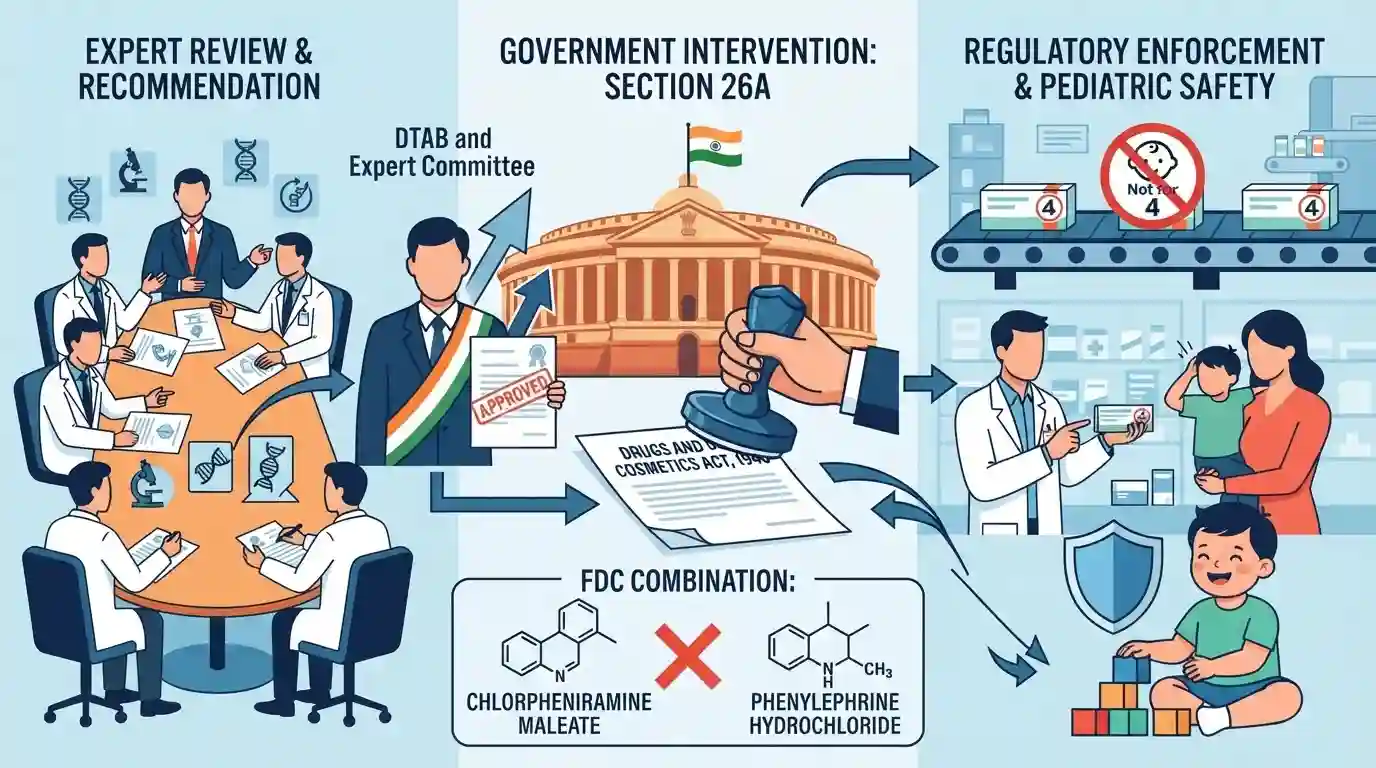
The Government of India has imposed restrictions on the manufacture, sale, and distribution of Fixed Dose Combinations (FDCs) containing Chlorpheniramine Maleate and Phenylephrine Hydrochloride for use in children below four years of age. Acting on recommendations from an Expert Committee and the Drugs Technical Advisory Board (DTAB), the Ministry of Health and Family Welfare invoked Section 26A of the Drugs and Cosmetics Act, 1940 to enforce this rule. Pharmaceutical manufacturers must now prominently display a warning stating that the FDC shall not be used in children under four on labels, package inserts, and promotional literature. The move reflects the government's intervention to protect pediatric populations from potentially harmful or irrational drug combinations when safer alternatives are available.
মূল বিষয়
- The Indian Government has restricted the manufacture, sale, and distribution of Fixed Dose Combinations (FDCs) of Chlorpheniramine Maleate and Phenylephrine Hydrochloride for children under four years of age.
- Manufacturers are mandated to display the specific warning: "Fixed Dose Combination shall not be used in children below four years of age" on all packaging, inserts, and promotional materials.
- The restriction is enforced under Section 26A of the Drugs and Cosmetics Act, 1940, which empowers the government to regulate drugs in the interest of public health.
- The regulatory action follows direct recommendations from the Drugs Technical Advisory Board (DTAB) and an Expert Committee, citing potential health risks to very young children and the availability of safer alternatives.
গুরুত্বপূর্ণ শব্দ
Fixed Dose Combinations (FDCs)

Pharmaceutical formulations containing two or more active pharmacological ingredients combined in a fixed ratio in a single dosage form (such as a tablet or syrup) to improve compliance or efficacy.
UPSC context
GS Paper 3 (Public Health / Science); tests awareness of therapeutic rationality, drug safety, and antimicrobial resistance in India.
Drugs and Cosmetics Act, 1940
The primary legislation in India regulating the import, manufacture, distribution, and sale of drugs, cosmetics, and medical devices to ensure their safety, quality, and efficacy.
UPSC context
GS Paper 2 (Governance / Statutory Laws); tests knowledge of foundational legal frameworks protecting public health and regulatory compliance.
Drugs Technical Advisory Board (DTAB)
The highest statutory technical advisory body in India on drug-related matters, established under the Drugs and Cosmetics Act, 1940, chaired by the Director General of Health Services.
UPSC context
GS Paper 2 (Regulatory / Statutory Bodies); tests technical-oversight mechanisms in healthcare and the validity of pharmaceutical formulations.
Section 26A (Drugs and Cosmetics Act)
A legal provision empowering the Central Government to prohibit, restrict, or regulate the manufacture, sale, or distribution of drugs if they pose health risks or lack therapeutic value.
UPSC context
GS Paper 2 (Government Policies / Health); tests executive powers to enforce pharmaceutical bans in the interest of public safety.
Central Drugs Standard Control Organisation (CDSCO)
India's National Regulatory Authority (NRA) responsible for approving new drugs, conducting clinical trials, setting drug standards, and coordinating state-level drug control authorities.
UPSC context
GS Paper 2 (Governance / Regulatory Institutions); tests knowledge of institutional oversight protecting public health against substandard pharmaceuticals.
প্রিলিমস ফাঁদ
The Drugs Controller General of India (DCGI) acts as the ex-officio Chairperson of the Drugs Technical Advisory Board (DTAB).
The DTAB is chaired by the Director General of Health Services (DGHS). The DCGI serves as the Member-Secretary of this statutory advisory body.
সংযুক্ত স্থির ধারণা
What is the Drugs Technical Advisory Board (DTAB) and its composition?
- Statutory Origin: Established under Section 5 of the Drugs and Cosmetics Act, 1940, to advise governments on drug technicalities.
- Ex-Officio Leadership: Chaired by the Director General of Health Services (DGHS), with the DCGI serving as its Member-Secretary.
- Key Mandate: Advises both Central and State governments on statutory technical matters arising from the administration of the Act.
What are Fixed Dose Combinations (FDCs) and why are they regulated?
- Basic Definition: Formulations containing two or more active ingredients in a single, fixed-ratio dosage form to improve compliance.
- Regulatory Trigger: Regulated under Section 26A of the 1940 Act due to risks of irrational combinations and side-effect tracking difficulties.
- AMR Association: Overuse of unscientific antibiotic FDCs is a prime driver of antimicrobial resistance (AMR) in India.
আন্তঃবিষয় প্যাটার্ন
Central-State Drug Regulation
While central bodies like CDSCO set drug standards, State Licensing Authorities handle local manufacturing licenses, presenting coordination challenges in federal public health administration.
FDCs and Antimicrobial Resistance
The proliferation of unapproved, irrational antibiotic FDCs directly undermines India's National Action Plan on AMR, creating a critical link between trade regulation and global health security.

Multi-statement questions are likely to test the statutory origin of DTAB, distinguishing the roles of DGHS, DCGI, and Section 26A powers.
সংযুক্ত PYQ · 1
সংযুক্ত PYQ · 1
- 2024MainsGS2
In a crucial domain like the public healthcare system the Indian State should play a vital role to contain the adverse impact of marketisation of the system. Suggest some measures through which the State can enhance the reach of public healthcare at the grassroots level.
