BRICS Communications Ministers Meeting and India ICT Chairship 2026
Source:PIB ↗
આ શા માટે મહત્વનું છે
India's upcoming Chairship of BRICS in 2026 makes the grouping highly relevant for both Prelims and Mains. Furthermore, India is increasingly using its Digital Public Infrastructure (DPI) as a diplomatic tool and a soft-power asset in global governance forums, blending technology with international relations.
સારાંશ
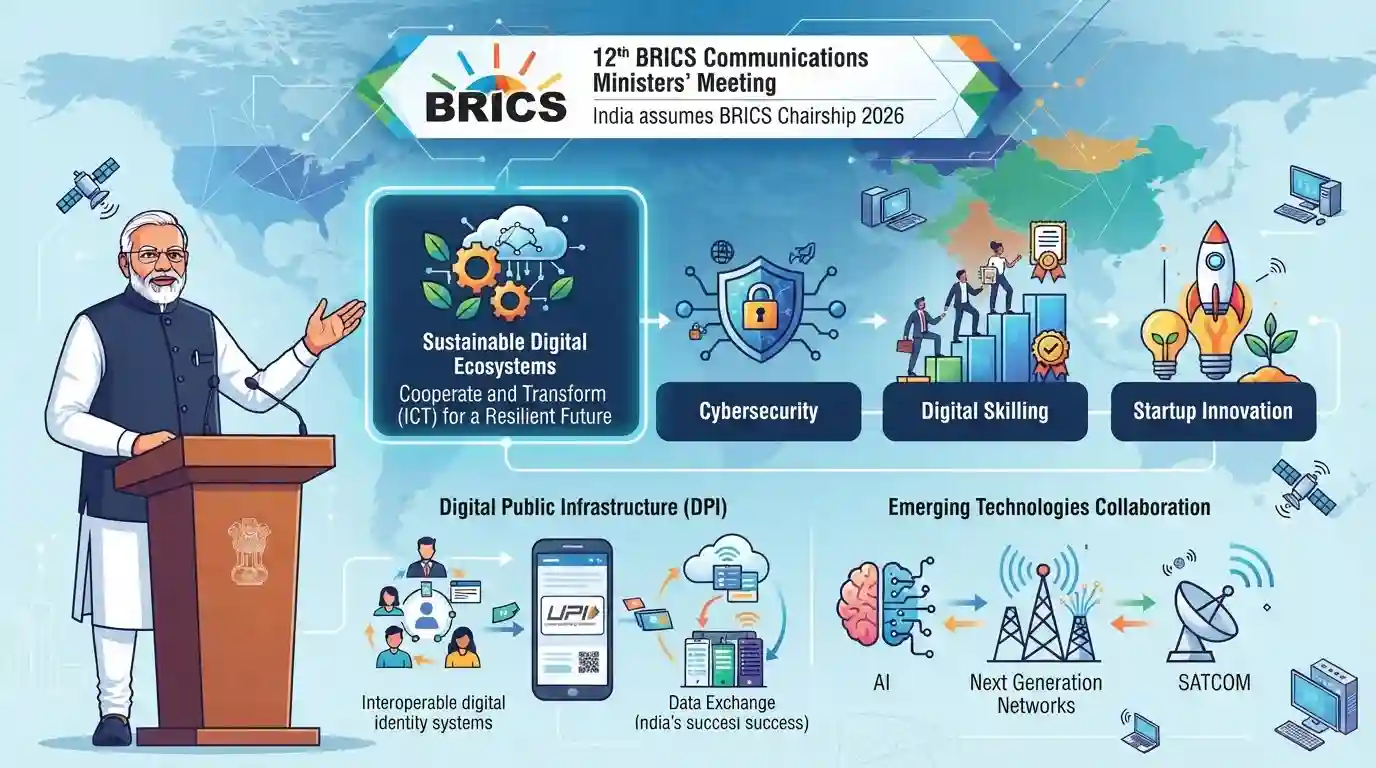
Union Minister of Communications Jyotiraditya M. Scindia led the Indian delegation at the 12th BRICS Communications Ministers’ Meeting in Pune. Addressing the expanded BRICS bloc, the Minister announced that India will assume the BRICS Chairship in 2026. He unveiled the 2026 ICT track theme: "Innovate, Cooperate and Transform (ICT) for a Resilient Future," structured around four pillars—sustainable digital ecosystems, cybersecurity, digital skilling, and startup innovation. India offered to share its successful Digital Public Infrastructure (DPI) frameworks and advocated for collaborative approaches to emerging technologies like AI, Next Generation Networks, and SATCOM, emphasizing BRICS' central role in shaping an inclusive global digital future.
મુખ્ય મુદ્દા
- The 12th BRICS Communications Ministers' Meeting was held in Pune, Maharashtra, led by India's Union Minister of Communications Jyotiraditya Scindia.
- India announced its upcoming Chairship of BRICS in 2026, unveiling the ICT track theme: 'Innovate, Cooperate and Transform (ICT) for a Resilient Future'.
- Four strategic pillars were outlined for BRICS ICT cooperation: sustainable digital ecosystems, cybersecurity, digital skilling, and innovation/startups.
- India emphasized sharing its Digital Public Infrastructure (DPI) experience and called for a balanced, ethical approach to Artificial Intelligence (AI) and cybersecurity.
- The meeting highlighted BRICS' growing influence in global tech governance, given the bloc represents nearly half of humanity and two-fifths of the global economy.
મહત્વપૂર્ણ શબ્દો
Digital Public Infrastructure (DPI)

Foundational, interoperable digital systems—encompassing identity, payments, and data exchange—that enable secure, inclusive, and scalable public service delivery and economic activity.
UPSC context
Crucial for GS Paper 2 (Governance) and GS 3 (Technology), showcasing India's e-governance successes like UPI and its tech diplomacy.
BRICS
A geopolitical grouping originally including Brazil, Russia, India, China, and South Africa. Expanded in 2024 to include Egypt, Ethiopia, Iran, and the UAE, representing emerging economies of the Global South.
UPSC context
Essential for GS Paper 2 (International Relations), focusing on global groupings, multipolarity, and India's strategic foreign policy interests.
Ministry of Communications
The central government ministry responsible for telecommunications and postal services, managing India's ICT infrastructure, digital inclusion policies, and international telecom cooperation.
UPSC context
Relevant to GS Paper 2 (Government Policies) and GS 3 (Infrastructure), highlighting the regulatory framework for India's digital transformation.
પ્રિલિમ્સ ટ્રેપ
The 12th BRICS Communications Ministers Meeting established an exclusive, jointly funded 'BRICS Digital Public Infrastructure' framework.
India offered to share its own domestic DPI frameworks (like India Stack) with member nations. It did not create an exclusive, jointly funded BRICS-level DPI framework.
સંલગ્ન સ્થિર ખ્યાલો
What is the current composition and chairship rotation mechanism of BRICS?
- Rotation mechanism: It traditionally rotates annually following the B-R-I-C-S acronym order. India assumed its fourth chairship in 2026.
- Expanded membership: Expanded from 5 to 11 full members, adding Egypt, Ethiopia, Iran, Saudi Arabia, UAE, and Indonesia (in 2025).
What are the core components of India's Digital Public Infrastructure (DPI)?
- Core philosophy: Open-source, interoperable digital building blocks that enable essential, society-wide functions rather than proprietary silos.
- The India Stack: Built on three foundational pillars: Identity (Aadhaar), Payments (UPI), and Data Exchange (DigiLocker/Account Aggregator).
આંતર-વિષય પેટર્ન
DPI as India's strategic soft power
India is systematically using multilateral platforms (G20, SCO, and now BRICS) to export its DPI (India Stack) as a cost-effective, non-coercive alternative to Western financial and digital aid for the Global South.
Tech governance and multipolarity
By emphasizing 'safe-by-design' AI and ethical cybersecurity at BRICS, India is pushing for a multipolar global tech governance model to counterbalance Western-dominated standard-setting bodies.

BRICS expansion (11 members) + India's 2026 Chairship + DPI diplomacy likely to merge into a single multi-statement Prelims question.
સંલગ્ન PYQ · 5
સંલગ્ન PYQ · 5
- 2012MainsGS2
Compare the significance of IBSA and BRICS in the context of India's multilateral diplomacy.
- 2025PrelimsGS1
Consider the following statements with regard to BRICS : I. 16th BRICS Summit was held under the Chairship of Russia in Kazan. II. Indonesia has become a full member of BRICS. III. The theme of the 16th BRICS Summit was Strengthening Multiculturalism for Just Global Development and Security. Which of the statements given above is/are correct?
- 2015PrelimsGS1
The 'Fortaleza Declaration', recently in the news, is related to the affairs of
- 2026PrelimsGS1
Which one of the following best describes the key objective of India's 'Open Network for Digital Commerce' (ONDC) initiative ?
- 2023MainsGS3
Introduce the concept of Artificial Intelligence (AI). How does Al help clinical diagnosis? Do you perceive any threat to privacy of the individual in the use of Al in healthcare?
