Mobile Phone Manufacturing Scheme Notified for Domestic Value Addition
Source:PIB ↗
Why It Matters
Electronics manufacturing is a key driver for export-led growth and employment generation in India. The transition from PLI-LSEM to MPMS marks a crucial policy shift towards deeper integration in global value chains (GVCs) and addresses structural challenges in domestic value addition, which are frequent themes in GS3 Mains questions regarding industrial policy and self-reliance.
Summary
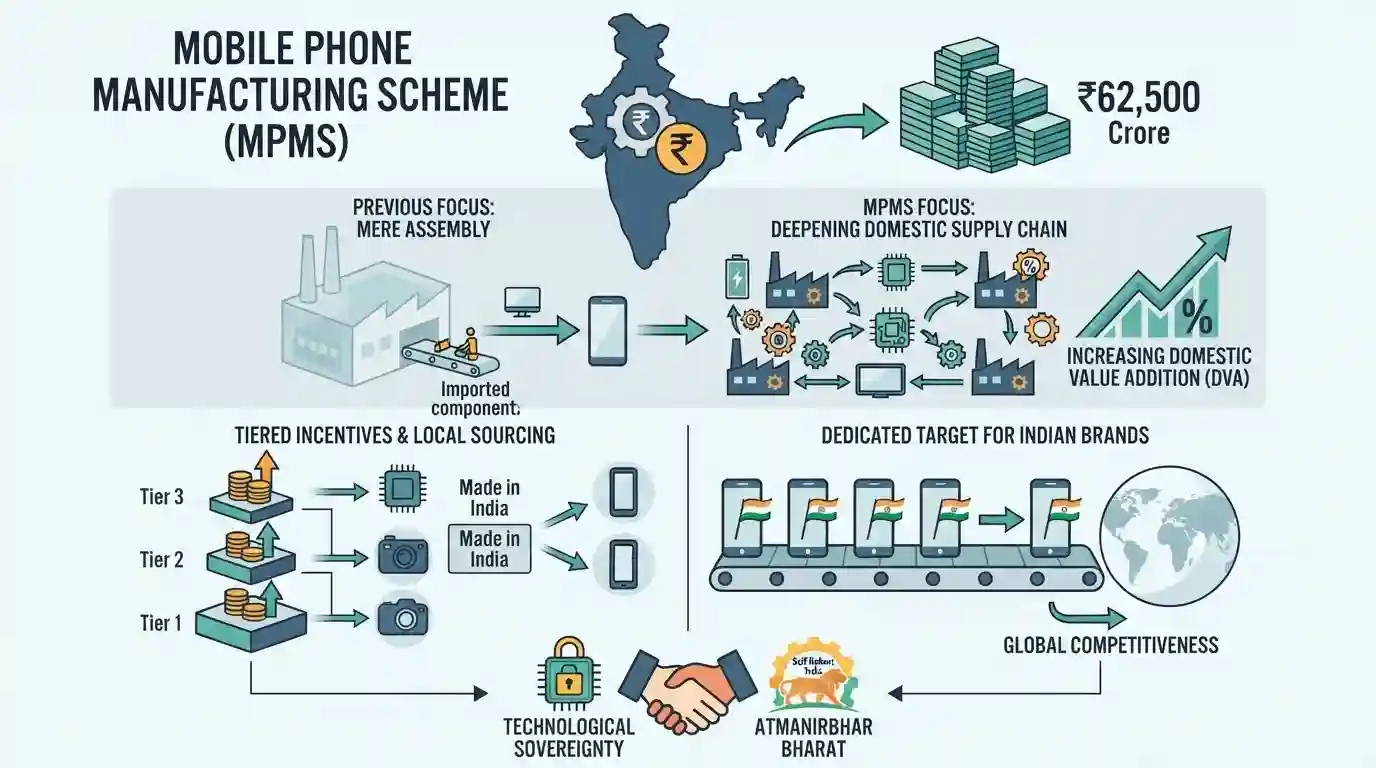
The Ministry of Electronics and Information Technology (MeitY) has notified the Mobile Phone Manufacturing Scheme (MPMS) with an outlay of ₹62,500 crore over five years. As the successor to the PLI-LSEM scheme, MPMS shifts the focus from mere assembly to deepening the domestic supply chain and increasing Domestic Value Addition (DVA). By introducing tiered incentives for local component sourcing and a dedicated target segment for Indian brands, the scheme aims to build technological sovereignty, enhance global competitiveness, and realize the vision of an Atmanirbhar Bharat in electronics manufacturing.
Key Points
- The Government notified the ₹62,500 crore Mobile Phone Manufacturing Scheme (MPMS) running from FY 2026-27 to FY 2030-31.
- The scheme aims to shift India from an assembly hub to a deeper manufacturing ecosystem by emphasizing Domestic Value Addition (DVA).
- It comprises two target segments: TS1 for expanding overall manufacturing capacity, and TS2 specifically for supporting and nurturing domestic Indian mobile phone brands.
- It introduces a tiered incentive structure that rewards manufacturers for sourcing components locally, directly addressing criticisms of the previous PLI-LSEM scheme.
- MPMS is a strategic step toward achieving technological sovereignty and building globally competitive 'Indian Brands' in the electronics sector.
Important Terms
Mobile Phone Manufacturing Scheme (MPMS)

A ₹62,500 crore government scheme (2026–2031) offering 2.25-5% incentives on eligible mobile sales. Succeeding the PLI-LSEM, it aims to boost local component sourcing, deepen the domestic supply chain, and support the global expansion of Indian brands.
UPSC context
Highly relevant for GS Paper 3 (Industrial Policy) to illustrate state intervention transitioning from mere assembly to deep supply chain indigenization.
Domestic Value Addition (DVA)
The share of a product’s final value generated within the home country rather than imported. India aims to increase its electronics DVA from the current 23% to 35-40% by manufacturing components locally rather than just assembling them.
UPSC context
Crucial for GS Paper 3 (Economy, Indigenization of Technology) as a metric of true self-reliance, distinguishing deep manufacturing from import-dependent assembly.
Production Linked Incentive Scheme for Large Scale Electronics Manufacturing (PLI-LSEM)
A 2020–2026 scheme offering financial rewards for boosting domestic mobile and component manufacturing. It catalyzed ₹96,000 crore in investments, transforming India into a net exporter and the world's second-largest mobile manufacturer by volume.
UPSC context
Important for GS Paper 3 (Mobilization of Resources) as a successful case study of export promotion and generating massive manufacturing investments.
Atmanirbhar Bharat
The overarching government vision for a self-reliant India. In electronics, it emphasizes reducing import dependence and achieving technological sovereignty by fostering indigenous R&D, local supply chains, and building resilient domestic manufacturing ecosystems.
UPSC context
Foundational for GS Paper 3 (Economic Growth, Indigenization of Technology) testing understanding of strategic autonomy within globalized value chains.
Make in India
Launched in 2014 to transform India into a global design and manufacturing hub. In the electronics sector, the initiative has propelled production growth by seven times and export growth by eleven times over the last decade.
UPSC context
Relevant for GS Paper 3 (Industrial Policy, Employment) to evaluate the long-term impact of manufacturing-focused initiatives on job creation and competitiveness.
Prelims Trap
"MPMS applies uniform turnover thresholds and identical incentive rates for both global and domestic manufacturers."
MPMS relies on an asymmetric structure: a ₹10,000 crore turnover threshold for global firms versus just ₹1,000 crore for domestic firms, alongside exclusive R&D incentives for Indian brands.
Static Concepts Connected
What is the "Smile Curve" in manufacturing?
- High-Value Ends: R&D, product design (pre-production), and branding/sales (post-production) capture the highest economic value on the curve.
- Low-Value Middle: Basic physical assembly sits at the bottom of the curve, capturing the lowest profit margins. Previous policies were criticized for keeping India here.
- Policy Shift: MPMS's dedicated 3% incentive for local product design and R&D explicitly attempts to push Indian manufacturing up the higher-value left side of the curve.
How do production-linked schemes avoid violating WTO anti-subsidy rules?
- SCM Agreement: The WTO's Agreement on Subsidies and Countervailing Measures (SCM) strictly prohibits subsidies that are directly contingent on export performance (like India's old MEIS).
- Production, Not Exports: PLI and MPMS incentives are disbursed based on incremental production and sales, regardless of whether the goods are exported or consumed domestically.
- Compliance Mechanism: By linking payouts to domestic manufacturing scale rather than export targets, these schemes remain largely WTO-compliant (though they can still be actionable if they harm another member's industry).
Cross-Topic Patterns
Addressing the 'Assembly Hub' critique
Former economists criticized previous PLIs for simply increasing component imports while boosting final-product exports. MPMS's specific Domestic Value Addition (DVA) targets directly address this macroeconomic vulnerability.
Synergy with Semiconductor & Fab Missions
The specific 0.3% local sourcing incentive for display/camera modules perfectly dovetails with the India Semiconductor Mission's (ISM) multi-billion-dollar push for domestic display and semiconductor fabrication units.

Expect a question contrasting PLI-LSEM's assembly focus with MPMS's Domestic Value Addition (DVA) and asymmetric domestic firm quotas.
Linked PYQs · 2
Linked PYQs · 2
- 2025MainsGS3
Discuss the rationale of the Production Linked Incentive (PLI) scheme. What are its achievements? In what way can the functioning and outcomes of the scheme be improved?
- 2025MainsGS3
India aims to become a semiconductor manufacturing hub. What are the challenges faced by the semiconductor industry in India? Mention the salient features of the India Semiconductor Mission.
