India and Nepal Hold Joint Working Group Meeting on Border Security
Source:PIB ↗
কেন এটি গুরুত্বপূর্ণ
The India-Nepal border is unique due to its open and porous nature, which facilitates deep socio-cultural ties but also presents severe security challenges like human trafficking, smuggling, and cross-border crimes. Strengthening border infrastructure (such as Integrated Check Posts) and inter-agency coordination is vital to national security and for nurturing a stable bilateral relationship.
সারসংক্ষেপ
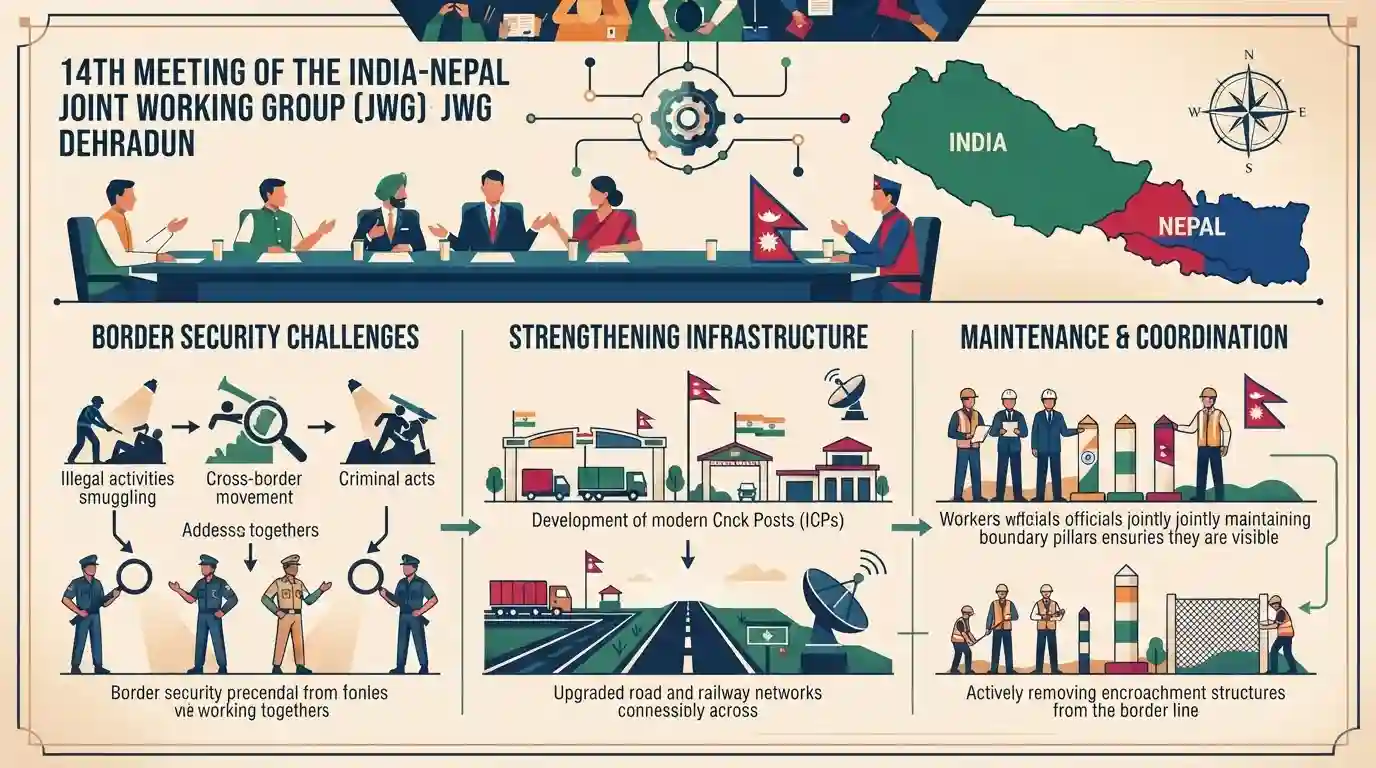
The 14th meeting of the India-Nepal Joint Working Group (JWG) in Dehradun highlighted key aspects of border management and security. Delegations led by the respective Ministries of Home Affairs discussed pressing challenges such as trans-border crimes and criminal activities along the open border. Both nations committed to strengthening border infrastructure, specifically through Integrated Check Posts (ICPs) and transport networks, alongside maintaining boundary pillars and removing encroachments to ensure better coordination.
মূল বিষয়
- The 14th India-Nepal Joint Working Group (JWG) meeting was held in Dehradun on 20-21 August 2026.
- The delegations focused on bilateral cooperation regarding border management and addressing trans-border crime.
- Key priorities discussed included the effective utilisation of border infrastructure like Integrated Check Posts (ICPs), roads, and railway networks.
- Both sides emphasized the removal of border encroachments, maintenance of boundary pillars, and capacity building for institutional coordination.
গুরুত্বপূর্ণ শব্দ
Integrated Check Posts (ICPs)

Modern border facilities created by the Land Ports Authority of India (LPAI). They consolidate customs, immigration, and security within a single zone to streamline cargo and passenger movement.
UPSC context
Crucial for GS Paper III (Border Management/Infrastructure) and GS Paper II (Neighborhood Relations). Tests understanding of secure cross-border trade facilitation.
India-Nepal Joint Working Group (JWG)
A bilateral institutional mechanism between India and Nepal to discuss border management, trans-border crime, border infrastructure, and coordinate security efforts.
UPSC context
Important for GS Paper II (India & its Neighborhood) and GS Paper III (Internal Security). Tests awareness of bilateral diplomacy and border coordination.
Open Border
The porous boundary between India and Nepal, rooted in the 1950 Treaty of Peace and Friendship, permitting largely unrestricted movement of citizens without visas.
UPSC context
Central to GS Paper II (India-Nepal Relations) and GS Paper III (Border Security). Tests knowledge of historical treaties and related security challenges.
Ministry of Home Affairs (MHA)
The central government ministry responsible for internal security, border management (including the Department of Border Management), and center-state relations in India.
UPSC context
Foundational for GS Paper III (Security) and GS Paper II (Governance). Tests knowledge of India's internal security and border management architecture.
প্রিলিমস ফাঁদ
"The open border between India and Nepal is guarded jointly by the Border Security Force (BSF)."
The Sashastra Seema Bal (SSB) is the sole border guarding force for the India-Nepal border under the 'One Border, One Force' principle, not the BSF.
সংযুক্ত স্থির ধারণা
What is India's 'One Border, One Force' policy?
- Kargil Review Committee: Originated from the Kargil Review Committee recommendations to assign a single Central Armed Police Force to a specific border to prevent command duplication.
- SSB's mandate: Under this policy, the Sashastra Seema Bal (SSB) was designated in 2001 as the sole border-guarding force for the open borders of Nepal and Bhutan.
- Other alignments: Other force alignments include the BSF for Pakistan/Bangladesh, ITBP for China, and Assam Rifles for Myanmar.
What are Integrated Check Posts (ICPs)?
- Single-window hubs: They are border infrastructure combining customs, immigration, and quarantine services under one roof to facilitate seamless cross-border trade and passenger movement.
- LPAI Management: On the Indian side, all ICPs are developed and managed by the Land Ports Authority of India (LPAI) under the Ministry of Home Affairs.
আন্তঃবিষয় প্যাটার্ন
Free movement vs Internal Security
The 1950 Treaty allows passport-free transit, complicating security. This mirrors GS3 debates on balancing cross-border ethnic ties with national security, similar to the Free Movement Regime (FMR) along the Myanmar border.
Cartographic disputes & Das Gaja
Local encroachment issues in the ten-yard 'Das Gaja' no-man's-land often spark localized tensions, forming a continuous sub-text to larger sovereign territorial disputes like Kalapani and Susta.

Expect a multi-statement question mapping border-guarding forces (SSB for Nepal) alongside border infrastructure (ICPs) and state borders.
সংযুক্ত PYQ · 3
সংযুক্ত PYQ · 3
- 2024MainsGS3
India has a long and troubled border with China and Pakistan fraught with contentious issues. Examine the conflicting issues and security challenges along the border. Also give out the development being undertaken in these areas under the Border Area Development Programme (BADP) and Border Infrastructure and Management (BIM) Scheme.
- 2020MainsGS3
Analyze internal security threats and transborder crimes along Myanmar, Bangladesh and Pakistan borders including Line of Control (LoC). Also discuss the role played by various security forces in this regard.
- 2018MainsGS3
India's proximity to two of the world's biggest illicit opium-growing states has enhanced her internal security concerns. Explain the linkages between drug trafficking and other illicit activities such as gunrunning, money laundering and human trafficking. What counter-measures should be taken to prevent the same?
