CCI Penalizes Agro Input Associations for Anti-Competitive Practices
Source:PIB ↗
Why It Matters
Demonstrates the active role of the Competition Commission of India (CCI) as a statutory body in regulating markets and preventing anti-competitive behaviour, such as cartelisation. This is highly relevant for GS2 (Statutory, regulatory, and quasi-judicial bodies) and GS3 (Market regulation and agricultural economy).
Summary
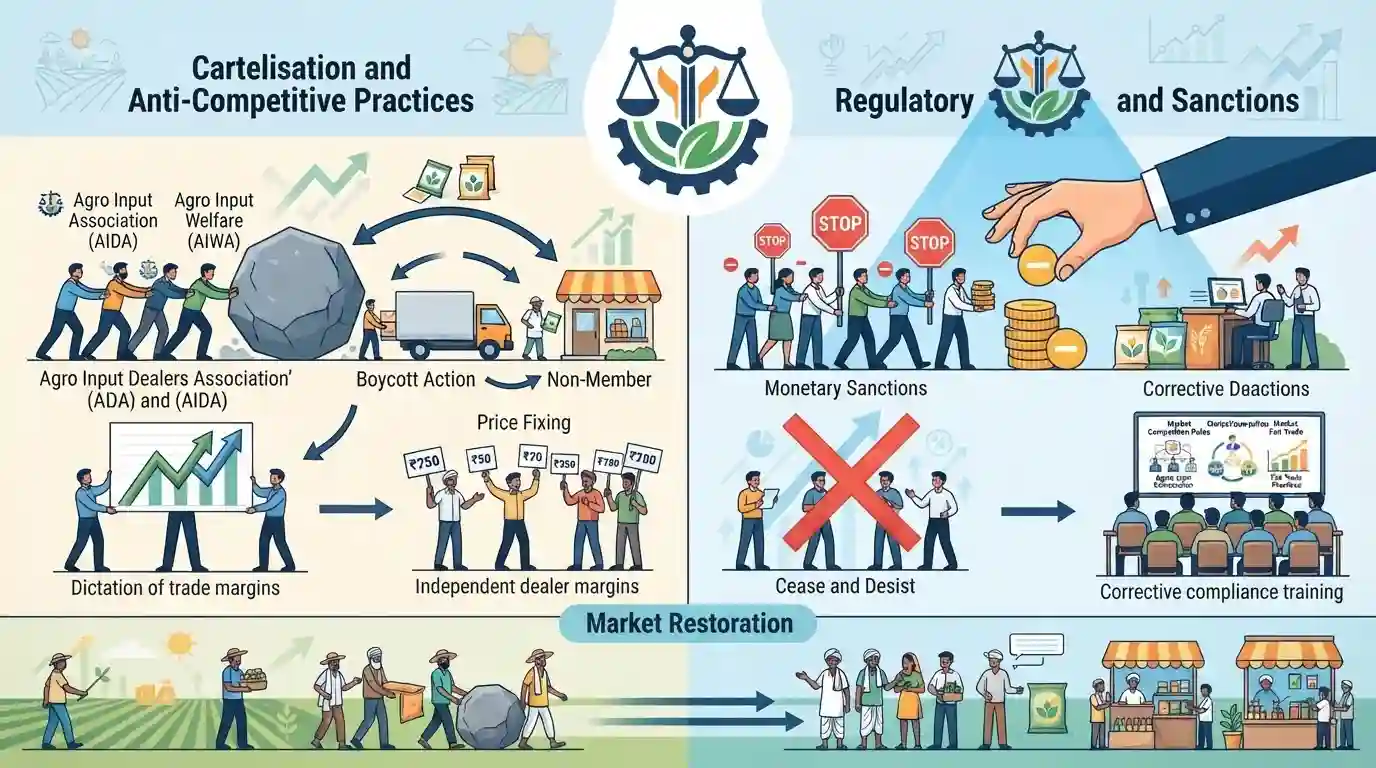
The Competition Commission of India (CCI) has imposed monetary and non-monetary sanctions on the Agro Input Dealers Association (AIDA) and the Agro Input Welfare Association (AIWA) for cartelisation and anti-competitive practices. The associations were penalised for boycotting companies that supplied products to non-members and for dictating trade margins, in violation of the Competition Act, 2002. Along with financial penalties and cease-and-desist orders, the CCI mandated the associations to conduct competition compliance training for their members, reinforcing the regulatory body's role in ensuring fair market practices.
Key Points
- The Competition Commission of India (CCI) sanctioned AIDA and AIWA for engaging in anti-competitive cartelization.
- The associations were found boycotting companies supplying products to non-members and dictating trade margins.
- These practices violate Section 3(3)(b) read with Section 3(1) of the Competition Act, 2002.
- Monetary penalties and cease-and-desist orders were imposed on the associations and their key office bearers.
- AIWA was specifically directed to organize competition compliance training programs for its members to prevent future violations.
Important Terms
Competition Act, 2002

India's primary competition law, replacing the MRTP Act, 1969. It prohibits anti-competitive agreements, prevents abuse of dominant market positions, and regulates business combinations like mergers to protect consumer welfare.
UPSC context
GS Paper 3 (Indian Economy). Crucial for understanding economic reforms, market efficiency, and the legal framework for fair trade.
Competition Commission of India (CCI)
A statutory body established under the Competition Act, 2002, responsible for enforcing competition laws, eliminating anti-competitive practices, and ensuring fair market competition and consumer protection in India.
UPSC context
GS Paper 2 (Statutory Bodies) & GS Paper 3. Important for market regulation, anti-monopoly frameworks, and institutional governance.
Agro Input Dealers Association (AIDA)
A trade association representing agricultural input dealers, recently penalized by the CCI for cartelisation, boycotting non-member suppliers, and unlawfully dictating trade margins in violation of competition laws.
UPSC context
GS Paper 3 (Agriculture & Economy). Relevant to agricultural supply chains, input availability, and market fairness issues.
Agro Input Welfare Association (AIWA)
An association in the agricultural input sector fined by the CCI alongside AIDA for participating in anti-competitive agreements, limiting market access, and engaging in cartel-like behavior.
UPSC context
GS Paper 3 (Agriculture). Highlights the regulatory challenges of local associations attempting to monopolize or distort agricultural markets.
Anti-Competitive Agreements
Arrangements between enterprises, like cartels or boycotts, that restrict or distort market competition. Prohibited under Section 3 of the Competition Act, 2002 to protect consumer interests.
UPSC context
GS Paper 3 (Economy). Tests knowledge on market distortions, regulatory mechanisms, and the mandate of the Competition Commission of India.
Prelims Trap
"Under the Competition Act, holding a dominant position in the market is considered an illegal anti-competitive practice."
Merely holding a dominant market position is legally permissible in India. The law only prohibits the *abuse* of that dominant position (Section 4), unlike anti-competitive agreements which are outright barred.
Static Concepts Connected
What is the structure and mandate of the Competition Commission of India (CCI)?
- Origin & Mandate: A statutory, quasi-judicial body under the Ministry of Corporate Affairs, established via the Competition Act 2002 on the Raghavan Committee's recommendation.
- Composition: Consists of a Chairperson and 2 to 6 members (maximum 7 total), appointed by the Central Government.
- Appellate Authority: The National Company Law Appellate Tribunal (NCLAT) serves as the designated appellate authority to hear appeals against CCI decisions.
How does Indian law differentiate between anti-competitive agreements and abuse of dominance?
- Anti-competitive Agreements: Section 3 prohibits horizontal (cartels, bid-rigging) and vertical (exclusive supply) agreements that cause an appreciable adverse effect on market competition.
- Abuse of Dominance: Section 4 prohibits firms from imposing unfair prices or conditions. The abuse is penalized, but being a monopoly/dominant player is not inherently illegal.
- Global Turnover Penalty: The 2023 amendment allows CCI to levy penalties based on an enterprise's total "global turnover," drastically increasing deterrence for multinational corporations.
Cross-Topic Patterns
CCI + Agriculture Supply Chains
Agricultural productivity heavily relies on fair input pricing. Cartelization by agro-dealer associations inflates farmer input costs, creating a direct link between corporate market regulation and agrarian distress.
Multi-jurisdictional role of NCLAT
NCLAT's role extends beyond insolvency (IBC) and company law to handling competition law appeals from the CCI, making it a critical cross-cutting appellate tribunal in Indian corporate governance.

Statements combining the CCI's statutory backing, NCLAT appellate jurisdiction, and the nuance that 'dominance is not illegal' are probable.
Linked PYQs · 1
Linked PYQs · 1
- 2023MainsGS2
Discuss the role of the Competition Commission of India in containing the abuse of dominant position by the Multi-National Corporations in India. Refer to the recent decisions.
