BRICS Tourism Ministers Adopt Jaipur Declaration on Cooperation
Source:PIB ↗
Why It Matters
India's leadership in the BRICS tourism track underscores its strategy to leverage soft power and service-led economic diplomacy. The integration of modern priorities like Artificial Intelligence and sustainability with cultural heritage promotion is vital for understanding international relations (GS2) and the economic potential of the tourism sector (GS3).
Summary
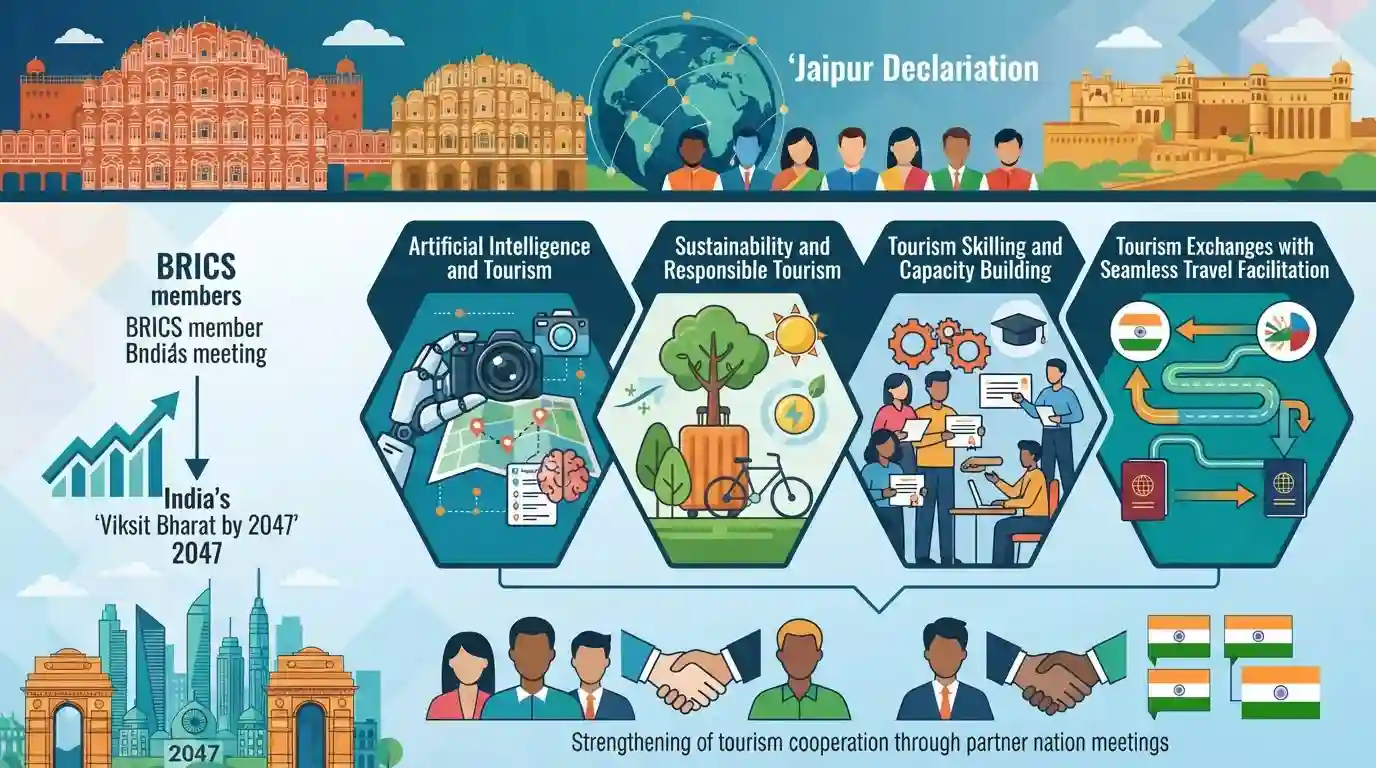
The BRICS Tourism Ministers’ Meeting, held under India's Chairship in Jaipur in August 2026, concluded with the adoption of the 'Jaipur Declaration'. Theming "Building for Resilience, Innovation, Cooperation and Sustainability", the meeting saw participation from 9 BRICS Member States. The Declaration outlines four key thematic priorities: Artificial Intelligence and Tourism, Sustainability and Responsible Tourism, Tourism Skilling and Capacity Building, and Tourism Exchanges with Seamless Travel Facilitation. The event highlighted tourism's crucial role in achieving India's 'Viksit Bharat by 2047' vision and showcased Jaipur's rich architectural heritage, including Hawa Mahal and Amber Fort. Bilateral meetings were also held with key partner nations to strengthen tourism cooperation.
Key Points
- Adoption of the Jaipur Declaration by BRICS Tourism Ministers under India's 2026 Chairship.
- Focus on four thematic pillars: AI in tourism, sustainable practices, skilling, and seamless travel facilitation.
- Participation of 9 BRICS member states reflects the grouping's expanded footprint and collaborative efforts in the services sector.
- Emphasis on tourism as a critical driver for inclusive economic growth and realizing India's 'Viksit Bharat 2047' goals.
- Showcasing of India's cultural heritage to international delegates through visits to iconic Jaipur landmarks like Hawa Mahal, City Palace, and Amber Fort.
Important Terms
Jaipur Declaration

A 2026 communique adopted by BRICS Tourism Ministers under India's chairship. It outlines a cooperation framework focusing on AI in tourism, sustainability, capacity building, and seamless travel facilitation.
UPSC context
GS-2 (International Relations) & GS-3. Tests knowledge of BRICS sectoral initiatives and sustainable tourism frameworks.
Viksit Bharat by 2047
India's ambitious national vision to transform into a developed, inclusive, and sustainable $30-40 trillion economy by its 100th year of independence in 2047.
UPSC context
GS-3 (Economic Planning). Crucial for mains essays and questions evaluating long-term development targets and policies.
BRICS
An intergovernmental organization of major emerging economies that recently expanded to nine member states. It fosters geopolitical, economic, and cultural cooperation as a voice for the Global South.
UPSC context
GS-2 (Global Groupings). Tests awareness of multipolar diplomacy, institutional expansion, and India's strategic multilateral engagements.
Amber Fort
A 16th-century Rajput hill fort near Jaipur, built by Raja Man Singh I. A UNESCO World Heritage site renowned for its artistic blend of Hindu and Mughal architecture.
UPSC context
GS-1 (Indian Heritage and Culture). Tests knowledge of regional architectural styles, Rajput history, and UNESCO sites.
Prelims Trap
The Jaipur Declaration is a recent agreement on wildlife conservation or G20 trade facilitation.
City-based declarations are frequent prelims traps. The 2026 Jaipur Declaration specifically relates to the BRICS Tourism Ministers’ Communique, not environmental conservation or WTO.
Static Concepts Connected
How has BRICS membership expanded from its inception to 2025?
- Founding members: Originally BRIC (Brazil, Russia, India, China) in 2006, holding its first summit in 2009.
- First expansion: South Africa joined the bloc in 2010, officially changing the acronym to BRICS.
- Recent expansions: Expanded in 2024 (Egypt, Ethiopia, Iran, UAE) and early 2025 (Indonesia, the first Southeast Asian member).
Why is the Walled City of Jaipur a UNESCO World Heritage Site?
- Grid-based planning: Recognized as an exceptional example of 18th-century indigenous city planning based on a grid-iron layout.
- Vedic & syncretic design: Its architecture reflects a syncretic blend of ancient Hindu (Vastu Shastra), Mughal, and Western design elements.
- Iconic monuments: Houses culturally significant landmarks including the Hawa Mahal, City Palace, and the Jantar Mantar observatory.
Cross-Topic Patterns
Tech diplomacy in multilateral forums
AI is shifting from a pure GS3 Science topic to a GS2 IR diplomatic tool, evidenced by the BRICS Jaipur Declaration prioritizing Artificial Intelligence within its tourism pillars.
Soft power as an economic multiplier
Leveraging GS1 UNESCO heritage sites (Jaipur's Walled City) as a soft power tool to drive GS3 economic growth, directly aligning cultural preservation with 'Viksit Bharat 2047' goals.

Expect a 'match the following' prelims question pairing recent city declarations (Jaipur, Kazan) with their respective groupings and themes.
Linked PYQs · 4
Linked PYQs · 4
- 2012MainsGS2
Compare the significance of IBSA and BRICS in the context of India's multilateral diplomacy.
- 2014PrelimsGS1
With reference to a grouping of countries known as BRICS, consider the following statements: 1. The First Summit of BRICS was held in Rio de Janeiro in 2009. 2. South Africa was the last to join the BRICS grouping. Which of the statements given above is/are correct?
- 2024PrelimsGS1
Consider the following properties included in the World Heritage List released by UNESCO: 1. Shantiniketan 2. Rani-ki-Vav 3. Sacred Ensembles of the Hoysalas 4. Mahabodhi Temple Complex at Bodhgaya How many of the above properties were included in 2023 ?
- 2025PrelimsGS1
Consider the following statements with regard to BRICS : I. 16th BRICS Summit was held under the Chairship of Russia in Kazan. II. Indonesia has become a full member of BRICS. III. The theme of the 16th BRICS Summit was Strengthening Multiculturalism for Just Global Development and Security. Which of the statements given above is/are correct?
