NHAI and Road Safety Board Collaborate on Highway Safety Measures
Source:PIB ↗
આ શા માટે મહત્વનું છે
India has a high rate of road traffic accidents. The NHAI-NRSB collaboration reflects an institutional shift from reactive measures to a proactive, technology-integrated (AI, ATMS) 'Safe System' approach. This is relevant for UPSC Mains GS3 under infrastructure development and the application of technology for public safety.
સારાંશ
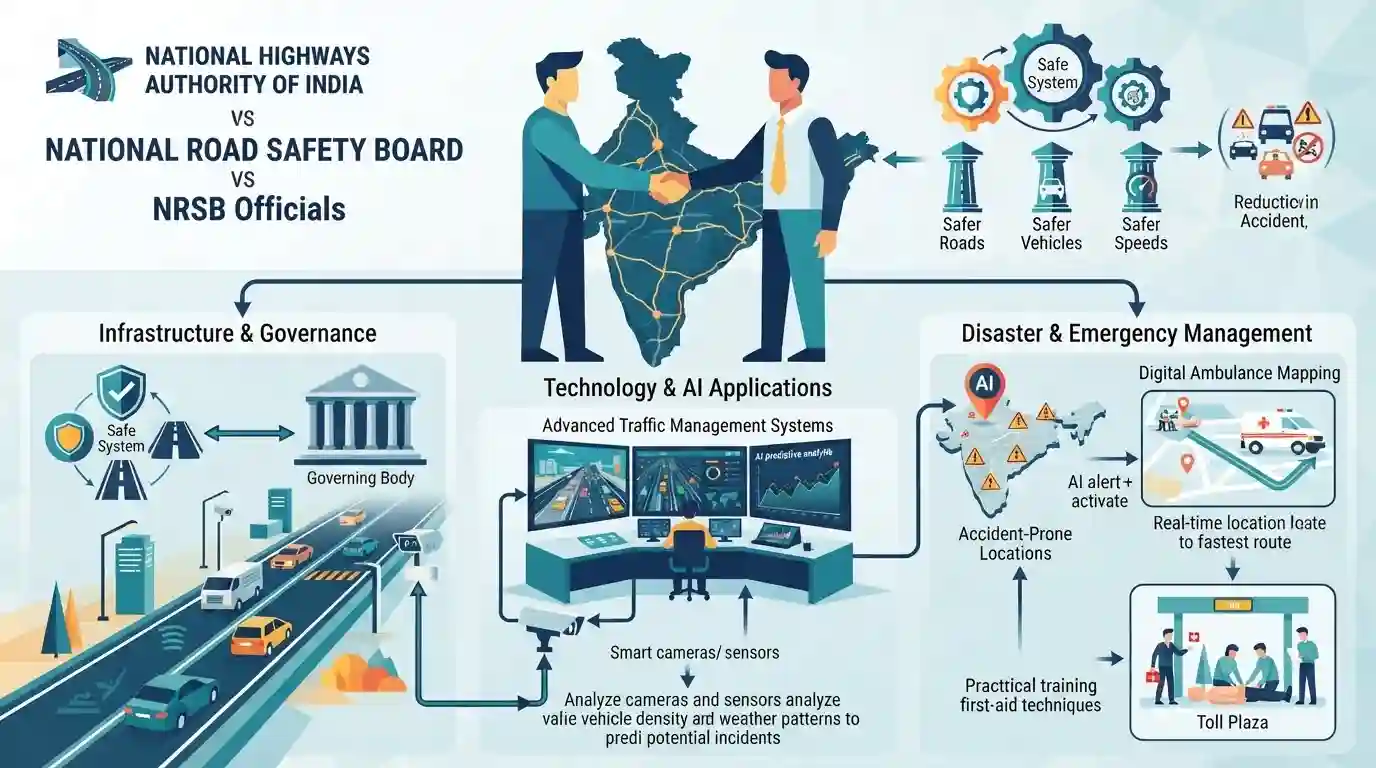
The National Highways Authority of India (NHAI) and the National Road Safety Board (NRSB) held an introductory meeting to deliberate on strengthening road safety on National Highways. The discussions focused on creating a collaborative institutional framework and adopting a 'Safe System' approach to reduce accidents. Key technological interventions discussed included Advanced Traffic Management Systems (ATMS) and AI-driven predictive tools, along with digital mapping of ambulances for faster emergency response. Practical steps such as first-aid training at toll plazas and identifying accident-prone locations underscore a shift toward holistic and data-driven road infrastructure management.
મુખ્ય મુદ્દા
- NHAI and NRSB deliberated on establishing a structured institutional framework to enhance road safety on National Highways.
- Emphasis was laid on the 'Safe System' approach, covering risk identification, highway engineering, commercial vehicle safety, and digital safety management.
- Technological integration was a key focus, including the deployment of Advanced Traffic Management Systems (ATMS), AI-based predictive solutions, and digital mapping of ambulances.
- Operational initiatives discussed included first-aid training for toll plaza staff, identifying top accident-prone locations, and sharing global best practices for crash investigation.
મહત્વપૂર્ણ શબ્દો
National Highways Authority of India (NHAI)

An autonomous statutory body created under the NHAI Act of 1988. Operating under MoRTH, it is responsible for the development, maintenance, and management of India's vast national highways network.
UPSC context
Crucial for GS-3 (Infrastructure) and GS-2 (Statutory Bodies). Tests knowledge of road sector governance, infrastructure financing, and asset monetization.
National Road Safety Board (NRSB)
An apex advisory statutory body established under Section 215B of the Motor Vehicles Act. It advises the Centre and states on road safety, traffic management, and new vehicle technologies.
UPSC context
Important for GS-2 (Governance/Statutory Bodies) and GS-3 (Infrastructure). Tests knowledge of institutional reforms aimed at curbing road accident fatalities.
Ministry of Road Transport & Highways (MoRTH)
The apex central ministry in India responsible for formulating and administering policies, regulations, and laws concerning road transport, motor vehicles, and the national highways network.
UPSC context
Relevant for GS-2 (Government Policies) and GS-3 (Infrastructure). Tests awareness of the regulatory framework driving India's transport connectivity and logistics.
Safe System Approach
A globally recognized road safety philosophy that acknowledges human fallibility. It shifts focus from blaming drivers to proactively designing forgiving road infrastructure that absorbs errors and prevents fatal crashes.
UPSC context
Key for GS-3 (Infrastructure/Disaster Management) and Essays. Tests the conceptual shift in urban mobility and road safety governance.
Advanced Traffic Management Systems (ATMS)
Intelligent technology frameworks that integrate real-time data from cameras and sensors to dynamically monitor highway traffic, reduce congestion, detect incidents, and speed up emergency response.
UPSC context
Important for GS-3 (Science & Technology in Infrastructure). Tests awareness of AI and IoT applications in modernizing traffic and highway management.
પ્રિલિમ્સ ટ્રેપ
"The National Road Safety Board is an executive body created by the Ministry of Road Transport."
NRSB is a statutory body constituted under Section 215B of the Motor Vehicles Act, 1988 (via the 2019 Amendment), not an executive body.
સંલગ્ન સ્થિર ખ્યાલો
What is the mandate and nature of the National Road Safety Board (NRSB)?
- Statutory Origin: Established under Section 215B of the Motor Vehicles Act, 1988 (introduced by the 2019 Amendment).
- Advisory Role: Acts as an advisory body to Central and State governments on road safety, traffic management, and trauma care facilities.
- Standard Setting: Responsible for formulating standards regarding road design, vehicle mechanics, and vehicular operations.
What is the 'Safe System' approach to road safety?
- Core Premise: Acknowledges that human error is inevitable; shifts focus from blaming drivers to creating 'forgiving' road infrastructure.
- Global Standard: Serves as the central paradigm of the UN’s Second Decade of Action for Road Safety (2021-2030).
- Key Pillars: Combines safe roads, safe speeds, safe vehicles, safe road users, and effective post-crash response to keep crash forces within survivable limits.
આંતર-વિષય પેટર્ન
AI & ATMS creating 'Digital Highways'
AI-driven ANPR and optic fibre networks under ATMS enforce traffic laws while creating digital corridors ready for 5G, blending physical transport with digital telecom infrastructure.
The macroeconomic toll of road crashes
India hosts 1% of global vehicles but 11% of crash fatalities, draining 3-5% of GDP annually. Road safety is a macroeconomic and public health imperative, not just a transport issue.

Expect a Prelims multi-statement question mixing NRSB's statutory status under the MV Act 1988 with AI applications in traffic control.
સંલગ્ન PYQ · 1
સંલગ્ન PYQ · 1
- 2024MainsGS3
What is the technology being employed for electronic toll collection on highways? What are its advantages and limitations? What are the proposed changes that will make this process seamless? Would this transition carry any potential hazards?
