Digital BRICS Forum in Pune Highlights India Stack and DPI Models
Source:PIB ↗
हे का महत्त्वाचे आहे
This development is significant for UPSC as it bridges International Relations (GS2) with Technology and Internal Security (GS3). Multilateral groupings like BRICS are increasingly expanding their focus from traditional geopolitics and economics to digital governance, cybersecurity, and DPI. Understanding India's promotion of its digital goods (like India Stack) on international platforms is crucial for answering questions on India's soft power, cyber diplomacy, and leadership in the Global South.
सारांश
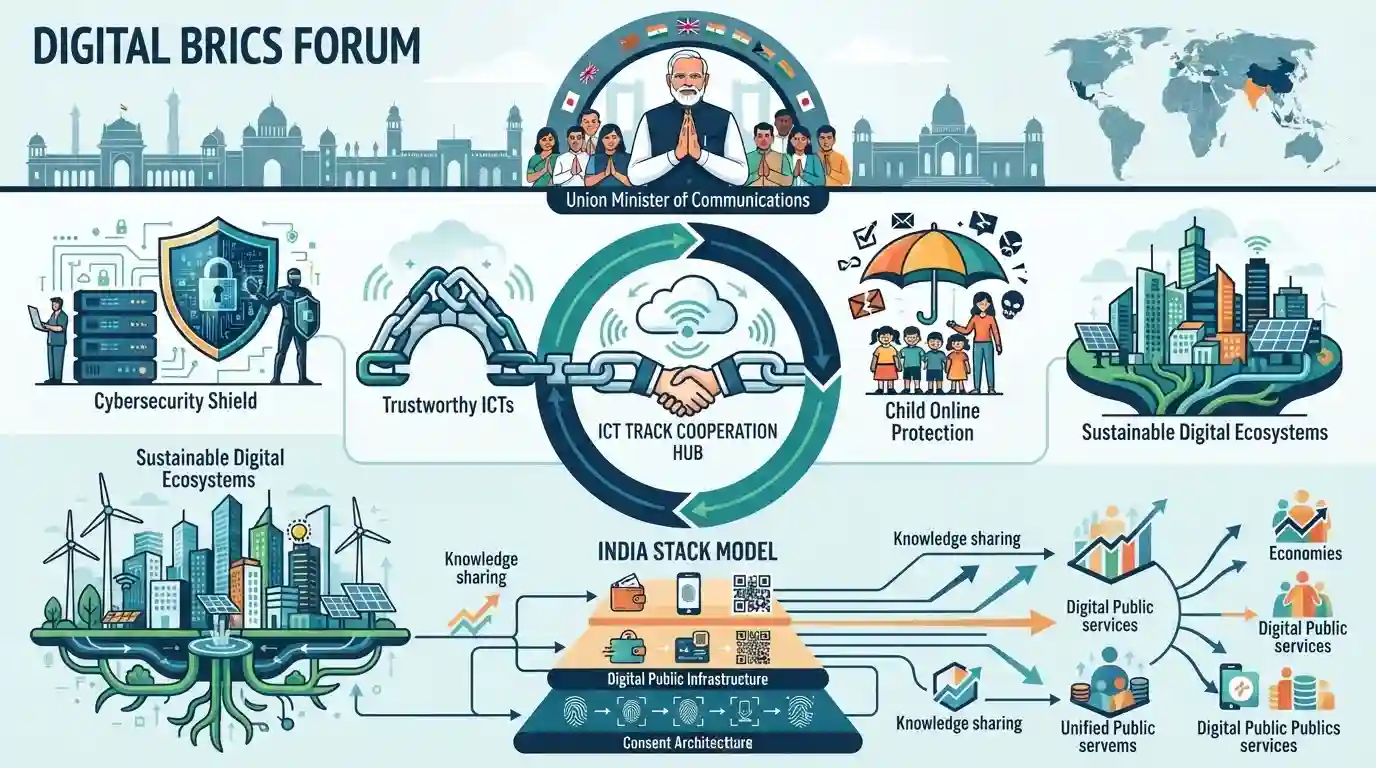
The Union Minister of Communications welcomed international delegations to the Digital BRICS Forum in Pune, underscoring India's commitment to tech-driven multilateral diplomacy. The forum focused on strengthening cooperation in the ICT track, specifically targeting Cybersecurity, Trustworthy ICTs, and Child Online Protection. A significant portion of the discussions centered on building Sustainable and Resilient Digital Ecosystems by leveraging Digital Public Infrastructure (DPI). India highlighted its pioneering solutions in digital identity and payment systems (like the India Stack) as scalable models for driving shared digital and economic growth across BRICS nations.
मुख्य मुद्दे
- The Digital BRICS Forum was held in Pune to enhance collaboration on ICT and digital infrastructure among member nations.
- Critical discussions focused on Cybersecurity, Trustworthy ICTs, and Child Online Protection.
- A major theme was the development of Sustainable and Resilient Digital Ecosystems through Digital Public Infrastructure (DPI).
- India showcased its successful digital models, such as digital identity systems and seamless payments (India Stack), as blueprints for BRICS members.
- The event highlighted the growing role of technology and digital governance in India's multilateral diplomacy.
महत्त्वाच्या संज्ञा
Digital Public Infrastructure (DPI)

A set of shared digital platforms—including digital identification, payment systems, and data exchange solutions—that enable nations to deliver essential services to citizens at societal scale.
UPSC context
GS Paper III (S&T) & GS Paper II (Governance): Tests understanding of digital inclusion, economic growth, and public service delivery.
BRICS
An influential multilateral grouping of major emerging economies focused on economic cooperation, development, and reform of international financial institutions to foster a multipolar world order.
UPSC context
GS Paper II (International Relations): Tests knowledge of global groupings, India's foreign policy, and multipolar global governance dynamics.
Digital BRICS Forum
A multi-stakeholder platform under the BRICS ICT Track, bringing together government, industry, academia, and startups to discuss emerging digital technologies and resilient digital ecosystems.
UPSC context
GS Paper II (IR) & GS Paper III (S&T): Tests understanding of multilateral tech cooperation and digital diplomacy.
Ministry of Communications
The Union Ministry responsible for telecommunications, postal services, and digital connectivity policies, driving national digital infrastructure and representing India in global ICT forums.
UPSC context
GS Paper II (Governance): Tests knowledge of institutional frameworks governing communication technology and digital development policies.
पूर्वपरीक्षा सापळा
DPI frameworks like India Stack mandate a centralized database model to achieve seamless interoperability across diverse cross-border systems.
DPI uses a federated architecture and open APIs. Data remains distributed to ensure privacy and security, rather than being stored in a single centralized repository.
संबंधित स्थिर संकल्पना
What are the three core architectural layers of Digital Public Infrastructure?
- Digital Identity Layer: Provides unique, verifiable, and secure proof of identity (e.g., Aadhaar) to establish trust.
- Fast Payment System: Enables instant, interoperable, and low-cost digital financial transactions at population scale (e.g., UPI).
- Consent-based Data Exchange: Allows secure, user-controlled sharing of personal data across service providers (e.g., Account Aggregator framework).
What is the current composition of the expanded BRICS bloc?
- Founding Members: Formed by Brazil, Russia, India, and China in 2009; South Africa joined in 2010.
- 2024 Expansion: Five nations officially joined: Egypt, Ethiopia, Iran, Saudi Arabia, and the United Arab Emirates (UAE).
- 2025 Accession: Indonesia formally joined the group, bringing the total active membership to 11 nations.
आंतर-विषय नमुने
DPI as geopolitical soft power
Exporting India Stack to BRICS nations offers the Global South a public-good tech alternative, counterbalancing Western proprietary platforms and China's Digital Silk Road.
Cybersecurity meets data protection laws
Aligning Digital BRICS cybersecurity standards on child protection requires bridging domestic laws like India's DPDP Act with transnational data-flow protocols.

Expect a multi-statement question linking BRICS expansion (11 members) with the core architectural design principles of India's DPI.
संबंधित PYQ · 5
संबंधित PYQ · 5
- 2012MainsGS2
Compare the significance of IBSA and BRICS in the context of India's multilateral diplomacy.
- 2013MainsGS3
What is a digital signature ? What does its authentication mean? Give various salient built-in features of a digital signature.
- 2025PrelimsGS1
Consider the following statements with regard to BRICS : I. 16th BRICS Summit was held under the Chairship of Russia in Kazan. II. Indonesia has become a full member of BRICS. III. The theme of the 16th BRICS Summit was Strengthening Multiculturalism for Just Global Development and Security. Which of the statements given above is/are correct?
- 2014PrelimsGS1
With reference to a grouping of countries known as BRICS, consider the following statements: 1. The First Summit of BRICS was held in Rio de Janeiro in 2009. 2. South Africa was the last to join the BRICS grouping. Which of the statements given above is/are correct?
- 2020PrelimsGS1
In India, the term "Public Key Infrastructure" is used in the context of
