Japan Defence Minister and Prime Minister Modi Discuss Bilateral Ties
Source:PIB ↗
কেন এটি গুরুত্বপূর্ণ
Japan is a vital strategic and QUAD partner for India. The evolution of India-Japan relations from economic cooperation to deep-tier defence co-development and technology transfers (such as the UNICORN mast agreement) is central to India's maritime security strategy, domestic defence indigenisation goals, and balancing geopolitical dynamics in the Indo-Pacific.
সারসংক্ষেপ
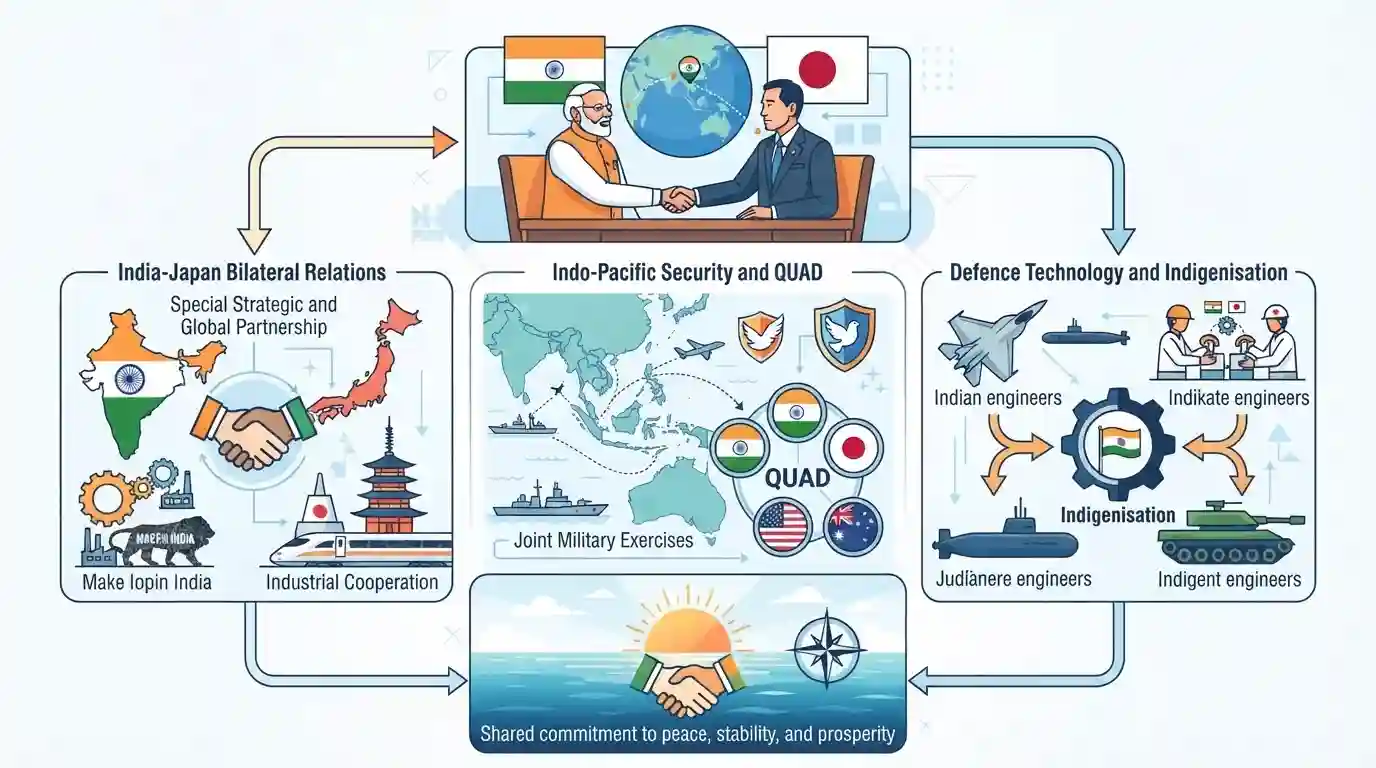
During his visit to New Delhi, Japan’s Minister of Defense Minoru Kihara called on Prime Minister Narendra Modi. The leaders discussed strengthening the India-Japan Special Strategic and Global Partnership. PM Modi highlighted the vast opportunities for Japanese industries to partner with Indian companies in defence equipment co-development and co-production under the 'Make in India' framework. They also exchanged views on regional security, reinforcing their shared commitment to peace, stability, and prosperity in the Indo-Pacific region through enhanced defence cooperation and joint military exercises.
মূল বিষয়
- The meeting underscored the robustness of the India-Japan Special Strategic and Global Partnership, aligning bilateral security objectives in Asia.
- Prime Minister Modi invited Japanese defence manufacturing firms to collaborate, co-develop, and co-produce military hardware in India under the 'Make in India' initiative.
- Both sides emphasized the critical role of India-Japan defence and security cooperation in ensuring a free, open, inclusive, and rules-based Indo-Pacific.
- They appreciated the expanding scope and interoperability achieved through regular joint bilateral and multilateral military exercises (such as Dharma Guardian, Veer Guardian, and Malabar).
গুরুত্বপূর্ণ শব্দ
India-Japan Special Strategic and Global Partnership

The apex bilateral framework between India and Japan, elevated in 2014, that governs defense, economic, and technological cooperation based on shared democratic values and regional stability.
UPSC context
GS Paper II (Bilateral Relations) - tests India's strategic foreign policy, security alignments, and maritime cooperation in Asia.
2+2 Ministerial Dialogue
A premier high-level diplomatic format involving the Foreign and Defence Ministers of India and its key partners to holistically review strategic, defence, and foreign policy ties.
UPSC context
GS Paper II (Bilateral Groupings) - tests institutional formats for strategic, security, and diplomatic cooperation.
Make in India
A flagship national program launched in 2014 to promote investment, foster innovation, build infrastructure, and transform the country into a global manufacturing hub, including in defense.
UPSC context
GS Paper III (Indigenisation of Technology) - tests government policies for self-reliance, FDI promotion, and industrial growth.
Indo-Pacific Region
A vast, interconnected geopolitical area encompassing the Indian and Pacific Oceans, central to global maritime trade, security cooperation, and strategic alignments like the QUAD.
UPSC context
GS Paper II (Global Groupings) - tests geopolitics, maritime security, regional stability, and international alliances.
প্রিলিমস ফাঁদ
The Acquisition and Cross-Servicing Agreement (ACSA) is a mutual military defense pact committing both nations to collective defense.
ACSA is strictly a reciprocal logistics support agreement for sharing fuel, food, and base access. It is not a mutual security defense treaty or military alliance.
সংযুক্ত স্থির ধারণা
What is Article 9 of the Japanese Constitution and how has its interpretation evolved?
- The Pacifist Clause: Outlaws war as a sovereign right of the nation and bans the maintenance of land, sea, and air forces.
- Self-Defense Forces: Interpreted since 1954 to permit the Japan Self-Defense Forces (JSDF) strictly for national self-defense.
- Collective Defense: Reinterpreted in 2014 and codified in 2015 to permit 'collective self-defense' to aid allies under attack.
What is India's '2+2' Ministerial Dialogue mechanism?
- Format: A strategic format pairing the Foreign and Defence Ministers of India with their foreign counterparts.
- Key Partners: India shares this cabinet-level mechanism with the US, Japan, Australia, Russia, and the UK.
- Strategic Value: Designed to provide a holistic, politically-guided approach to security and diplomatic relations.
আন্তঃবিষয় প্যাটার্ন
UNICORN & naval indigenisation
The UNICORN mast project showcases how bilateral technology transfers directly bypass foreign reliance to accelerate India's domestic naval manufacturing capabilities under 'Make in India'.
Quad logistics & economic corridors
India-Japan defense logistics (ACSA) run parallel to Quad initiatives aimed at securing maritime shipping lanes and critical mineral supply routes against unilateral dominance.

Expect questions linking Japan's relaxed defense export rules with specific bilateral projects like ACSA and the UNICORN naval mast.
সংযুক্ত PYQ · 3
সংযুক্ত PYQ · 3
- 2019MainsGS2
‘The time has come for India and Japan to build a strong contemporary relationship, one involving global and strategic partnership that will have a great significance for Asia and the world as a whole.’ Comment.
- 2020MainsGS2
Quadrilateral Security Dialogue (Quad)' is transforming itself into a trade bloc from a military alliance, in present times - Discuss.
- 2014MainsGS3
Foreign Direct Investment (FDI) in the defence sector is now set to be liberalized. What influence this is expected to have on Indian defence and economy in the short and long run?
