Master Plan for Delhi 2047 Unveils Sustainable Urban Growth Roadmap
Source:PIB ↗
हे का महत्त्वाचे आहे
Provides a vital case study on modern urban planning strategies in Indian megacities. Concepts like Transit-Oriented Development (TOD), Land Pooling, Transferable Development Rights (TDR), and 'Green-Blue' ecological restoration are critical for answering Mains questions related to urbanization challenges, smart cities, and sustainable development.
सारांश
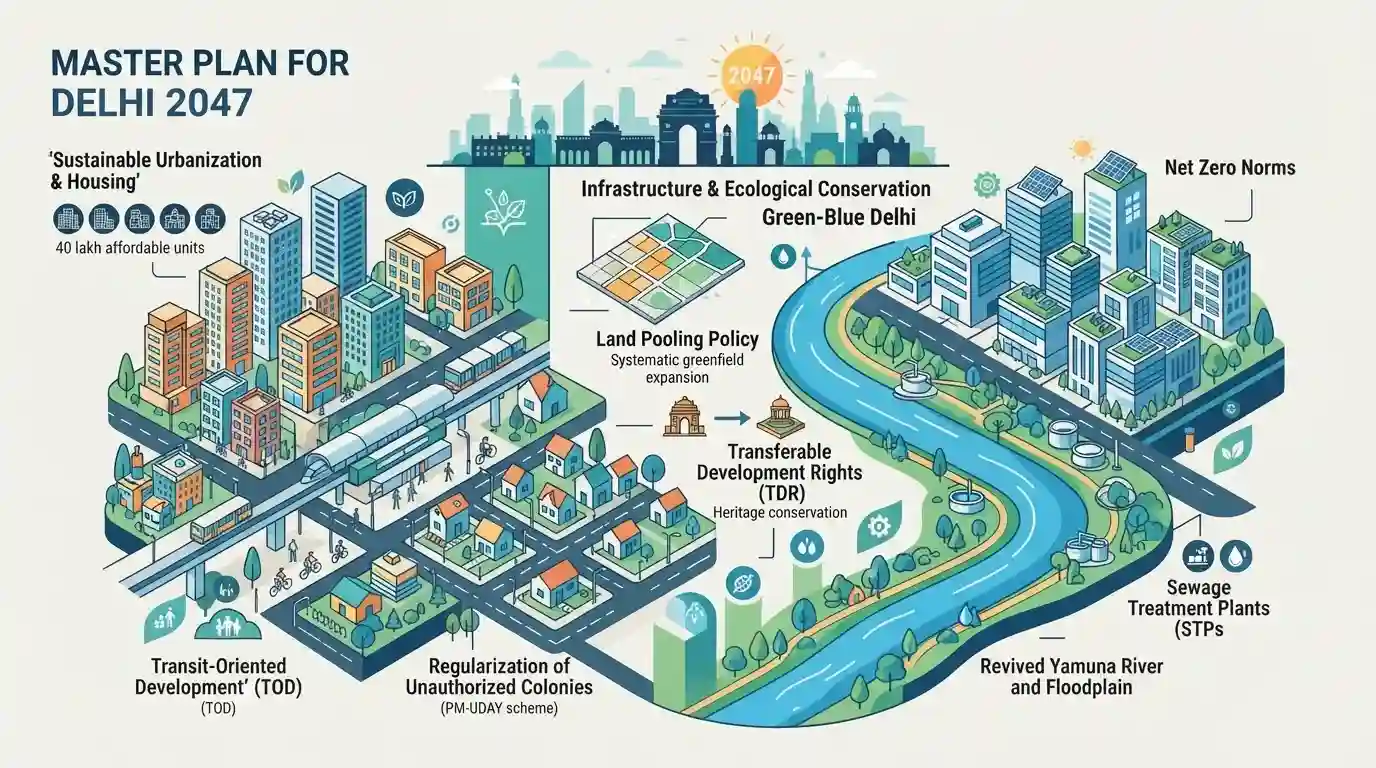
The Master Plan for Delhi 2047 (MPD-2047), unveiled by Union Minister Manohar Lal, provides a comprehensive blueprint to transform Delhi into a sustainable, equitable, and vibrant megacity. The plan aligns with the national vision of 'Viksit Bharat' and outlines strategic interventions such as creating 40 lakh affordable housing units, expanding Transit-Oriented Development (TOD), and regularizing unauthorized colonies through the PM-UDAY scheme. It emphasizes ecological sustainability via the 'Green-Blue Delhi' initiative, which includes reviving the Yamuna floodplain, improving sewage treatment capacity, and enforcing Net Zero norms. Additionally, it introduces innovative urban planning tools like Transferable Development Rights (TDR) for heritage conservation and the Land Pooling Policy for systematic greenfield expansion.
मुख्य मुद्दे
- The Delhi Master Plan 2047 (MPD-2047) aims to transform Delhi into an equitable, sustainable, and economically vibrant global city by 2047.
- It targets the creation of 40 lakh new affordable housing units and plans for an urban expansion of 200 sq. km. through the Land Pooling Policy.
- The plan introduces dual planning approaches: Area-based redevelopment for existing brownfield areas and Right-of-Way (ROW) based planning for greenfield areas.
- It incorporates a 'Green-Blue Delhi' initiative, focusing on the ecological restoration of 1700 hectares of the Yamuna River floodplain and expanding Sewage Treatment capacity.
- Transit-Oriented Development (TOD), Transferable Development Rights (TDR) for heritage conservation, and a transition to Net Zero development form core pillars of the plan.
महत्त्वाच्या संज्ञा
Delhi Master Plan 2047 (MPD-2047)

A comprehensive urban planning framework notified in 2026 to guide Delhi’s development, focusing on housing, transit-oriented development, environmental revival, and infrastructure integration as its population approaches 3.2 crore by 2047.
UPSC context
GS Paper II/III: Tests understanding of sustainable urbanization, metropolitan development, urban governance, and infrastructure policies.
Land Pooling Policy
An urban development tool where private landowners voluntarily assemble land parcels for unified, infrastructure-first planning by authorities like the DDA, avoiding complex, costly, and litigation-prone direct land acquisition.
UPSC context
GS Paper III: Tests concepts of land reforms, infrastructure financing, public-private partnerships, and greenfield city development.
PM-UDAY Scheme
A central government initiative to confer legal property ownership, transfer, and mortgage rights to residents of 1,731 unauthorized colonies in Delhi, facilitating their planned integration and urban redevelopment.
UPSC context
GS Paper II: Evaluates knowledge of welfare schemes, housing rights, urban integration, and governance for marginalized populations.
Delhi Development Authority (DDA)
A statutory autonomous body established in 1957 responsible for the planned development, land acquisition, housing, and infrastructure management within the National Capital Territory of Delhi.
UPSC context
GS Paper II: Tests knowledge of statutory bodies, urban local governance, and institutional mechanisms in regional planning.
Unified Metropolitan Transport Authority (UMTA)
A unified nodal agency designed to coordinate planning, physical integration, common ticketing, and transit policy enforcement among multiple metropolitan transport service providers and authorities.
UPSC context
GS Paper III: Evaluates concepts of multimodal transit, transport infrastructure, urban mobility planning, and administrative coordination.
Ministry of Housing and Urban Affairs (MoHUA)
The apex central ministry in India responsible for formulating national policies, administering urban schemes, and coordinating housing and sustainable urban development initiatives.
UPSC context
GS Paper II: Tests knowledge of central ministries, policy-making processes, and governance frameworks for national urban development.
पूर्वपरीक्षा सापळा
Land Pooling under MPD-2047 involves compulsory state acquisition of private land under the LARR Act, 2013 with monetary compensation.
Land pooling is a voluntary, participatory mechanism where landowners get a portion of developed land back, avoiding contentious compulsory land acquisition.
संबंधित स्थिर संकल्पना
What is Transit-Oriented Development (TOD) and its core features?
- High-Density Integration: Promotes compact, mixed-use development within walking distance of rapid transit stations.
- NMT Prioritization: Prioritizes pedestrians and non-motorized transport, reducing dependency on private vehicles.
- Value Capture Financing: Generates revenue for transit operators through real estate development around transport corridors.
How do Transferable Development Rights (TDR) function in urban planning?
- Core Mechanic: Allows property owners in restricted zones (e.g., heritage sites) to trade unused development rights.
- Zonal Exchange: Unused Floor Area Ratio (FAR) is transferred from conservation zones to high-density growth zones.
- Market-Driven Conservation: Compensates landowners without direct state expenditure, incentivizing heritage preservation and slum redevelopment.
आंतर-विषय नमुने
Urban Hydrology + Disaster Management
Blue-Green infrastructure transitions urban flood mitigation from rigid engineered concrete drains to natural, sponge-like floodplain restoration.
Property Formalization + Financial Integration
Schemes like PM-UDAY convert dead capital in informal settlements into collateralizable assets, linking urban poor with institutional credit networks.

Statements testing innovative urban planning mechanisms (TDR, Land Pooling, TOD) versus traditional land acquisition are highly probable.
संबंधित PYQ · 5
संबंधित PYQ · 5
- 2025MainsGS1
How does smart city in India, address the issues of urban poverty and distributive justice?
- 2016MainsGS1
With a brief background of quality of urban life in India, introduce the objectives and strategy of the 'Smart City Programme'.
- 2020MainsGS1
Account for the huge flooding of million cities in India including the smart ones like Hyderabad and Pune. Suggest lasting remedial measures.
- 2024MainsGS3
Industrial pollution of river water is a significant environmental issue in India. Discuss the various mitigation measures to deal with this problem and also the government's initiatives in this regard.
- 2024MainsGS3
Flooding in urban areas is an emerging climate-induced disaster. Discuss the causes of this disaster. Mention the features of two such major floods in the last two decades in India. Describe the policies and frameworks in India that aim at tackling such floods.
