CMLRE Releases National Report on Deep Sea Fishery Resources
Source:PIB ↗
Why It Matters
As India intensifies its focus on ocean resources through initiatives like the Deep Ocean Mission and the Blue Economy policy, scientific mapping of deep-sea fisheries is paramount. This development is directly relevant to GS3 syllabus topics, specifically the economics of animal-rearing (fisheries), food/nutritional security, and environmental conservation in marine habitats.
Summary
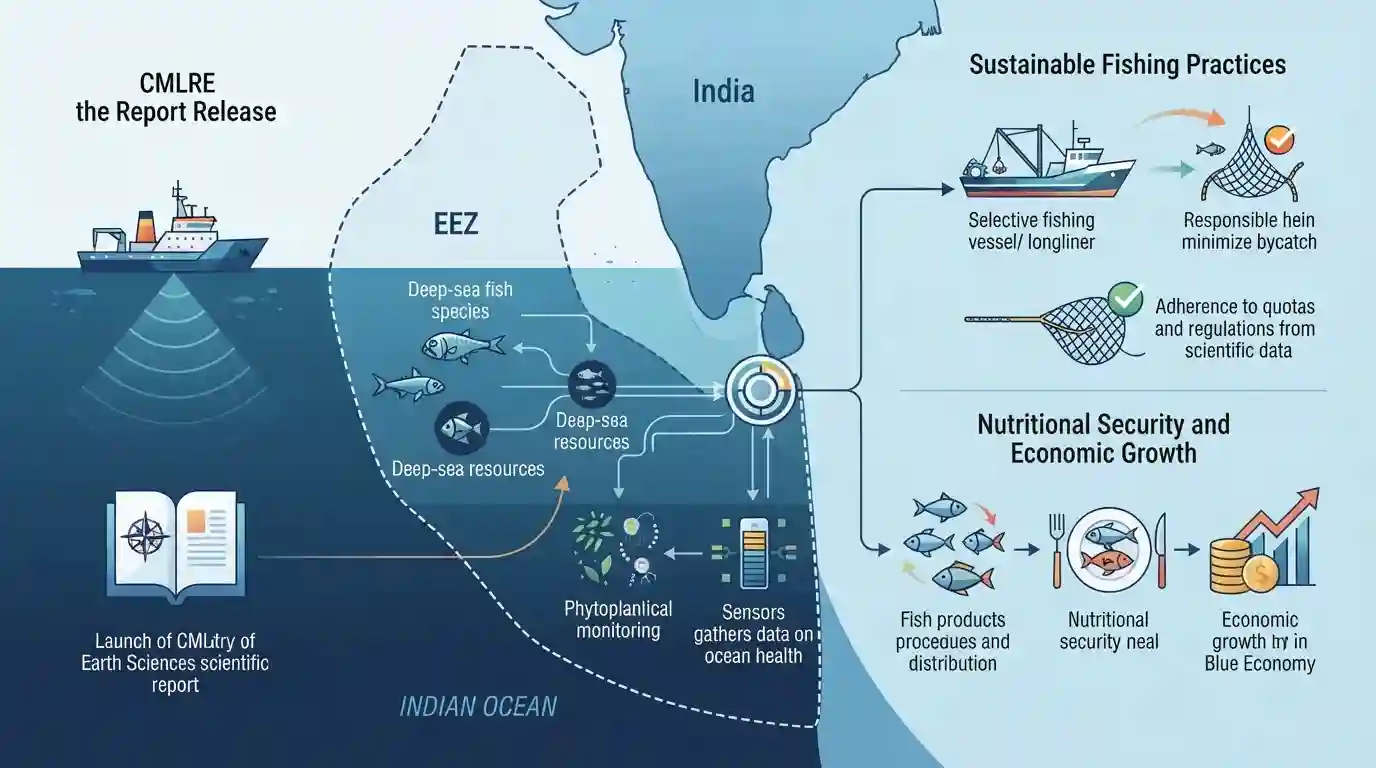
The Centre for Marine Living Resources and Ecology (CMLRE), an attached office of the Ministry of Earth Sciences, released a landmark National Report on Deep-Sea and Distant-Water Fishery Resources of the Indian EEZ. The report serves as a foundational scientific document intended to support India's transition to a Sustainable Blue Economy. By detailing the availability and ecological status of deep-sea resources in the Exclusive Economic Zone, the report provides a roadmap for sustainable fishing practices that can ensure nutritional security and economic growth without compromising marine biodiversity.
Key Points
- The Centre for Marine Living Resources and Ecology (CMLRE) unveiled a comprehensive National Report on Deep-Sea and Distant-Water Fishery Resources.
- The report focuses on mapping marine resources within the Indian Exclusive Economic Zone (EEZ).
- It provides critical scientific data necessary for the sustainable exploitation of deep-sea fisheries, aiming to fuel India's Sustainable Blue Economy.
- The initiative underscores the balance between achieving nutritional and economic security while preserving fragile deep-sea marine ecosystems.
Important Terms
Sustainable Blue Economy

The sustainable use of ocean and coastal resources to drive economic growth, improve livelihoods, and create jobs while preserving the health of marine ecosystems for future generations.
UPSC context
GS Paper III (Economy/Environment): Tests understanding of coastal development, marine ecology, resource conservation, and schemes like the Deep Ocean Mission.
Centre for Marine Living Resources and Ecology (CMLRE)
An attached office of the Ministry of Earth Sciences, based in Kochi, mandated to survey, assess, and sustainably manage marine living resources and ecosystems within India's Exclusive Economic Zone (EEZ).
UPSC context
GS Paper III (Environment): Tests knowledge of marine biodiversity conservation, deep-sea research institutions, and ecological resource management frameworks in India.
Ministry of Earth Sciences
The Union Ministry responsible for providing scientific services and policies in meteorology, oceanography, seismology, hydrology, and polar sciences to build national climate and disaster resilience.
UPSC context
GS Paper III (Science & Technology): Crucial for analyzing national missions like PRITHVI, weather-forecasting, and climate-resilience governance frameworks.
Prelims Trap
The Centre for Marine Living Resources and Ecology (CMLRE) is an attached office under the Ministry of Fisheries, Animal Husbandry and Dairying.
Despite its heavy focus on fisheries and marine fauna, CMLRE is under the Ministry of Earth Sciences (MoES), not the Ministry of Fisheries or MoEFCC.
Static Concepts Connected
What are the maritime zones defined under UNCLOS?
- Territorial Sea: Extends up to 12 nautical miles from the baseline; the coastal state exercises full territorial sovereignty over the sea, airspace, seabed, and subsoil.
- Contiguous Zone: Extends from 12 to 24 nautical miles; the state can prevent/punish infringements of customs, fiscal, immigration, or sanitary laws within its territory.
- Exclusive Economic Zone: Extends up to 200 nautical miles; provides exclusive sovereign rights for exploring, exploiting, conserving, and managing living and non-living natural resources.
- Continental Shelf: Comprises the seabed and subsoil up to the outer edge of the margin or 200 nautical miles, granting sovereign rights for harvesting non-living resources.
How are National Repositories designated under India's Biological Diversity Act?
- Section 39 Designation: Empowers the Central Government to designate state institutions as official repositories for specific categories of biological resources.
- Conservation Mandate: Ensures safe custody of representative samples of biological material, including type specimens of newly discovered marine and terrestrial species.
- Bhavasagara Referral Centre: Maintained by CMLRE, it acts as the official legal custodian of all deep-sea fauna discovered within Indian waters.
Cross-Topic Patterns
Blue Economy + Indo-Pacific Security
Deep-sea fishery mapping strengthens India's maritime domain awareness (MDA) and sovereign presence in the Indian Ocean, acting as a geopolitical counterweight to distant-water fishing fleets from extra-regional actors.
Deep-Sea Biodiversity + Global Commons
Sustainable deep-sea resource extraction within India's EEZ directly aligns with international conservation principles established under the newly adopted BBNJ (High Seas) Treaty.

UPSC may target CMLRE's parent ministry (MoES) alongside UNCLOS EEZ boundaries and Biological Diversity Act repository provisions.
Linked PYQs · 4
Linked PYQs · 4
- 2026PrelimsGS1
Which of the following statements with regard to India's Deep Ocean Mission is/are correct? 1. It was launched by the Ministry of Ports, Shipping and Waterways, Government of India. 2. Matsya-6000 has been designed to carry 3 people for deep sea exploration. 3. Samudrayaan is a project under this mission. Select the answer using the code given below :
- 2026PrelimsGS1
At the United Nations Ocean Conference (UNOC) held in June, 2025 in France, the Food and Agricultural Organization (FAO) of the United Nations demonstrated its leading voice on marine and ocean issues, especially on sustainable fisheries and aquaculture for resilient livelihood and "Blue Transformation". Which of the following combinations about the "Four Betters" proposed by FAO for "Blue Transformation" is correct ?
- 2021PrelimsGS1
What is blue carbon?
- 2025MainsGS3
Why is maritime security vital to protect India's sea trade? Discuss maritime and coastal security challenges and the way forward.
