AIKosh Platform Workshop to Strengthen Sovereign AI Data Ecosystem
Source:PIB ↗
हे का महत्त्वाचे आहे
AIKosh represents a foundational pillar of India's evolving digital landscape, shifting focus from merely digitizing services to building indigenous AI capacity based on national datasets. Understanding these platforms helps aspirants analyze India's Digital Public Infrastructure (DPI) model, its data governance frameworks, and its strategies for deploying 'Sovereign AI' in e-governance and economic development.
सारांश
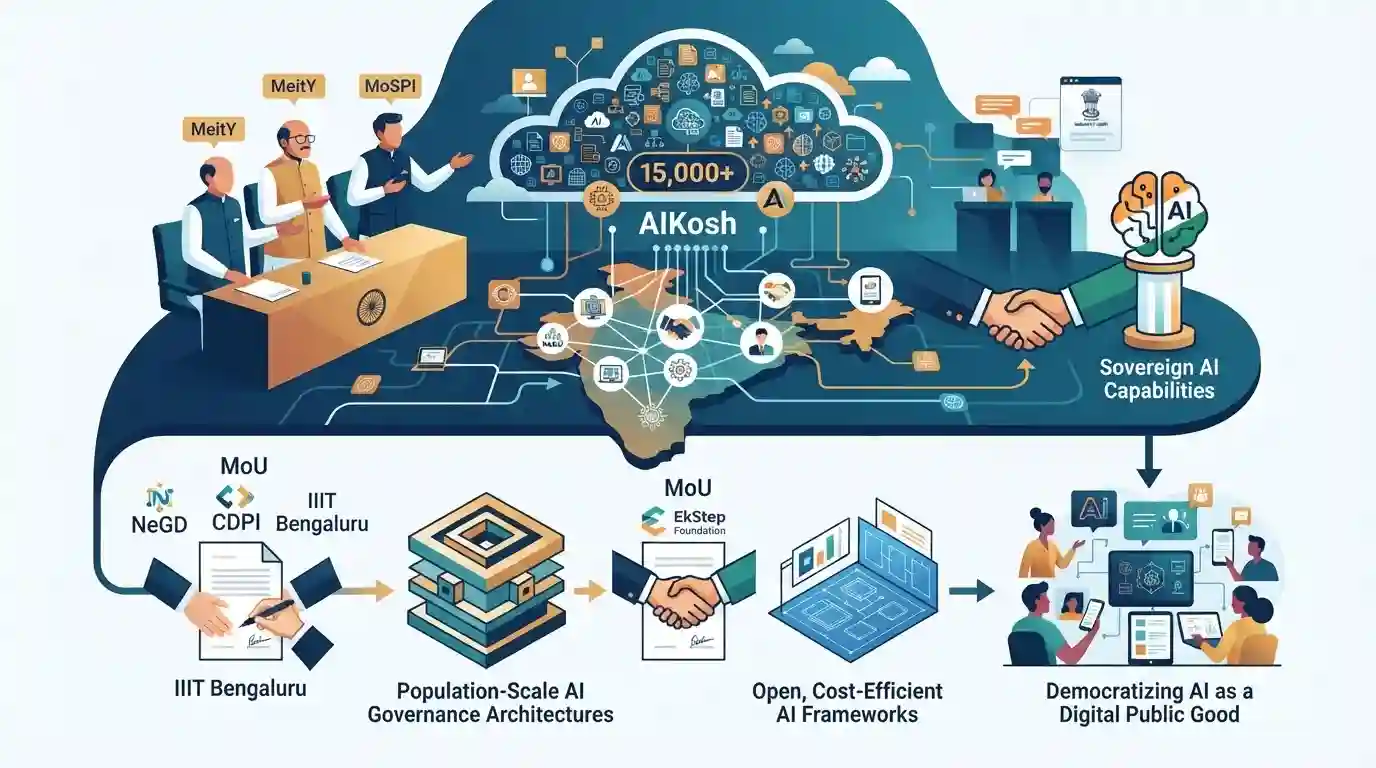
The IndiaAI Mission recently organized a workshop on AIKosh, India's national platform offering over 15,000 datasets and hundreds of AI models to bolster the nation's sovereign AI capabilities and digital public infrastructure (DPI). Government representatives from MeitY and MoSPI emphasized the critical need for secure, discoverable, and interoperable data environments. To operationalize these goals, IndiaAI signed key Memorandums of Understanding (MoUs): one with NeGD and CDPI (via IIIT Bengaluru) to develop population-scale AI governance architectures, and another with EkStep Foundation to build open, cost-efficient AI frameworks, collectively aiming to democratize AI as a digital public good.
मुख्य मुद्दे
- The IndiaAI Mission hosted a workshop on AIKosh, a national repository that provides over 15,000 datasets, 300 AI models, and toolkits to boost the country's AI-ready data ecosystem.
- Discussions centered on establishing secure, interoperable, and easily discoverable data frameworks across various ministries, a fundamental step for developing Sovereign AI solutions.
- IndiaAI, NeGD, and CDPI signed a tripartite MoU to formulate population-scale, AI-enabled e-governance platforms and support secure data exchange for AIKosh.
- A second MoU was signed between IndiaAI and EkStep Foundation to co-create cost-efficient AI operating systems and open-gate models for broad public utility.
- The initiative reinforces India's approach to treating datasets and AI resources as Digital Public Goods (DPGs), augmenting the broader Digital Public Infrastructure (DPI) architecture.
महत्त्वाच्या संज्ञा
AIKosh

India's national AI-ready dataset and model platform under the IndiaAI Mission, hosting over 15,000 datasets, 300 models, and development tools to build secure and sovereign AI solutions.
UPSC context
GS Paper III (Science & Technology) testing strategies for national data governance and sovereign artificial intelligence capabilities.
IndiaAI Mission
A comprehensive government initiative launched under MeitY with a ₹10,371 crore outlay to build indigenous AI compute capacity, foundation models, skill development, and robust data infrastructure.
UPSC context
GS Paper III (IT & Computers) testing knowledge of indigenous technology development, technology sovereign frameworks, and inclusive economic growth.
National e-Governance Division (NeGD)
An independent business division of the Digital India Corporation under MeitY, tasked with technical and programme management support for implementing Digital India and e-governance initiatives.
UPSC context
GS Paper II (E-governance) testing institutional frameworks driving public digital delivery systems.
Centre for Digital Public Infrastructure (CDPI)
A software-neutral organization housed at IIIT Bengaluru that provides pro-bono technical architecture advisory to help countries design, implement, and scale inclusive digital public infrastructure (DPI).
UPSC context
GS Paper II & III (Governance, S&T) testing international digital cooperation and tech-enabled public delivery models.
EkStep Foundation
A non-profit co-founded by Nandan Nilekani that focuses on open-source digital infrastructure and public goods to solve large-scale education, learning, skilling, and agricultural challenges.
UPSC context
GS Paper II & III testing private-public partnerships, digital public infrastructure, and tech-driven social empowerment.
Ministry of Electronics and Information Technology (MeitY)
The executive ministry of the Government of India responsible for IT policy, electronics manufacturing, digital governance (Digital India), cybersecurity, and national AI mission promotion.
UPSC context
GS Paper II (Government Policies) testing administration mechanisms, digital sovereignty, and tech governance.
पूर्वपरीक्षा सापळा
AIKosh is designed to monetize non-personal data of citizens to fund state-of-the-art GPU infrastructure.
AIKosh is a Digital Public Good that strictly prohibits data monetization, ensuring non-personal data is used only for public-interest AI research and development.
संबंधित स्थिर संकल्पना
What are the three core layers of India's Digital Public Infrastructure (DPI)?
- Identity layer: Anchored by Aadhaar, offering a secure, biometric-backed digital identity to enable remote authentication.
- Payment layer: Driven by Unified Payments Interface (UPI), allowing instant, interoperable, and cashless transactions.
- Data sharing: Facilitated by Data Empowerment and Protection Architecture (DEPA) for user-controlled, consent-backed data exchanges.
What is the distinction between Digital Public Goods (DPGs) and DPI?
- DPG definition: Open-source software, open data, and open AI models that are freely accessible and reusable.
- DPI definition: The broader digital ecosystem or 'railways' built on open standards, enabling population-scale societal services.
- Relationship: DPGs serve as the foundational building blocks used to construct functional, interoperable DPI networks.
आंतर-विषय नमुने
Sovereign AI vs Tech Cartelization
India's push for sovereign compute (10,000+ GPUs) counters global tech monopolies, reinforcing national security and strategic autonomy in critical technologies.
DPI and global digital governance
Exporting India's DPI model serves as a soft power tool in the Global South, offering affordable alternatives to Western proprietary tech systems.

Sovereign AI and India's four-layered DPI model (Aadhaar, UPI, DEPA, AI) will likely be tested via conceptual multi-statement questions.
संबंधित PYQ · 3
संबंधित PYQ · 3
- 2023MainsGS3
Introduce the concept of Artificial Intelligence (AI). How does Al help clinical diagnosis? Do you perceive any threat to privacy of the individual in the use of Al in healthcare?
- 2023MainsGS3
What is the status of digitalization in the Indian economy? Examine the problems faced in this regard and suggest improvements.
- 2018PrelimsGS1
The identity platform 'Aadhaar' provides open "Application Programming Interfaces (APIs)". What does it imply? 1. It can be integrated into any electronic device. 2. Online authentication using iris is possible. Which of the statements given above is/are correct?
