CSIR Workshop on Advanced Composites for Sustainable Infrastructure
Source:PIB ↗
हे का महत्त्वाचे आहे
India's rapid infrastructure push requires a shift away from traditional, carbon-intensive construction methods. Understanding the application of advanced composites and alternative materials (like industrial slag) is highly relevant for UPSC aspirants, bridging Science & Technology with Environmental Sustainability and Infrastructure (GS-3).
सारांश
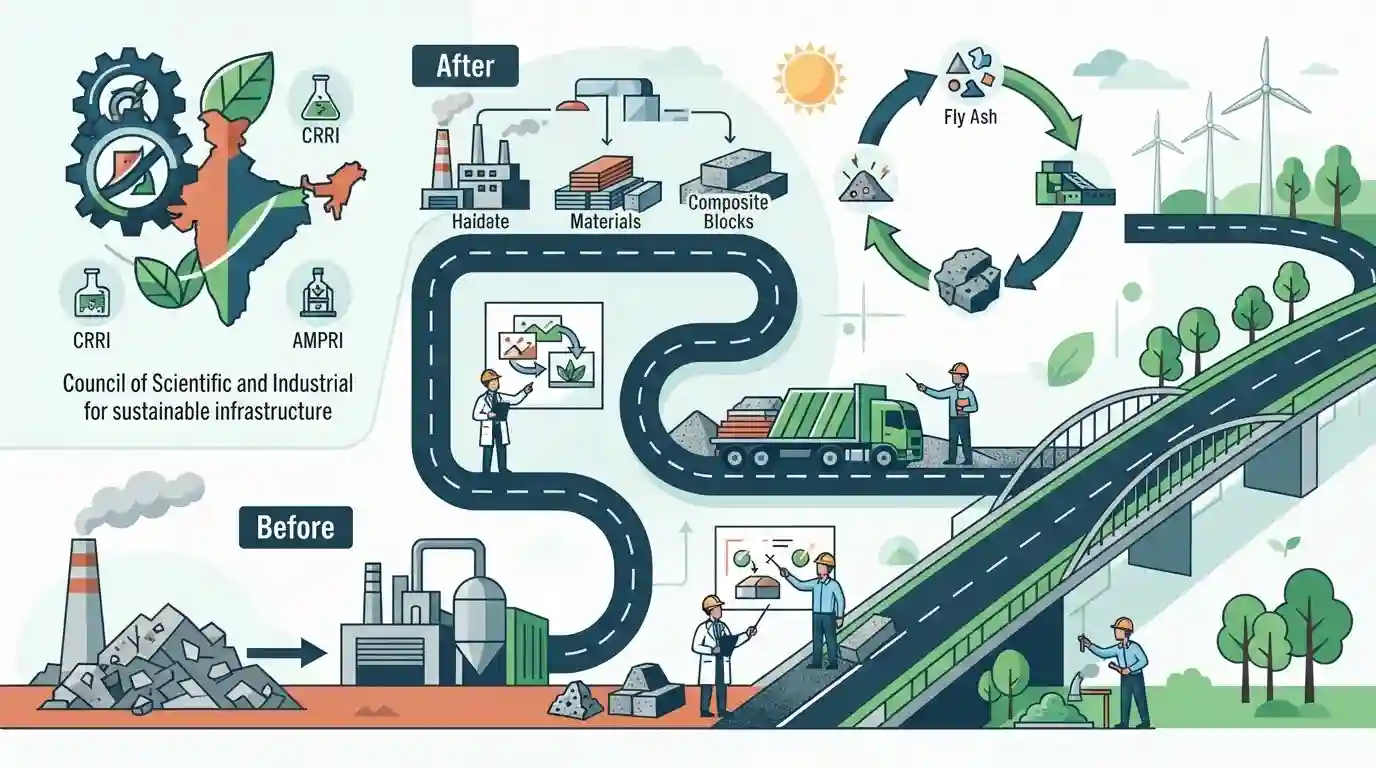
The Council of Scientific and Industrial Research (CSIR), through its constituent laboratories CRRI and AMPRI, organized a workshop on 'Innovative Materials and Advanced Composites for Sustainable Infrastructure'. The event highlighted the critical role of material science in advancing sustainable construction methods. By focusing on alternative materials, industrial waste utilization, and advanced composites, the workshop aimed to foster circular economy principles in infrastructure development, contributing to India's climate goals and ensuring the creation of resilient, eco-friendly physical infrastructure.
मुख्य मुद्दे
- CSIR-CRRI and CSIR-AMPRI collaborated to organize a workshop centered on innovative materials and advanced composites for the construction sector.
- The initiative focused on integrating sustainable practices into infrastructure development to minimize environmental impact and carbon footprints.
- Discussions likely emphasized the 'Waste to Wealth' approach, promoting the use of industrial by-products (such as steel slag, copper slag, and fly ash) as alternative construction materials.
- Advanced composites and smart materials are vital for enhancing the resilience, longevity, and cost-effectiveness of modern roads and civil structures.
महत्त्वाच्या संज्ञा
Council of Scientific and Industrial Research (CSIR)

A premier, autonomous R&D organization in India established in 1942. Funded by the Ministry of Science and Technology, it operates a pan-India network of laboratories dedicated to scientific, industrial, and societal research.
UPSC context
GS Paper 3: Science and Technology. Tests knowledge of India's institutional framework, key scientific achievements, and R&D policies.
Waste to Wealth Mission
One of the nine national missions under the Prime Minister's Science, Technology, and Innovation Advisory Council (PM-STIAC). Led by the Principal Scientific Adviser's office, it focuses on deploying technologies to recover energy and resources from waste.
UPSC context
GS Paper 3: Environment, Circular Economy. Tests understanding of sustainable waste management strategies, government initiatives, and resource efficiency.
Central Road Research Institute (CSIR-CRRI)
Established in 1952 in New Delhi, this premier national laboratory of CSIR conducts research and development on road design, construction, maintenance, runways, and the utilization of industrial waste in highway engineering.
UPSC context
GS Paper 3: Infrastructure, Science & Tech. Tests knowledge of institutions driving resilient transport infrastructure, sustainable materials, and road safety.
Advanced Materials and Processes Research Institute (CSIR-AMPRI)
A CSIR laboratory based in Bhopal, focusing on lightweight and functional materials, sustainable construction, advanced composites, and waste-to-wealth technologies by converting industrial and natural wastes into value-added materials.
UPSC context
GS Paper 3: Science & Tech, Infrastructure. Tests awareness of material science innovations, circular economy principles, and sustainable construction materials.
पूर्वपरीक्षा सापळा
Fly ash and steel slag can fully substitute Portland cement in concrete, completely eliminating the need for conventional binders.
Fly ash acts as a supplementary cementitious material for partial replacement (typically 15-35%). Complete 100% substitution is structurally unviable for standard civil construction.
संबंधित स्थिर संकल्पना
What are the properties and structural applications of Fly Ash?
- Source and Composition: Produced during coal combustion in thermal power plants; rich in silicon dioxide, aluminum oxide, and calcium oxide.
- Concrete Modification: Acts as a pozzolanic material, partially replacing Portland cement to reduce carbon footprint and heat of hydration.
- Agricultural Use: Improves soil water-holding capacity and provides micronutrients, though heavy metal leaching requires careful monitoring.
How is steel slag utilized in sustainable road construction?
- Production Source: An industrial byproduct generated during the separation of impurities from molten steel in steel-making furnaces.
- Road Base Application: Utilized as a high-strength aggregate for road bases, validated by the Indian Roads Congress (IRC) for durability.
- Clinker Replacement: Serves as a partial raw material replacement for clinker in cement manufacturing, cutting energy use.
आंतर-विषय नमुने
Industrial Waste + Climate Commitments
Utilizing slag and fly ash directly lowers the carbon intensity of the construction sector, helping India achieve its NDC target of reducing emissions intensity of GDP.
Circular Economy + Infrastructure
Integrates CSIR's Waste-to-Wealth technologies with NHAI and PM Gati Shakti projects to build cost-effective, climate-resilient national highways.

Expect a multi-statement Prelims question testing the environmental viability and permissible applications of steel slag and fly ash.
संबंधित PYQ · 2
संबंधित PYQ · 2
- 2020PrelimsGS1
In rural road construction, the use of which of the following is preferred for ensuring environmental sustainability or to reduce carbon footprint? 1. Copper slag 2. Cold mix asphalt technology 3. Geotextiles 4. Hot mix asphalt technology 5. Portland cement Select the correct answer using the code given below:
- 2021MainsGS3
“Investment in infrastructure is essential for more rapid and inclusive economic growth.” Discuss in the light of India's experience.
