Railways Orders Indigenous AC EMU Rakes for Mumbai Suburban Network
Source:PIB ↗
Why It Matters
It provides a practical example of the government's approach to upgrading urban mass rapid transport systems (MUTP) and leveraging domestic manufacturing capacities, crucial for GS3 topics on Infrastructure and Economy.
Summary
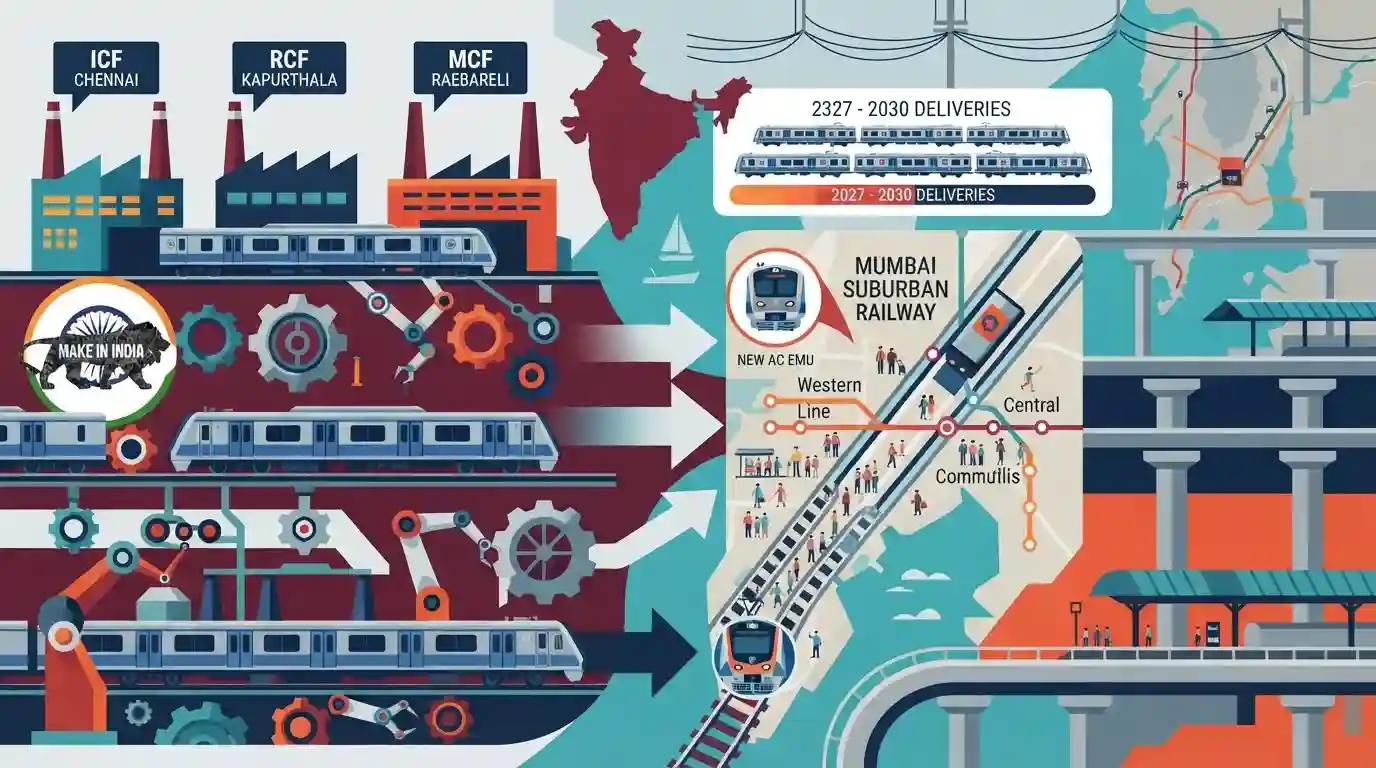
The Ministry of Railways has directed its production units—ICF Chennai, RCF Kapurthala, and MCF Raebareli—to manufacture 238 AC EMU rakes for the Mumbai Suburban Railway. This massive order, allocated under the Mumbai Urban Transport Project (MUTP), aims to sync rolling stock availability with ongoing infrastructure upgrades. By utilizing established RDSO and ICF specifications, production will be expedited, with deliveries slated between 2027 and 2030. This decision underscores the government's dual focus on modernizing urban public transport ("moving people") and strengthening indigenous manufacturing capabilities (Make in India).
Key Points
- The Ministry of Railways has prioritized the indigenous manufacturing of 238 AC EMU rakes to meet the needs of the Mumbai Suburban Railway under the Mumbai Urban Transport Project (MUTP).
- The manufacturing will be distributed across three production units: ICF Chennai (120 rakes), RCF Kapurthala (71 rakes), and MCF Raebareli (47 rakes).
- The rakes will be built using existing and proven RDSO and ICF specifications to facilitate swift manufacturing and supply.
- Deliveries are scheduled to commence in 2027, with the entire sanctioned quantity targeted for completion by 2030.
- The initiative aims to bridge the gap between infrastructure commissioning and rolling stock induction, optimizing urban mobility and boosting domestic manufacturing capabilities for modern trains.
Important Terms
Mumbai Urban Transport Project (MUTP)

A multi-modal infrastructure initiative to upgrade Mumbai's transport network, executed by the Mumbai Railway Vikas Corporation (MRVC) with joint funding from the Indian Railways and the Government of Maharashtra.
UPSC context
GS Paper 3 (Infrastructure/Urban Transport); tests center-state financial cooperation and strategies to modernize mass transit systems.
Make in India
A flagship national initiative launched in 2014 to boost domestic manufacturing, attract foreign investment, and transform India into a global design and manufacturing hub.
UPSC context
GS Paper 3 (Economic Development/Manufacturing); tests economic reforms, employment generation, and policies for indigenous production.
RDSO (Research Designs and Standards Organisation)
The sole research, development, and standards-formulating body under the Ministry of Railways, acting as a technical adviser to standardizing railway equipment, based in Lucknow.
UPSC context
GS Paper 3 (S&T/Infrastructure); tests indigenous technical standard development and the 'One Nation One Standard' framework.
ICF (Integral Coach Factory)
A premier rail coach manufacturing facility in Chennai, established in 1955, famous for indigenously designing and producing the semi-high-speed Vande Bharat trainsets.
UPSC context
GS Paper 3 (Infrastructure/Indigenization); tests public sector manufacturing efficiency and progress toward self-reliance in mass transit.
RCF (Rail Coach Factory)
A major passenger coach manufacturing unit of Indian Railways in Kapurthala, Punjab, established in 1985, which designs and manufactures Tejas and export-grade coaches.
UPSC context
GS Paper 3 (Manufacturing/Infrastructure); tests regional industrial expansion and international export capabilities in transport sectors.
MCF (Modern Coach Factory)
An advanced, highly automated rail coach factory in Raebareli, Uttar Pradesh, utilizing Industry 4.0 standards to manufacture modern rolling stock like Vande Bharat coaches.
UPSC context
GS Paper 3 (Infrastructure/S&T); tests implementation of smart manufacturing, automation, and robotic technologies in public infrastructure.
Prelims Trap
MUTP Phase III is fully funded by the World Bank as part of its urban upgrade assistance.
While early phases were World Bank-aided, current MUTP phases are co-financed by the Asian Infrastructure Investment Bank (AIIB) and domestic governments.
Static Concepts Connected
What is the institutional structure of MRVC?
- Joint Venture: Established as a 51:49 public sector partnership between the Ministry of Railways and the Government of Maharashtra.
- Special Mandate: Responsible for executing suburban rail infrastructure projects specifically under the Mumbai Urban Transport Project (MUTP).
What are the core tenets of NUTP?
- People First: Focuses on 'moving people' instead of 'moving vehicles' to optimize urban space and transport capacity.
- Clean Transit: Emphasizes high-capacity, low-carbon public transport systems (like Metro and EMU rail) to reduce vehicular pollution.
Cross-Topic Patterns
MDB financing trends in India
The funding shift of MUTP from World Bank to AIIB highlights India's evolving relationship with multilateral development banks for regional mega-infrastructure projects.
Cooperative federalism in transport
Joint ventures like MRVC present a model for center-state cost-sharing, streamlining land acquisition, and aligning urban planning priorities between levels of government.

Questions on urban infrastructure funding may test the specific roles of AIIB/ADB versus World Bank in flagship projects like MUTP.
Linked PYQs · 3
Linked PYQs · 3
- 2014MainsGS3
National Urban Transport Policy emphasises on 'moving people' instead of 'moving vehicles'. Discuss critically the success of the various strategies of the Government in this regard.
- 2022MainsGS3
Why is Public Private Partnership (PPP) required in infrastructural projects ? Examine the role of PPP model in the redevelopment of Railway Stations in India.
- 2023PrelimsGS1
Consider the following infrastructure sectors: 1. Affordable housing 2. Mass rapid transport 3. Health care 4. Renewable energy On how many of the above does UNOPS Sustainable Investments in Infrastructure and Innovation (S3i) initiative focus for its investments?
