Civil Aviation Ministry Flags off Transshipment Cargo Operations
Source:PIB ↗
આ શા માટે મહત્વનું છે
This development is highly relevant for GS-3 Infrastructure and Logistics, highlighting how reducing regulatory bottlenecks (re-screening) can drastically improve supply chain efficiency and make Indian airports globally competitive transshipment hubs.
સારાંશ
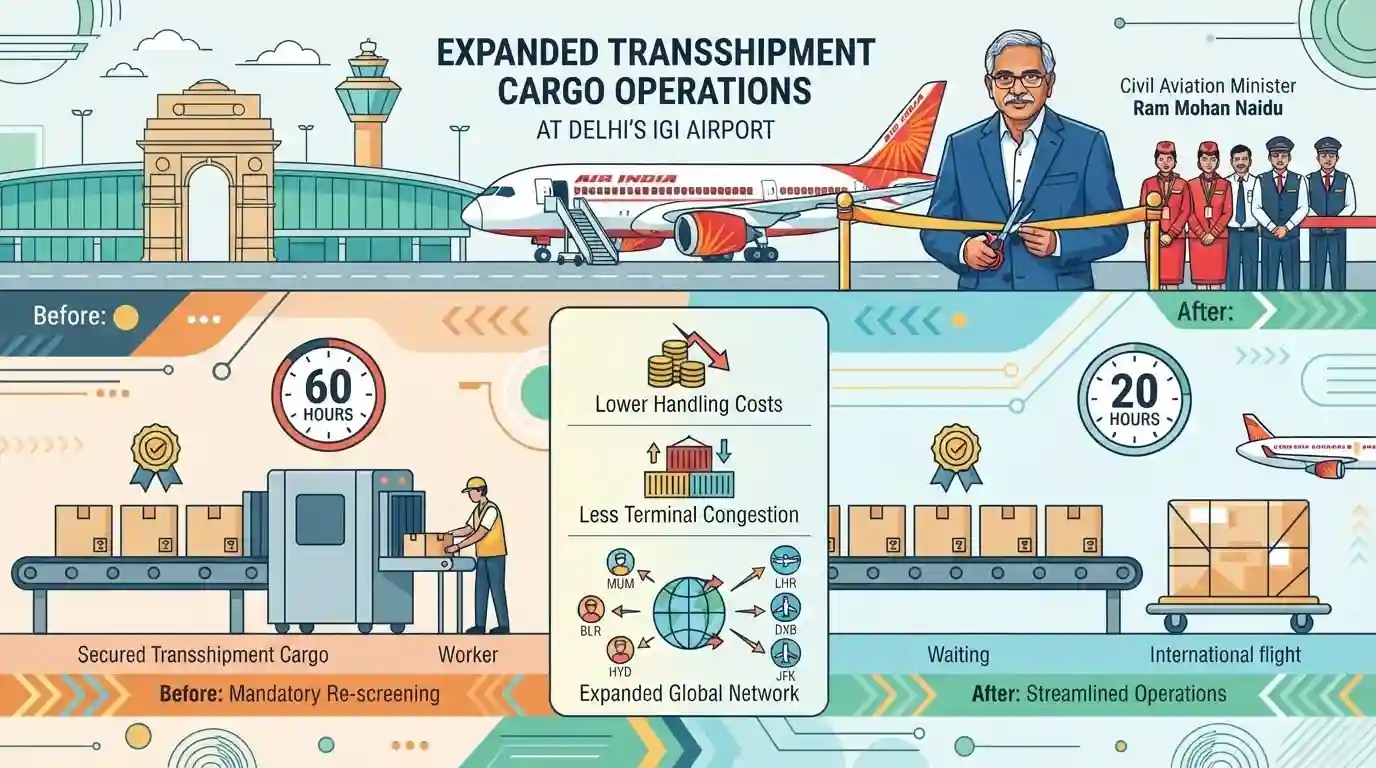
Civil Aviation Minister Ram Mohan Naidu flagged off expanded Transshipment Cargo Operations at Delhi's IGI Airport. Enabled by a revised regulatory framework from the Bureau of Civil Aviation Security (BCAS), the initiative exempts secured transshipment cargo from mandatory re-screening. This critical reform significantly reduces transit times from 60 to 20 hours, lowers handling costs, and eases terminal congestion. Operated initially by Air India, the network connects key domestic cities to international destinations, advancing India's objective to become a competitive global cargo transshipment hub and improving ease of doing business in the aviation and logistics sectors.
મુખ્ય મુદ્દા
- The Ministry of Civil Aviation has expanded Transshipment (TP) Cargo Operations at Delhi's IGI Airport to boost India's ambition of becoming a global cargo hub.
- A key regulatory reform by the Bureau of Civil Aviation Security (BCAS) abolishes the mandatory re-screening of secured transshipment cargo when moved through designated Transfer Cargo Security Hold Areas (TCSHAs).
- This easing of doing business slashes end-to-end transit times for cargo from 60 hours to roughly 20 hours, simultaneously cutting handling costs and reducing terminal congestion.
- The initial domestic-to-international network operated by Air India connects cities like Bengaluru, Ahmedabad, Mumbai, and Hyderabad to global destinations like London and Copenhagen.
મહત્વપૂર્ણ શબ્દો
Bureau of Civil Aviation Security (BCAS)

The nodal regulatory authority under the Ministry of Civil Aviation responsible for laying down, implementing, and monitoring security standards and measures across Indian airports and airlines.
UPSC context
GS Paper 3: Internal Security and Infrastructure. Tests aviation safety protocols and logistical regulatory reforms.
Ministry of Civil Aviation
The nodal ministry of the Government of India responsible for formulating national policies and programs for the development, growth, and regulation of the civil air transport sector.
UPSC context
GS Paper 2 & 3: Governance and Infrastructure. Tests national policy frameworks and aviation sector development.
Delhi International Airport Limited (DIAL)
A joint-venture consortium primarily led by the GMR Group and Airports Authority of India that operates, maintains, and modernizes Indira Gandhi International Airport under a Public-Private Partnership model.
UPSC context
GS Paper 3: Infrastructure and Investment Models. Demonstrates Public-Private Partnership execution in major infrastructure development.
Air India
India's flag carrier airline, originally founded by Tata Sons, nationalized in 1953, and privatized back to the Tata Group in 2022 to improve operational efficiency and curb fiscal losses.
UPSC context
GS Paper 3: Economic Development. Relates to disinvestment policies, privatization, and aviation market dynamics.
Transshipment Cargo
Goods physically transferred from one transport vessel or mode to another at an intermediate customs/logistics hub before proceeding to their final global or domestic destination.
UPSC context
GS Paper 3: Infrastructure and Logistics. Essential for trade facilitation, customs streamlining, and supply chain efficiency.
પ્રિલિમ્સ ટ્રેપ
The Directorate General of Civil Aviation (DGCA) formulates security and screening protocols for air transshipment cargo.
BCAS handles aviation security (including cargo screening) and operates independently. DGCA handles safety, airworthiness, and licensing.
સંલગ્ન સ્થિર ખ્યાલો
What are the specific mandates of India's civil aviation regulators?
- BCAS: Regulates aviation security, including passenger and cargo screening protocols, aligned with the Chicago Convention.
- DGCA: Regulates aviation safety, enforces aircraft airworthiness standards, and issues pilot/crew licenses.
- AERA: Determines tariffs, aeronautical charges, and monitors performance standards at major Indian airports.
What are the core targets of the National Logistics Policy (NLP) 2022?
- Cost Reduction: Reduce logistics costs in India from ~14% of GDP to single digits to match global benchmarks.
- LPI Ranking: Elevate India into the top 25 countries by 2030 in the World Bank's Logistics Performance Index (LPI).
- Tech Integration: Implement the Unified Logistics Interface Platform (ULIP) for seamless multi-modal tracking and data-driven supply chains.
આંતર-વિષય પેટર્ન
Aviation Security & UN Conventions
BCAS enforces standards aligned with Annex 17 of the Chicago Convention. UPSC frequently tests domestic regulators against their international parent treaties or conventions.
Logistics Costs & Export Parity
Cutting transshipment transit times aligns directly with the National Logistics Policy goal to reduce India's logistics costs from 14% of GDP, making exports globally competitive.

Expect a multi-statement prelims question contrasting the regulatory mandates of BCAS vs DGCA alongside NLP 2022 cost targets.
સંલગ્ન PYQ · 2
સંલગ્ન PYQ · 2
- 2021MainsGS3
“Investment in infrastructure is essential for more rapid and inclusive economic growth.” Discuss in the light of India's experience.
- 2025MainsGS3
Elaborate the scope and significance of supply chain management of agricultural commodities in India.
