Directorate of Revenue Intelligence Busts Ivory Smuggling Ring
Source:PIB ↗
কেন এটি গুরুত্বপূর্ণ
Illegal wildlife trafficking is a multi-billion dollar illicit global industry that threatens biodiversity and funds organized crime. Understanding the legal instruments (Wildlife Protection Act, 1972, CITES) and enforcement bodies (DRI, forest departments) used to combat these ecological crimes is highly relevant for both GS Paper 1 (Geography/Ecology), GS Paper 3 (Environment/Security), and Prelims questions on conservation.
সারসংক্ষেপ
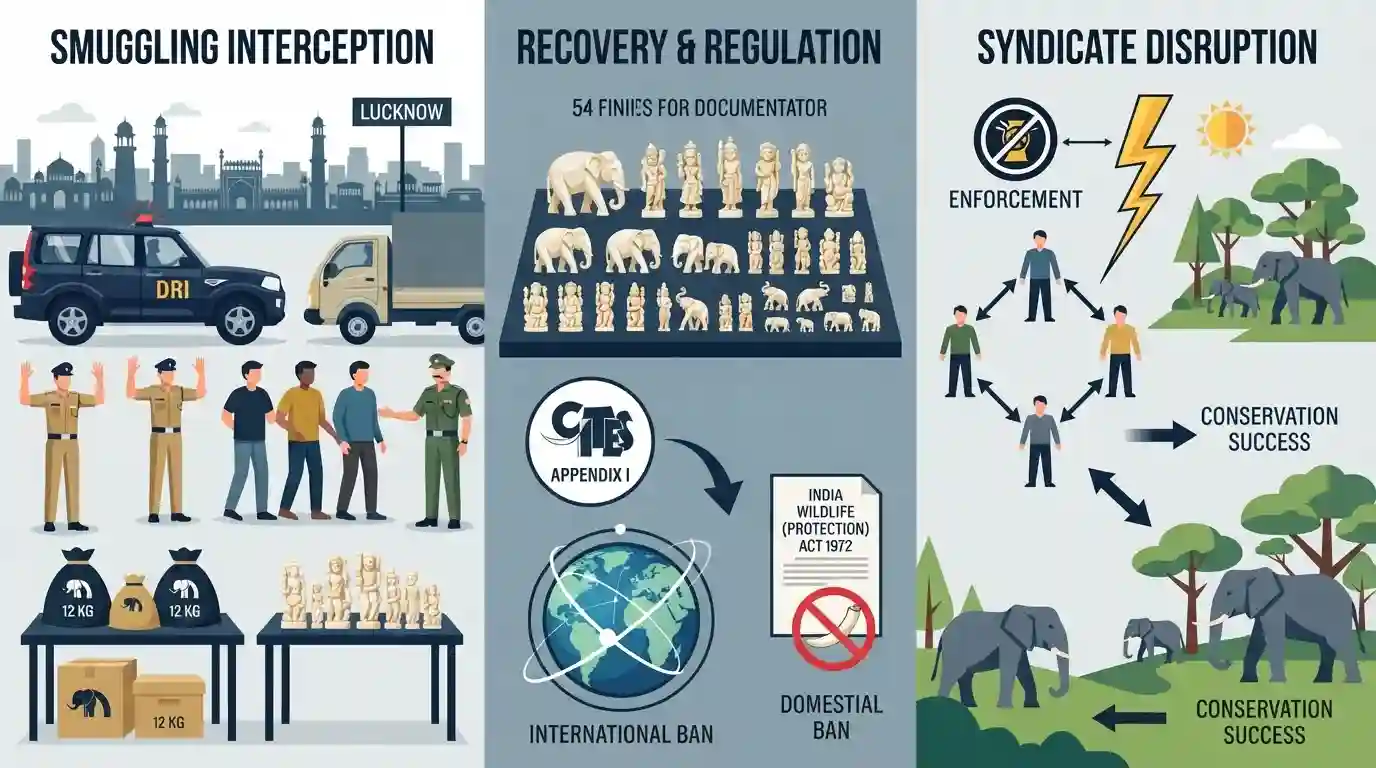
The Directorate of Revenue Intelligence (DRI) intercepted a major wildlife smuggling ring in Lucknow, Uttar Pradesh, recovering 54 finely carved ivory figurines weighing over 12 kg. Trade in elephant ivory is legally barred under India's Wildlife (Protection) Act, 1972, and is strictly banned internationally under CITES Appendix I. The four arrested suspects were handed over to the state forest department. This bust is part of a series of successful DRI crackdowns on ivory syndicates across India, highlighting the intersection of law enforcement, revenue intelligence, and environmental conservation.
মূল বিষয়
- The Directorate of Revenue Intelligence (DRI) busted a wildlife trafficking syndicate in Lucknow, seizing 54 exquisitely carved elephant ivory artefacts weighing 12.16 kg.
- Four individuals were arrested and handed over to the UP Forest Department for further investigation under the Wildlife (Protection) Act, 1972.
- Elephant ivory trade is banned under the domestic Wildlife (Protection) Act, 1972, and ivory/elephants are protected under Appendix I of CITES, which prohibits international commercial trade.
- This bust reflects a persistent trend of illegal ivory smuggling in India, following previous major DRI seizures in Sujangarh (Rajasthan), Howrah (West Bengal), and Mysuru (Karnataka) in mid-2024.
- The operation underscores the role of financial and revenue intelligence agencies like the DRI in tackling environmental crimes and preserving biodiversity by disrupting illicit trade networks.
গুরুত্বপূর্ণ শব্দ
Wildlife (Protection) Act, 1972

A landmark Indian statute providing a comprehensive legal framework for the protection of wild animals, plants, and habitats. It regulates wildlife trade, bans hunting, and establishes protected areas like sanctuaries and national parks.
UPSC context
GS Paper 3 (Environment); tests key domestic legislation, conservation schedules, and ecological protection frameworks.
Convention on International Trade in Endangered Species of Wild Fauna and Flora (CITES)
An international, legally binding treaty among governments designed to ensure that global trade in wild animal and plant specimens, and their derivatives, does not threaten the survival of species.
UPSC context
GS Paper 3 (Environment) and GS Paper 2 (International Treaties); tests global conservation accords and trade regulatory regimes.
Directorate of Revenue Intelligence (DRI)
The apex anti-smuggling intelligence and investigation agency of India. Operating under CBIC, Ministry of Finance, it combats commercial fraud, customs duty evasion, and smuggling of contraband, including illicit wildlife products.
UPSC context
GS Paper 3 (Internal Security); tests institutional capabilities in countering organized crime, smuggling networks, and financial offences.
প্রিলিমস ফাঁদ
The Directorate of Revenue Intelligence (DRI) is a specialized wildlife enforcement agency under the MoEFCC.
DRI is the apex anti-smuggling agency under the Ministry of Finance (CBIC). It utilizes the Customs Act to intercept cross-border wildlife and environmental contraband.
সংযুক্ত স্থির ধারণা
How did the WPA 2022 Amendment restructure the wildlife protection schedules?
- Schedules I & II: Consolidated earlier schedules to denote highest (Schedule I) and lesser (Schedule II) protection for animal species.
- Schedule III: Dedicated exclusively to the protection of specified plant species.
- Schedule IV: Newly introduced to legally regulate and protect species specifically listed under CITES appendices.
- Vermin Omission: The dedicated vermin schedule was completely omitted; vermin are now declared via notification instead.
How are CITES obligations legally operationalized within India?
- Chapter VB: The Wildlife (Protection) Amendment Act, 2022 added 'Chapter VB' specifically to domesticate CITES regulations.
- Dual Authorities: The law mandates a Management Authority to issue trade permits and a Scientific Authority to assess ecological impact.
- Border Enforcement: Border interception is managed by Customs/DRI, assisted technically by the Wildlife Crime Control Bureau (WCCB).
আন্তঃবিষয় প্যাটার্ন
Wildlife Trade & Organized Crime
Wildlife syndicates are increasingly probed under the Prevention of Money Laundering Act (PMLA), bridging environmental conservation with internal security and transnational financial crime.
Federal Policing & State Forests
While "Protection of Wild Animals" is a Concurrent List subject, ground enforcement heavily tests inter-agency federalism, requiring state forest departments to operationalize intelligence from central bodies like DRI.

Expect a multi-statement question contrasting the mandates of WCCB (MoEFCC) and DRI (Finance) alongside the WPA's new CITES Schedule IV.
সংযুক্ত PYQ · 3
সংযুক্ত PYQ · 3
- 2015PrelimsGS1
With reference to the International Union for Conservation of Nature and Natural Resources (IUCN) and the Convention on International Trade in Endangered Species of Wild Fauna and Flora (CITES), which of the following statements is/are correct? 1. IUCN is an organ of the United Nations and CITES is an international agreement between governments. 2. IUCN runs thousands of field projects around the world to better manage natural environments. 3. CITES is legally binding on the States that have joined it, but this Convention does not take the place of national laws. Select the correct answer using the code given below.
- 2017PrelimsGS1
In India, if a species of tortoise is declared protected under Schedule I of the Wildlife (Protection) Act, 1972, what does it imply?
- 2018MainsGS3
India's proximity to two of the world's biggest illicit opium-growing states has enhanced her internal security concerns. Explain the linkages between drug trafficking and other illicit activities such as gunrunning, money laundering and human trafficking. What counter-measures should be taken to prevent the same?
