India to Host Coast Guard Global Summit in New Delhi
Source:PIB ↗
কেন এটি গুরুত্বপূর্ণ
Highlights India's transition from an internal coastal security focus to a leadership role in global maritime governance. The focus on the 'MAHASAGAR' vision showcases proactive diplomacy and cooperation in securing global maritime commons, directly relevant to GS3 (Security) and GS2 (International Relations).
সারসংক্ষেপ
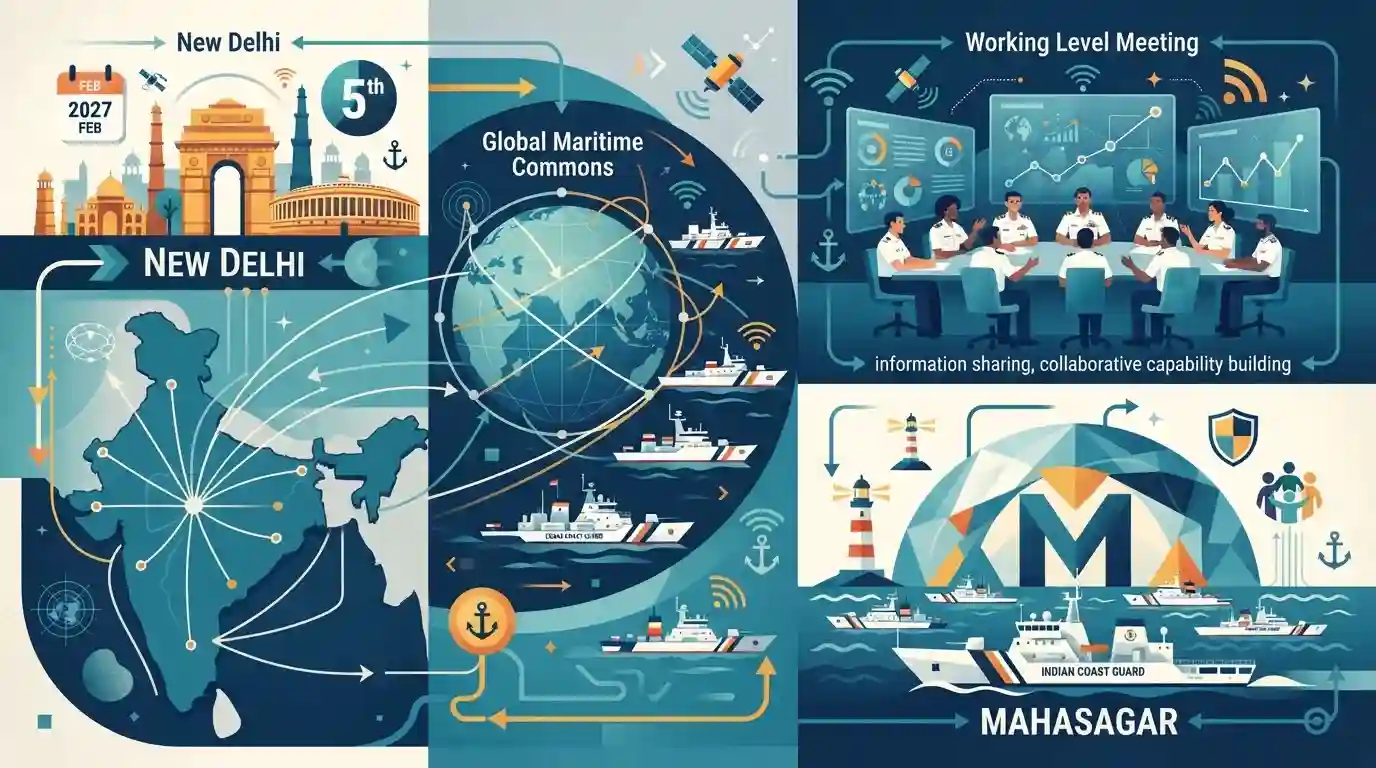
India is set to host the 5th Coast Guard Global Summit (CGGS) in New Delhi in February 2027, marking the Golden Jubilee of the Indian Coast Guard. Preparations have begun with a Working Level Meeting focusing on information sharing and collaborative capability building among global maritime agencies. The summit aims to advance India's 'MAHASAGAR' vision, promoting an inclusive and forward-looking maritime order to ensure the safety and security of the global maritime commons.
মূল বিষয়
- India will host the 5th Coast Guard Global Summit (CGGS) in New Delhi in February 2027.
- The event will coincide with the Swarnim Jayanti (Golden Jubilee) of the Indian Coast Guard.
- A Working Level Meeting (WLM) was held in hybrid mode to finalize the agenda, focusing on collaborative maritime order and information sharing.
- The summit promotes Bharat's 'MAHASAGAR' vision (Maritime Heads for Active Security And Growth for All in Region), emphasizing collective capability building for global maritime commons.
গুরুত্বপূর্ণ শব্দ
MAHASAGAR vision

An acronym for "Mutual and Holistic Advancement for Security and Growth Across Regions," this 2025 maritime doctrine expands the SAGAR framework to extend security and economic partnerships across the broader Global South.
UPSC context
GS II (International Relations) & GS III (Security) — tests maritime diplomacy, Global South engagements, and regional cooperation policies.
Indian Coast Guard
A multi-mission, armed maritime force of India established under the Coast Guard Act, 1978, operating under the Ministry of Defence to safeguard maritime zones, protect offshore assets, and prevent coastal crimes.
UPSC context
GS III (Internal Security & Border Management) — tests the roles, mandate, and organizational framework of India's coastal security forces.
Ministry of Defence
The Government of India ministry responsible for supervising and coordinating all agencies and functions directly relating to national security and the Indian Armed Forces (Army, Navy, Air Force, and Coast Guard).
UPSC context
GS III (Security & Defence Policy) — tests the administrative, policy-making, and structural framework of India's national security apparatus.
Coast Guard Global Summit
A high-level international forum bringing together global coast guards and maritime agencies to address shared security, safety, and environmental challenges, and build consensus around collaborative responses.
UPSC context
GS II (International Relations) & GS III (Security) — tests multilateral maritime forums, global security cooperation, and India's regional leadership.
প্রিলিমস ফাঁদ
The Indian Coast Guard (ICG) operates under the Ministry of Home Affairs to manage India's coastal security.
While coastal security is closely linked to border management (often MHA's domain), the ICG is uniquely established as an armed force under the Ministry of Defence.
সংযুক্ত স্থির ধারণা
What is the statutory basis and mandate of the Indian Coast Guard (ICG)?
- Statutory Origin: Established on a permanent footing under the Coast Guard Act, 1978, following the recommendations of the Rustamji Committee (1974).
- Nodal Authority: Operates as the fourth armed force of the Union under the administrative control of the Ministry of Defence.
- Core Mandates: Mandated with maritime law enforcement, search & rescue (SAR), and acting as the national coordinating agency for marine oil spills.
What are India's maritime zones under UNCLOS?
- Territorial Waters: Extends up to 12 nautical miles from the baseline where India exercises full sovereignty over the sea, seabed, and airspace.
- Contiguous Zone: Extends from 12 to 24 nautical miles, allowing India to enforce laws regarding customs, fiscal, immigration, and sanitation.
- Exclusive Economic Zone: Extends up to 200 nautical miles, granting exclusive sovereign rights for economic exploitation and marine resource management.
আন্তঃবিষয় প্যাটার্ন
SAGAR to MAHASAGAR shift
Reflects India's strategic foreign-policy evolution from regional maritime safety (SAGAR) to leadership in the wider Global South maritime commons (MAHASAGAR).
Dual-layered coastal policing
Highlights the coordination challenges between Union forces (ICG, Indian Navy) and State marine police forces under coastal state home departments.

Expect a question combining the statutory mandate of ICG under MoD with the evolution of India's SAGAR and MAHASAGAR doctrines.
সংযুক্ত PYQ · 3
সংযুক্ত PYQ · 3
- 2025MainsGS3
Why is maritime security vital to protect India's sea trade? Discuss maritime and coastal security challenges and the way forward.
- 2022MainsGS3
What are the maritime security challenges in India ? Discuss the organisational, technical and procedural initiatives taken to improve the maritime security.
- 2023MainsGS2
‘Sea is an important Component of the Cosmos’ Discuss in the light of the above statement the role of the IMO (International Maritime Organisation) in protecting environment and enhancing maritime safety and security.
