India and Armenia Advance Defense and Technical Cooperation
Source:PIB ↗
हे का महत्त्वाचे आहे
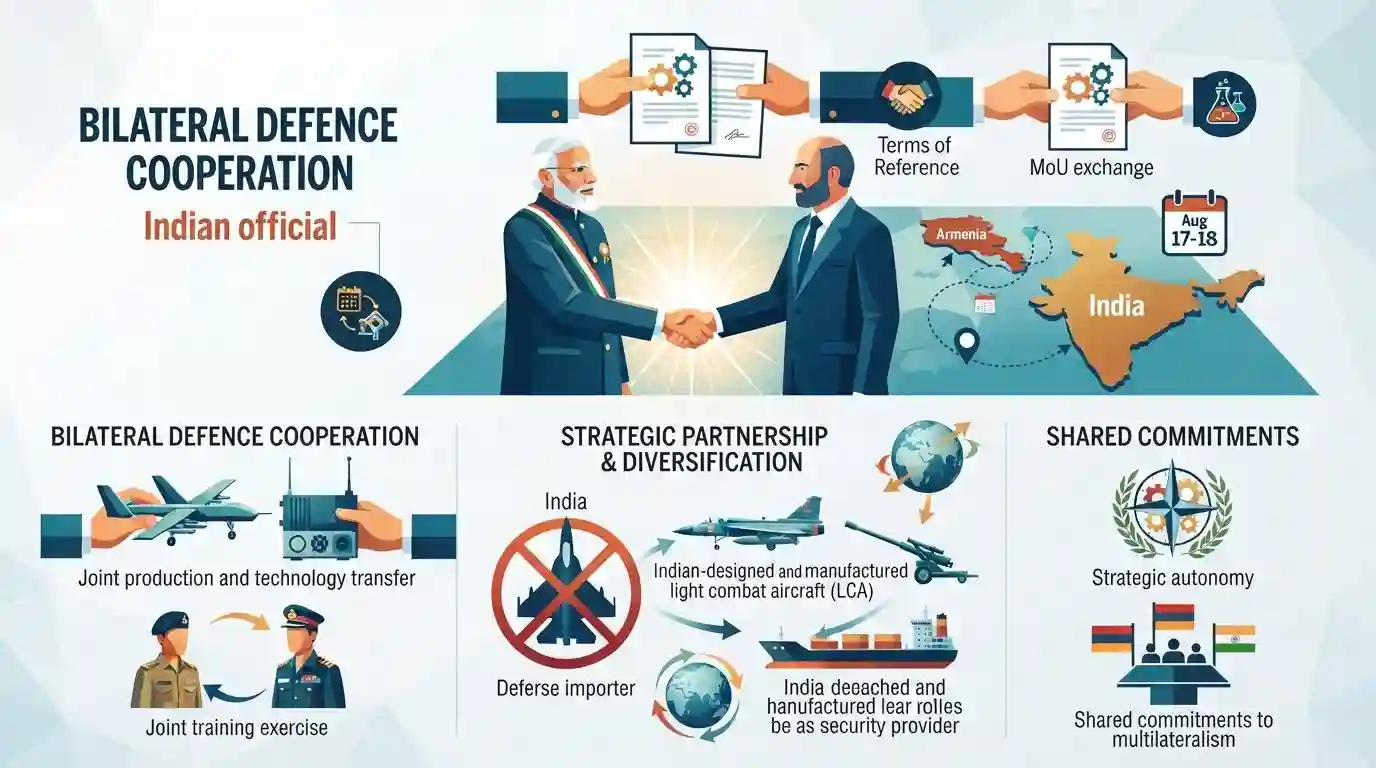
The evolving India-Armenia relationship highlights India's strategic outreach in the strategically crucial South Caucasus region. Armenia's deliberate pivot toward India for defense diversification provides a major boost to India's defense export ambitions ('Make in India' in defence) and reinforces India's image as a capable, reliable, and strategically autonomous global security partner.
सारांश
Defence Secretary Rajesh Kumar Singh visited Armenia from August 17-18, 2026, to strengthen bilateral defence and military technical cooperation. The visit culminated in the exchange of Terms of Reference for institutionalizing Joint Services Staff Talks and the signing of an MoU focused on defence innovation and R&D. Engaging with top Armenian officials, the Defence Secretary discussed capacity building, training, and defense procurement diversification. The visit underscores India's transition towards becoming a significant defence exporter and a reliable security partner in the South Caucasus region, as both nations emphasized shared commitments to multilateralism and strategic autonomy.
मुख्य मुद्दे
- India's Defence Secretary concluded a two-day visit to Armenia to advance bilateral defence and military technical cooperation.
- The two nations exchanged Terms of Reference to institutionalize 'Joint Services Staff Talks' between their armed forces.
- An MoU was signed between the Defence Ministries to expand cooperation in joint collaboration, innovation, and research and development (R&D).
- The discussions highlighted Armenia's intent to diversify its defence procurement, with India emerging as a major partner in military technical cooperation.
- Both sides reaffirmed their shared views on upholding multilateralism and strategic autonomy in international affairs.
महत्त्वाच्या संज्ञा
Terms of Reference for Joint Services Staff Talks

A bilateral framework document outlining the structure and objectives to institutionalize regular military-to-military dialogue, capability building, and cooperative exercises between the armed forces of India and partner nations like Armenia.
UPSC context
GS Paper II & III: Bilateral relations and security; tests knowledge of institutional mechanisms for military-to-military engagements.
Memorandum of Understanding on Joint Collaboration, Innovation and R&D
A bilateral agreement between Indian and Armenian defence ministries to expand cooperative defense research, development of military technologies, and high-tech innovation partnerships.
UPSC context
GS Paper II & III: Technology indigenization; tests bilateral defence diplomacy and technology-sharing frameworks.
Armenian Military Academy named after Vazgen Sargasyan
Armenia's premier military university where India has supported capacity building, including establishing an IT lab, symbolizing growing defence educational exchanges and strategic cooperation.
UPSC context
GS Paper II: International relations; tests India's strategic capacity-building footprint in the Eurasian region.
Ministry of Defence (India)
The Indian government ministry charged with coordinating and supervising all agencies and functions of the government relating directly to national security and the Indian Armed Forces.
UPSC context
GS Paper III: Security; tests understanding of executive bodies managing national security and global defence partnerships.
पूर्वपरीक्षा सापळा
The Zangezur Corridor is an Indian-backed transit route designed to facilitate the International North-South Transport Corridor (INSTC) through Armenia.
The Zangezur Corridor is pushed by Azerbaijan/Turkey and opposed by Armenia as a sovereignty threat. India supports Armenia's territorial integrity, not this corridor.
संबंधित स्थिर संकल्पना
What is the Collective Security Treaty Organization (CSTO)?
- Origin and Members: Intergovernmental military alliance signed in 1992, currently consisting of post-Soviet states like Russia, Belarus, Kazakhstan, Kyrgyzstan, and Tajikistan.
- Mutual Defence Clause: Governed by Article 4, which states that an aggression against one signatory is considered an aggression against all member states.
- Armenian Disengagement: Armenia formally froze its participation in 2024 and stopped funding its budget, citing CSTO's failure during border clashes with Azerbaijan.
What is the Organization of Turkic States (OTS)?
- Establishment: Established in 2009 as the Turkic Council, renamed OTS in 2021 to foster comprehensive cooperation among Turkic-speaking nations.
- Membership: Comprises five full members: Azerbaijan, Kazakhstan, Kyrgyzstan, Turkey, and Uzbekistan. Armenia is not a member.
- Strategic Alignment: Forms a key geopolitical axis (Turkey-Azerbaijan-Pakistan) that influences security and connectivity alignments in the South Caucasus.
आंतर-विषय नमुने
Defense exports as diplomatic leverage
India's transition from a net importer to exporting systems like Akash to Armenia shows how defense indigenization (GS-3) directly serves strategic balancing in the South Caucasus (GS-2).
INSTC and Caucasus transit corridors
India's defense ties with Yerevan align with securing the International North-South Transport Corridor (INSTC) to bypass hostile axes like the Turkey-Azerbaijan-Pakistan alignment.

South Caucasus corridors (Zangezur/Lachin) and India's defense export footprint likely to feature in a location-cum-geopolitics MCQ.
संबंधित PYQ · 3
संबंधित PYQ · 3
- 2023PrelimsGS1
Consider the following pairs: Regions often mentioned in news Reason for being in news 1. North Kivu and Ituri : War between Armenia and Azerbaijan 2. Nagorno-Karabakh : Insurgency in Mozambique 3. Kherson and Zaporizhzhia : Dispute between Israel and Lebanon How many of the above pairs are correctly matched?
- 2022PrelimsGS1
Consider the following countries: 1. Armenia 2. Azerbaijan 3. Croatia 4. Romania 5. Uzbekistan Which of the above are members of the Organization of Turkic States?
- 2024MainsGS2
Critically analyse India's evolving diplomatic, economic and strategic relations with the Central Asian Republics (CARs) highlighting their increasing significance in regional and global geopolitics.
