CAQM Approves Clean Vehicle Transition and Dust Control Rules
Source:PIB ↗
ఇది ఎందుకు ముఖ్యం
Delhi-NCR's air pollution remains a recurring area of evaluation in UPSC exams. The functional aspects of CAQM, technological enforcement of dust mitigation, punitive compliance for biomass co-firing (via NGT), and structural transport policy changes (like LGVs phase-out) represent highly probable areas for both Prelims (pollution standards) and Mains (environmental governance, policy efficacy).
సారాంశం
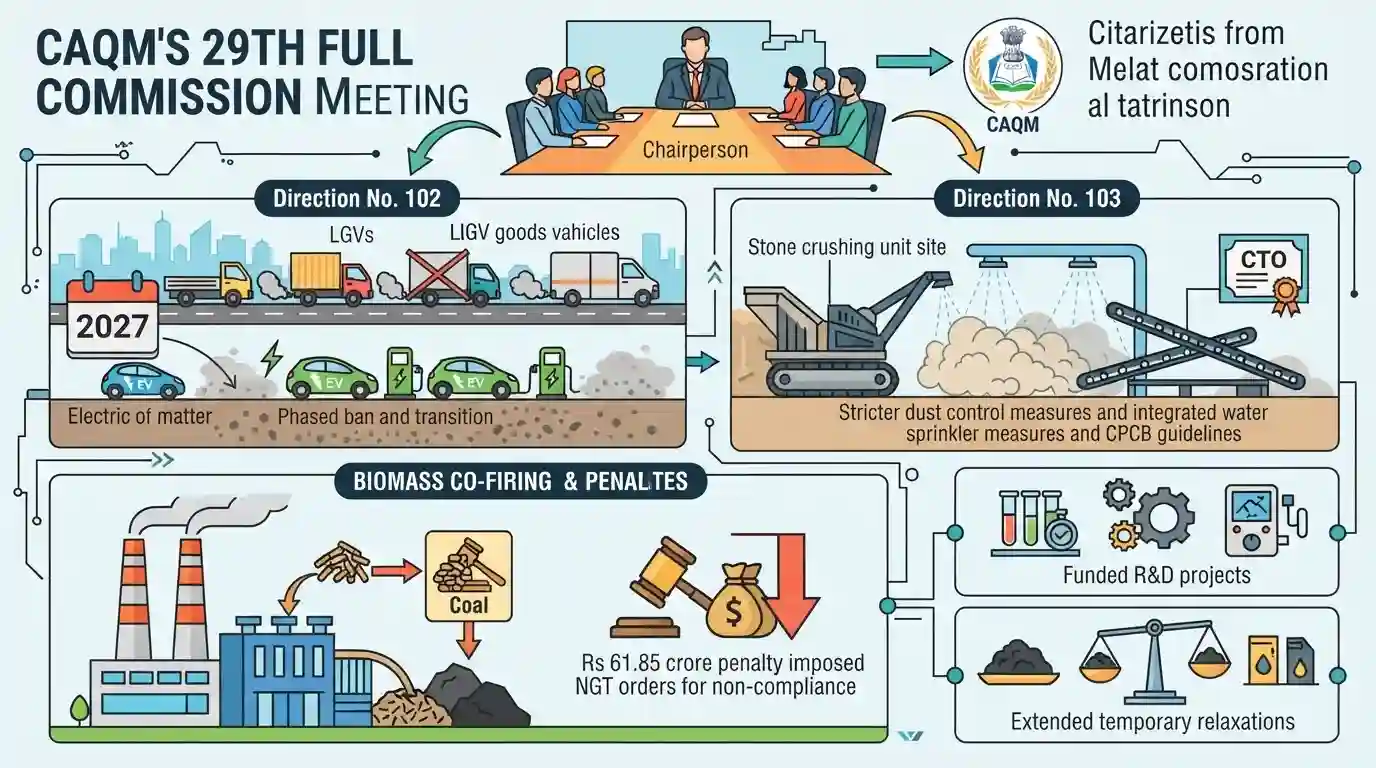
The 29th Full Commission meeting of the CAQM, chaired by Shri Rajesh Verma, approved key directives to combat air pollution in Delhi-NCR. Direction No. 102 mandates a phased ban/transition on diesel/petrol/CNG Light Goods Vehicles (LGVs) starting 2027 to curb particulate emissions. Direction No. 103 enforces stricter dust control for stone crushing units by integrating CPCB guidelines into CTO conditions. In addition, CAQM addressed non-compliance in biomass co-firing at thermal power plants (imposing Rs 61.85 crore in penalties under NGT orders), funded R&D projects targeting air pollution, and extended temporary alternate fuel relaxations due to global energy constraints.
ముఖ్య అంశాలు
- The Commission for Air Quality Management (CAQM) held its 29th Full Commission meeting on August 18, 2026, chaired by Shri Rajesh Verma.
- Approved Direction No. 102 mandating a phased transition toward cleaner Light Goods Vehicles (LGVs) in Delhi-NCR, starting January 2027, as LGVs make up 1.2% of the active vehicle fleet but contribute 3.3% of particulate matter (PM) emissions.
- Approved Direction No. 103 incorporating the Central Pollution Control Board's (CPCB) 2023 Guidelines for Stone Crushing Units into Consent to Operate (CTO) conditions, requiring continuous technology-enabled remote monitoring (sensors, video surveillance, and wheel-washing).
- Imposed Environmental Compensation (EC) of Rs 61.85 crore on six non-compliant Thermal Power Plants (TPPs) for failing to achieve biomass co-firing targets for 2024-25, in compliance with interim orders from the National Green Tribunal (NGT).
- Approved financial assistance of Rs 3.25 crore for four R&D projects covering road dust exposure, mechanical sweeping technologies, high-rise building particulate matter profiling, and rice residue burning forecasts.
- Extended fuel relaxation under Direction No. 65 till September 13, 2026, allowing industries to use alternate fuels due to energy disruptions caused by the Middle East conflict.
ముఖ్యమైన పదాలు
Commission for Air Quality Management (CAQM)

A statutory body tasked with coordinating, researching, and resolving air quality issues in the National Capital Region and adjoining areas, equipped with powers to issue binding environmental directives.
UPSC context
Core for GS Paper 3 (Environmental Pollution); tests knowledge of regional environmental governance and statutory bodies.
Direction No. 102
A CAQM directive banning new registrations of diesel, petrol, and CNG Light Goods Vehicles (LGVs) in Delhi-NCR in a phased manner starting 2027 to drastically reduce vehicular particulate emissions.
UPSC context
Relevant for GS Paper 3 (Vehicular Pollution); exemplifies phased regulatory policy transitions toward cleaner urban freight mobility.
Direction No. 103
A CAQM mandate enforcing stricter dust control at NCR stone crushing units, integrating CPCB guidelines and requiring continuous technology-enabled monitoring like PM sensors and CCTV cameras.
UPSC context
Important for GS Paper 3 (Pollution Control); highlights the use of tech-driven enforcement for mitigating fugitive dust in industrial sectors.
Central Pollution Control Board (CPCB)
A statutory organization that provides technical assistance, monitors national air and water quality, and issues foundational environmental guidelines and standards for industries across India.
UPSC context
Crucial for GS Paper 3; forms the backbone of India's institutional framework for pollution control and environmental standards.
National Green Tribunal (NGT)
A specialized judicial body established under the NGT Act 2010 to expedite the disposal of civil cases relating to environmental protection, forest conservation, and natural resources management.
UPSC context
Essential for GS Papers 2 & 3; frequently tests the jurisdiction, composition, and impact of environmental jurisprudence in India.
ప్రిలిమ్స్ ఉచ్చు
"CAQM's jurisdiction is strictly limited to the National Capital Region (NCR)."
The CAQM Act 2021 explicitly extends its jurisdiction beyond Delhi-NCR to "adjoining areas" in Punjab, Haryana, UP, and Rajasthan to tackle regional airshed pollution.
అనుసంధానమైన స్థిర భావనలు
What is the statutory mandate and jurisdiction of the CAQM?
- Statutory Status: Established under the CAQM Act 2021, replacing the Supreme Court-mandated Environment Pollution (Prevention and Control) Authority (EPCA).
- Wide Jurisdiction: Covers Delhi-NCR and adjoining areas in Punjab, Haryana, Uttar Pradesh, and Rajasthan to manage the regional airshed.
- Overriding Powers: Its orders and directives supersede those of the CPCB and SPCBs within its territorial jurisdiction regarding air pollution matters.
What is the SAMARTH Mission regarding Thermal Power Plants?
- SAMARTH Mission: It is the Ministry of Power's National Mission on Use of Biomass in Thermal Power Plants.
- Co-firing Target: Mandates the blending (co-firing) of 5% to 10% biomass pellets, primarily sourced from agricultural residues, with coal.
- Dual Benefit: Creates an economic supply chain for paddy straw, directly incentivizing farmers against stubble burning while reducing coal reliance.
అంతర-అంశ నమూనాలు
Geopolitics delaying green transition
The CAQM extended relaxations on alternate polluting fuels due to energy disruptions from the Middle East conflict, linking geopolitical stability to domestic environmental compliance.
NGT, CAQM, and CPCB institutional convergence
CAQM enforces CPCB guidelines for stone crushers and NGT orders for biomass penalties, illustrating the complex, multi-layered statutory governance of the Delhi-NCR airshed.

Expect a multi-statement question combining CAQM's statutory jurisdiction, NGT's compensation powers, and SAMARTH biomass co-firing targets.
అనుసంధాన PYQలు · 4
అనుసంధాన PYQలు · 4
- 2022PrelimsGS1
In the context of WHO Air Quality Guidelines, consider the following statements: 1. The 24-hour mean of PM2.5 should not exceed 15 µg/m³ and annual mean of PM2.5 should not exceed 5 µg/m³. 2. In a year, the highest levels of ozone pollution occur during the periods of inclement weather. 3. PM10 can penetrate the lung barrier and enter the bloodstream. 4. Excessive ozone in the air can trigger asthma. Which of the statements given above are correct?
- 2016PrelimsGS1
In the cities of our country, which among the following atmospheric gases are normally considered in calculating the value of Air Quality Index? 1. Carbon dioxide 2. Carbon monoxide 3. Nitrogen dioxide 4. Sulfur dioxide 5. Methane Select the correct answer using the code given below.
- 2022MainsGS2
“The most significant achievement of modern law in India is the constitutionalization of environmental problems by the Supreme Court.” Discuss this statement with the help of relevant case laws.
- 2014MainsGS3
Environmental Impact Assessment studies are increasingly undertaken before a project is cleared by the Government. Discuss the environmental impacts of coal-fired thermal plants located at coal pitheads.
