Scientists Develop Smart Cancer Drug Targeting Tumor Cells
Source:PIB ↗
हे का महत्त्वाचे आहे
Questions on targeted drug delivery, biotechnology applications, and precision medicine frequently appear in both Prelims and Mains (GS3). Understanding the mechanism of 'smart drugs' provides excellent contemporary examples for answers on India's indigenous R&D capabilities in healthcare.
सारांश
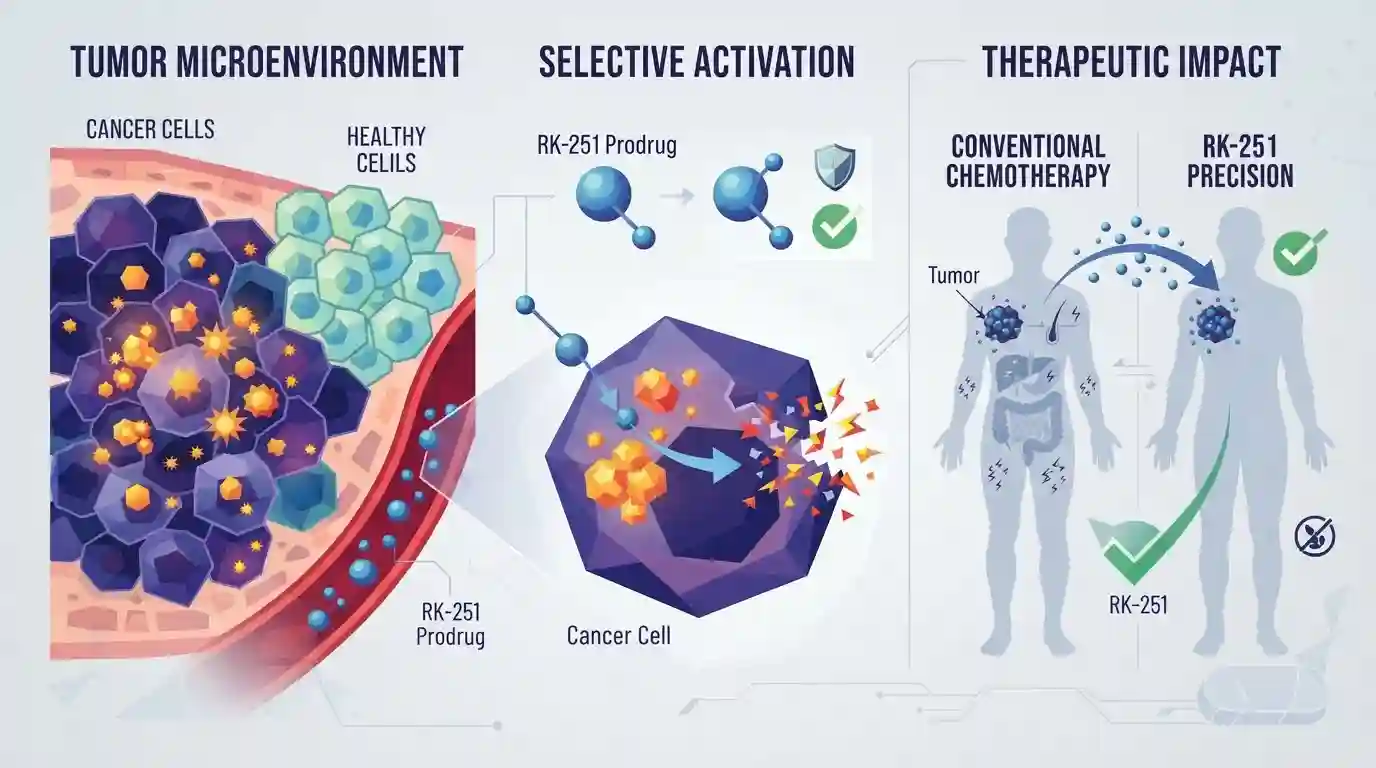
Researchers from IASST and IIT Guwahati have developed RK-251, a 'smart' cancer drug designed to selectively activate within cancer cells while remaining benign in healthy tissues. Triggered by elevated levels of Reactive Oxygen Species (ROS) characteristic of tumors, the prodrug delivers targeted destruction to malignant cells. Tested successfully in preclinical models including aggressive breast cancer cells, this indigenous breakthrough holds the potential to replace conventional chemotherapy, drastically reducing debilitating side effects and advancing precision medicine.
मुख्य मुद्दे
- Indian scientists from IASST and IIT Guwahati have developed RK-251, a novel 'smart' anti-cancer prodrug.
- Unlike traditional chemotherapy that indiscriminately damages both healthy and malignant cells, RK-251 selectively activates only within the tumor microenvironment.
- The drug is triggered by elevated levels of Reactive Oxygen Species (ROS) found primarily in cancer cells, releasing its active anti-cancer compound precisely where needed.
- Preclinical tests on aggressive triple-negative breast cancer cells and zebrafish models demonstrate high efficacy and a strong safety profile, potentially revolutionizing cancer treatment by minimizing toxic side effects.
महत्त्वाच्या संज्ञा
RK-251

A newly developed 'smart' cancer prodrug that selectively activates in tumor environments, releasing an anticancer compound (NBDHEX) when triggered by high levels of Reactive Oxygen Species, leaving healthy tissues unharmed.
UPSC context
GS Paper III (Science & Technology), tests awareness of indigenous medical advancements and targeted drug delivery systems.
Institute of Advanced Study in Science and Technology (IASST)
An autonomous research institute under the Department of Science and Technology (DST), Government of India, located in Guwahati, Assam, specializing in basic and applied physical and life sciences.
UPSC context
GS Paper III (S&T), tests knowledge of premier national scientific organizations and regional research initiatives.
Prodrug
A pharmacologically inactive compound designed to be administered and subsequently converted into its active, therapeutic form inside the body through physiological, enzymatic, or environmental triggers.
UPSC context
GS Paper III (S&T/Biotechnology), tests basic concepts of pharmacology and precision medicine.
Reactive Oxygen Species (ROS)
Highly reactive, oxygen-containing molecules that can cause cellular damage and are characteristically elevated in cancer cells, serving as biochemical triggers for selective drug activation.
UPSC context
GS Paper III (S&T/Biology), tests understanding of cellular biology, cancer microenvironments, and diagnostic/therapeutic targets.
Indian Institute of Technology (IIT) Guwahati
A premier public technical university in Assam, India, established in 1994, known for high-impact research, engineering education, and collaborative innovations in biotechnology and healthcare.
UPSC context
GS Paper III (S&T), tests awareness of elite educational and research institutions contributing to national technological development.
Ministry of Science & Technology
The apex Indian government ministry responsible for formulating science policy, funding scientific research, and coordinating national S&T initiatives through departments like DST, DBT, and DSIR.
UPSC context
GS Paper II & III (S&T Policy/Governance), tests knowledge of the institutional and administrative framework of India's scientific sector.
पूर्वपरीक्षा सापळा
"Reactive Oxygen Species (ROS) are toxic free radicals that are exclusively found in malignant cancer cells."
ROS naturally occur in healthy cells at low levels for cellular signaling and immune defense. They are merely elevated in tumors, creating oxidative stress that triggers the drug.
संबंधित स्थिर संकल्पना
What makes a 'Prodrug' different from conventional active pharmaceutical ingredients?
- Inactive State: Administered in a biologically inactive or significantly less active form to prevent widespread systemic toxicity.
- Trigger Mechanism: Requires enzymatic or chemical transformation within a specific cellular environment (like high ROS) to convert into the active therapeutic compound.
Why is the Zebrafish an ideal in-vivo model for human disease research?
- Genetic Homology: It is a freshwater fish that shares roughly 84% of genes associated with human diseases.
- Optical Clarity: Transparent embryos allow researchers to non-invasively observe internal organ development and disease progression in real-time.
- Drug Absorption: They can efficiently absorb chemical compounds and experimental drugs directly from their aquatic environment.
आंतर-विषय नमुने
CAR-T and Indigenous Oncology
RK-251 reflects a broader syllabus theme of indigenous precision medicine, paralleling the recent commercialization of India's first domestic CAR-T cell therapy (NexCAR19) for targeted cancer treatment.
Biomarkers and targeted delivery
This links directly with UPSC's focus on targeted drug delivery systems, often tested alongside nanotechnology (e.g., liposomes, gold nanoparticles) that similarly exploit unique tumor microenvironments.

Match-the-following questions linking 'Prodrug', 'Zebrafish model', and 'TNBC' to their precise biomedical definitions are highly probable.
संबंधित PYQ · 3
संबंधित PYQ · 3
- 2015PrelimsGS1
With reference to the use of nano-technology in health sector, which of the following statements is/are correct? 1. Targeted drug delivery is made possible by nanotechnology. 2. Nanotechnology can largely contribute to gene therapy. Select the correct answer using the code given below.
- 2020MainsGS3
What do you understand by nanotechnology and how is it helping in health sector?
- 2021MainsGS3
What are the research and developmental achievements in applied biotechnology? How will these achievements help to uplift the poorer sections of the society?
