Research and Development Innovation Fund Implements Safeguards
Source:PIB ↗
हे का महत्त्वाचे आहे
Historically, India's R&D spending has been dominated by the public sector, with private sector participation remaining significantly low compared to global averages. The RDI Fund's co-investment model aims to correct this imbalance. Furthermore, public-private risk-sharing requires robust 'Conflict of Interest' policies and ethical oversight to ensure accountability of public funds, a core theme in GS2 Governance, GS3 S&T Policy, and GS4 Ethics.
सारांश
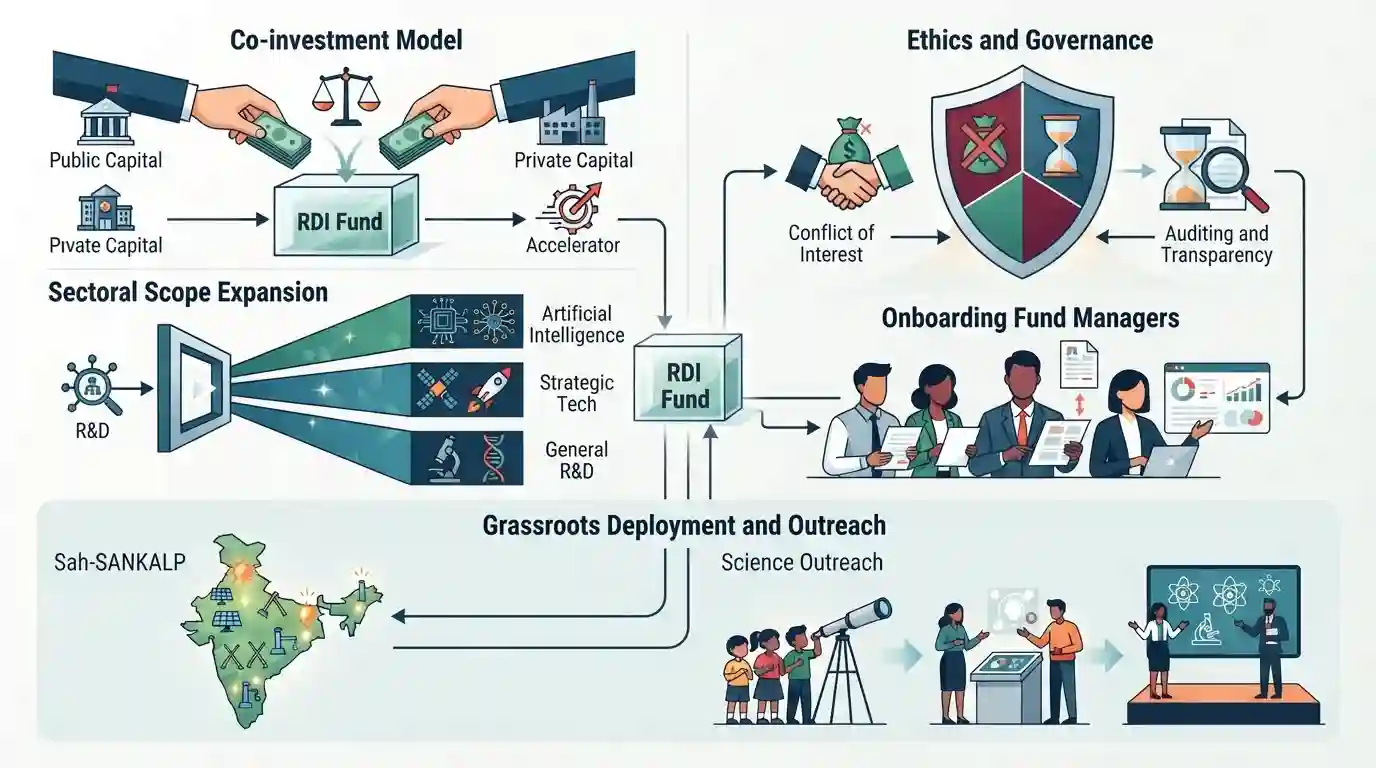
The Ministry of Science & Technology held a review meeting of the Research, Development, and Innovation (RDI) Fund, emphasizing its stringent 'Conflict of Interest' safeguards designed to protect taxpayers' money and private capital. The RDI Fund represents a novel co-investment model (matching public and private capital at a 50:50 ratio) to accelerate private participation in R&D. To expand its impact, its sectoral scope has been widened to strategic technologies such as Artificial Intelligence, and Second-Level Fund Managers are being onboarded. The meeting also highlighted progress under grassroots technological deployment (Sah-SANKALP) and preparations for several upcoming science outreach programs.
मुख्य मुद्दे
- The Research, Development, and Innovation (RDI) Fund acts as a first-of-its-kind public-private funding framework matching government funds (up to 50%) with private equity to boost private-sector participation in R&D.
- Stringent 'Conflict of Interest' protocols and safeguards are implemented to protect public funds (taxpayers' money) and private capital, maintaining transparency and fairness in investment decisions.
- The selection process for Second-Level Fund Managers (SLFMs) is underway to identify eligible startups and manage disbursements transparently.
- The sectoral scope of the RDI Fund has been widened following inter-ministerial consultations to include strategic technologies, particularly Artificial Intelligence (AI).
- Under the Sah-SANKALP initiative, 56 out of 60 government-backed scientific technologies have been deployed at the grassroots level, with 41 reaching high Technology Readiness Levels (TRL 8 or 9).
- Several upcoming public engagement initiatives were highlighted, including the ESTIC 2026 Conclave at Bharat Mandapam, the SSSS 2026 Beach Cleanup Campaign, and the weekly 'Vigyan Ki Baat' lecture series.
महत्त्वाच्या संज्ञा
Research, Development, and Innovation (RDI) Fund

A ₹1 lakh crore central fund under the Anusandhan National Research Foundation (ANRF) providing long-term, low-interest financing for private-sector-led deep-tech research and near-market commercialization (TRL-4+).
UPSC context
GS Paper III (S&T); tests R&D funding, public-private partnerships, and indigenization of technology.
Sah-SANKALP
Science and Advanced Networks for Knowledge-driven Action for Livelihood Promotion; a DST national mission deploying scalable, S&T-based livelihood solutions for Scheduled Caste (SC) communities in Aspirational Blocks.
UPSC context
GS Paper II & III (Socio-economic Welfare & S&T); tests inclusive growth and grassroots technology deployment.
Swachh Sagar Surakshit Sagar (SSSS) Campaign 2026
A nationwide coastal cleanup and marine conservation initiative led by the Ministry of Earth Sciences, focusing on removing marine litter, minimizing plastic usage, and enhancing public participation.
UPSC context
GS Paper III (Environment); tests marine pollution, coastal conservation, and community-driven ecological initiatives.
Emerging Science, Technology and Innovation Conclave (ESTIC) 2026
India's premier annual STI platform bringing global visionaries, Nobel Laureates, policymakers, and startups together to drive deep-tech collaboration and plan a roadmap for "Viksit Bharat 2047."
UPSC context
GS Paper III (S&T); tests deep-tech policy planning, international collaboration, and long-term development goals.
Ministry of Science & Technology
The Indian government's apex administrative ministry responsible for formulating science and technology policies, promoting scientific research, and managing key departments like DST, DBT, and DSIR.
UPSC context
GS Paper II & III (Governance & S&T); tests institutional structures and government-led research initiatives.
Council of Scientific and Industrial Research (CSIR)
An autonomous body under the Ministry of Science and Technology, operating as India’s largest industrial R&D organization, dedicated to advanced applied science and tech indigenization.
UPSC context
GS Paper III (S&T); tests technology indigenization, industrial research, and key national scientific institutions.
पूर्वपरीक्षा सापळा
The RDI Fund operates purely as a grant-in-aid scheme providing 100% unilateral government funding to public research institutions.
It utilizes a 50:50 public-private co-investment model to extend soft loans or equity, rather than unilateral grants, to incentivize commercial sunrise-sector research.
संबंधित स्थिर संकल्पना
What is the Anusandhan National Research Foundation (ANRF)?
- Statutory Base: Established under the ANRF Act, 2023, to provide high-level strategic direction for scientific research in India.
- Governing Board: Chaired by the Prime Minister of India, with the Minister of Science & Technology and Minister of Education as Vice-Presidents.
- Executive Council: Chaired by the Principal Scientific Advisor (PSA) to implement the Governing Board's decisions and manage allocations.
- Private Integration: Designed to bridge academia, research, and industry by actively leveraging private-sector co-investment for commercializing R&D.
What are Technology Readiness Levels (TRLs)?
- Origin & Purpose: A scale from 1 to 9 developed by NASA to assess the developmental maturity of a particular technology.
- Low to Mid Levels: Ranging from basic principles observed (TRL 1) to formulation of technology concept and proof-of-concept validation.
- High Levels (8-9): Represents actual system completion, qualification, and successful commercial operations in a real-world environment.
आंतर-विषय नमुने
Public R&D + Public-Private Ethics
Integrates GS3 technology indigenization with GS4 administrative ethics, illustrating how dual-layered governance prevents institutional conflict of interest in state-subsidized venture funding.
Deep Tech Funding + Market Failures
Connects GS3 scientific development to economic governance, highlighting how the state acts as a de-risking catalyst to mobilize private venture capital into capital-intensive deep-tech sectors.

ANRF and RDI Fund's 50:50 co-investment architecture likely to feature in comparison with traditional unilateral grant mechanisms.
संबंधित PYQ · 2
संबंधित PYQ · 2
- 2022MainsGS4
Discuss the significance of 'Conflict of interest' in the context of public administration.
- 2017MainsGS4
Conflict of interest in the public sector arises when official duties, public interest, and personal interest are taking priority one above the other. How can this conflict in administration be resolved? Describe with an example.
