Jaipur Hosts Second BRICS Tourism Working Group Meeting
Source:PIB ↗
આ શા માટે મહત્વનું છે
The BRICS grouping is a significant platform for Global South cooperation. As India holds the BRICS Chairship in 2026, hosting sector-specific working groups like the Tourism Working Group demonstrates India's leadership in shaping policies around AI, sustainable development, and skill building. Understanding these events is crucial for GS2 (Multilateral groupings) and GS3 (Economic growth and technology integration).
સારાંશ
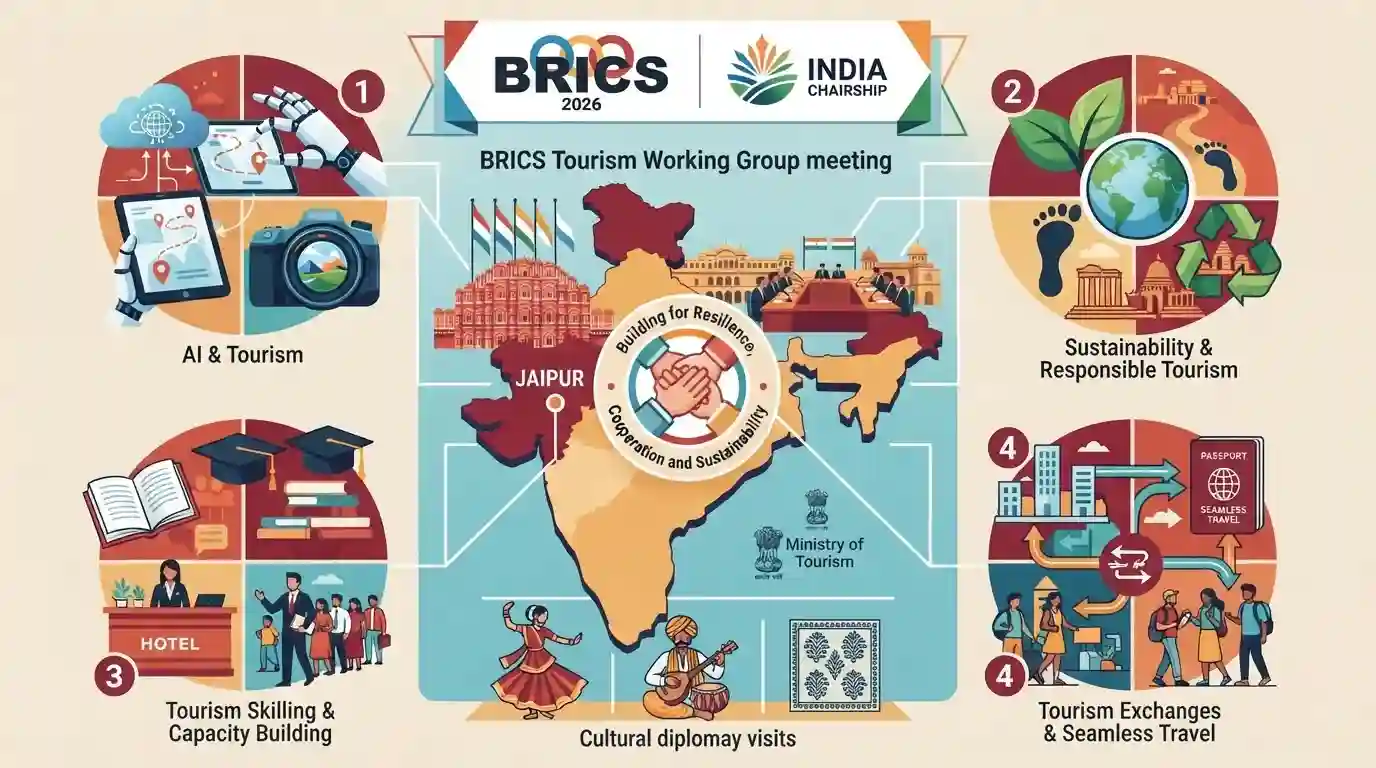
The Ministry of Tourism, Government of India, hosted the 2nd BRICS 2026 Tourism Working Group (TWG) Meeting in Jaipur, Rajasthan, under India's 2026 BRICS Chairship. Chaired by Tourism Secretary Bhuvnesh Kumar, the meeting focused on the overarching theme of 'Building for Resilience, Innovation, Cooperation and Sustainability.' Delegates advanced four core thematic priorities: AI and Tourism, Sustainability and Responsible Tourism, Tourism Skilling and Capacity Building, and Tourism Exchanges and Seamless Travel. The meet concluded with cultural diplomacy visits to Jaipur's iconic heritage landmarks (Hawa Mahal, City Palace, and Amer Palace), laying a strong foundation for the upcoming BRICS Tourism Ministers’ Meeting.
મુખ્ય મુદ્દા
- The 2nd BRICS 2026 Tourism Working Group (TWG) Meeting was held in Jaipur, Rajasthan, under India’s BRICS Chairship, chaired by the Secretary of the Ministry of Tourism, Bhuvnesh Kumar.
- The overarching theme of the meet was 'Building for Resilience, Innovation, Cooperation and Sustainability', aiming to deepen multilateral tourism ties within the BRICS framework.
- The discussions focused on India's four identified thematic priorities: Artificial Intelligence and Tourism, Sustainability and Responsible Tourism, Tourism Skilling and Capacity Building, and Tourism Exchanges and Seamless Travel Facilitation.
- The group highlighted tourism as a critical driver for economic growth, employment generation, sustainable development, and robust people-to-people diplomacy.
- Delegates went on a technical tour of Jaipur’s prominent UNESCO World Heritage/historical sites, including Hawa Mahal, City Palace, and Amer Palace, showcasing India’s cultural diplomacy.
- These deliberations lay down the groundwork and prepare the agenda for the upcoming BRICS Tourism Ministers' Meeting.
મહત્વપૂર્ણ શબ્દો
BRICS

An influential plurilateral alliance of major emerging economies (including Brazil, Russia, India, China, South Africa, and expanded members) representing the Global South, cooperating on economic development, sustainability, and reforming global governance.
UPSC context
GS Paper II: Bilateral, regional and global groupings; tests India's foreign policy interests and alignment with the Global South.
BRICS Tourism Working Group
A sector-specific ministerial track within BRICS that brings together policymakers to collaborate on intra-group travel frameworks, sustainable tourism, AI integration, and hospitality capacity building.
UPSC context
GS Paper II: Regional groupings; tests sectoral cooperative mechanisms and economic diplomacy among member nations.
Ministry of Tourism
The nodal agency of the Government of India responsible for formulating national policies, coordinating with states/UTs, promoting tourism, and implementing development schemes like Swadesh Darshan and PRASHAD.
UPSC context
GS Paper II: Government policies and interventions; tests the administration and implementation of national development schemes.
પ્રિલિમ્સ ટ્રેપ
Saudi Arabia is a confirmed full member of BRICS as of 2026, while Indonesia holds only partner status.
Saudi Arabia's formal accession remains under consideration, whereas Indonesia officially became a full member in early 2025.
સંલગ્ન સ્થિર ખ્યાલો
What is the organizational structure and decision-making process of BRICS?
- Institutional framework: Operates on a consensus-based model; there is no permanent physical headquarters or treaty-based secretariat.
- Presidency rotation: Rotates annually among the member nations, with the host country managing the agenda, working groups, and ministerial summits.
- Financial pillars: Includes the New Development Bank (NDB) and the Contingent Reserve Arrangement (CRA), established via the 2014 Fortaleza Declaration.
How does India leverage geographic decentralization in cultural diplomacy?
- Decentralized hosting: Hosting global meets in Tier-2/3 heritage cities projects India's civilizational depth beyond the national capital region.
- Soft-power synergy: Showcasing UNESCO sites like Jaipur's palaces fosters "soft power" and drives local heritage tourism economies.
આંતર-વિષય પેટર્ન
Tourism + Digital Public Infrastructure
India's push for seamless travel corridors leverages domestic DPI, showcasing UPI-like systems to simplify cross-border payments and identity verification for BRICS travelers.
Sustainable Tourism + Climate Commitments
Balancing tourism growth with BRICS "Responsible Tourism" goals reflects the geopolitical challenge of maintaining high-yield economic sectors while aligning with net-zero carbon pledges.

Expect a multi-statement question testing the expanded 11-member BRICS roster, distinguishing full members from 'Partner Countries'.
સંલગ્ન PYQ · 3
સંલગ્ન PYQ · 3
- 2025PrelimsGS1
Consider the following statements with regard to BRICS : I. 16th BRICS Summit was held under the Chairship of Russia in Kazan. II. Indonesia has become a full member of BRICS. III. The theme of the 16th BRICS Summit was Strengthening Multiculturalism for Just Global Development and Security. Which of the statements given above is/are correct?
- 2014PrelimsGS1
With reference to a grouping of countries known as BRICS, consider the following statements: 1. The First Summit of BRICS was held in Rio de Janeiro in 2009. 2. South Africa was the last to join the BRICS grouping. Which of the statements given above is/are correct?
- 2012MainsGS2
Compare the significance of IBSA and BRICS in the context of India's multilateral diplomacy.
